Hallahan D E, Virudachalam S, Kuchibhotla J, Kufe D W, Weichselbaum R R
Department of Radiation and Cellular Oncology, University of Chicago, IL 60637.
Proc Natl Acad Sci U S A. 1994 May 24;91(11):4897-901. doi: 10.1073/pnas.91.11.4897.
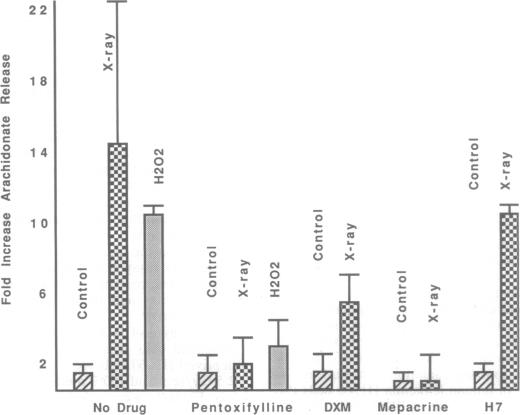
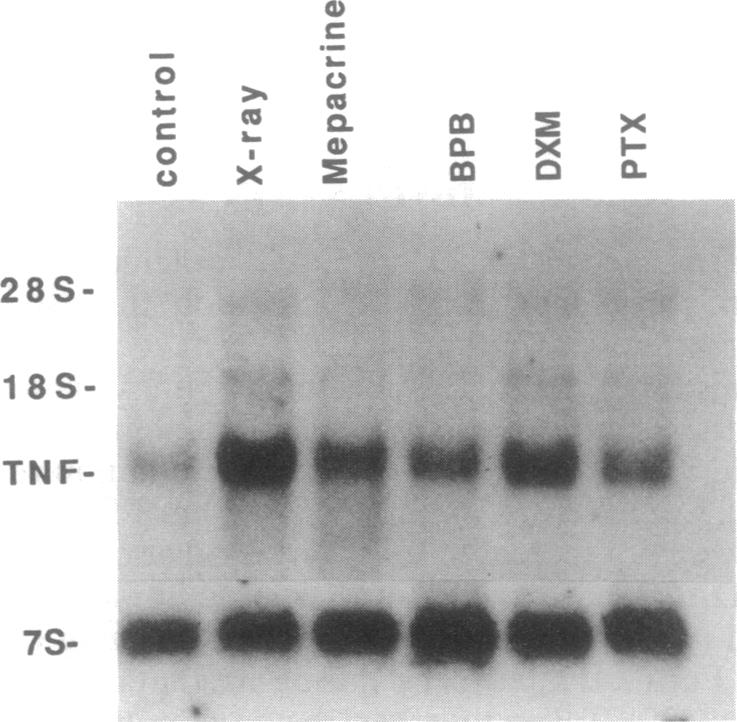
Cells adapt to adverse environmental conditions through a wide range of responses that are conserved throughout evolution. Physical agents such as ionizing radiation are known to initiate a stress response that is triggered by the recognition of DNA damage. We have identified a signaling pathway involving the activation of phospholipase A2 and protein kinase C in human cells that confers x-ray induction of the tumor necrosis factor alpha gene. Treatment of human cells with ionizing radiation or H2O2 was associated with the production of arachidonic acid. Inhibition of phospholipase A2 abolished radiation-mediated arachidonate production as well as the subsequent activation of protein kinase C and tumor necrosis factor alpha gene expression. These findings demonstrate that ionizing radiation-mediated gene expression in human cells is regulated in part by extranuclear signal transduction. One practical application of phospholipase A2 inhibitors is to ameliorate the adverse effects of radiotherapy associated with tumor necrosis factor alpha production.
细胞通过一系列在整个进化过程中保守的反应来适应不利的环境条件。诸如电离辐射等物理因素已知会引发由DNA损伤识别所触发的应激反应。我们已经在人类细胞中鉴定出一条涉及磷脂酶A2和蛋白激酶C激活的信号通路,该通路赋予肿瘤坏死因子α基因的X射线诱导作用。用电离辐射或H2O2处理人类细胞与花生四烯酸的产生有关。抑制磷脂酶A2消除了辐射介导的花生四烯酸产生以及随后蛋白激酶C的激活和肿瘤坏死因子α基因表达。这些发现表明,电离辐射介导的人类细胞基因表达部分受核外信号转导调节。磷脂酶A2抑制剂的一个实际应用是改善与肿瘤坏死因子α产生相关的放疗的不良反应。