Fattaey A R, Harlow E, Helin K
Massachusetts General Hospital Cancer Center, Charlestown 02129.
Mol Cell Biol. 1993 Dec;13(12):7267-77. doi: 10.1128/mcb.13.12.7267-7277.1993.
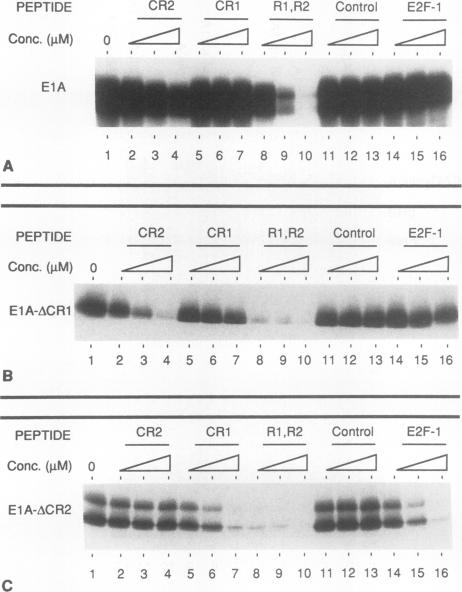
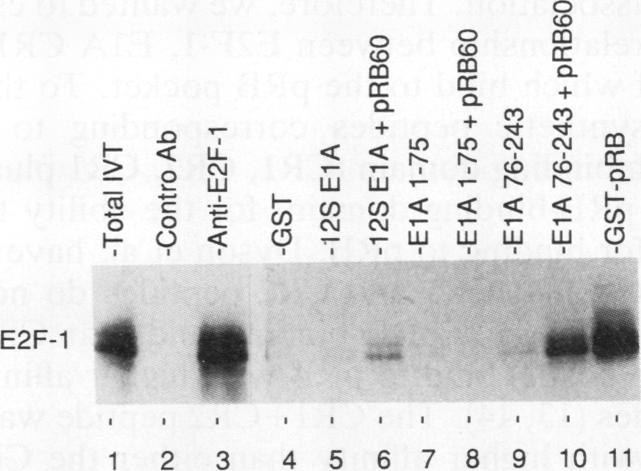
The transcription factor E2F is present in independent complexes with the product of the retinoblastoma susceptibility gene, pRB, and a related gene product, p107, in association with the cyclin A-cdk2 or the cyclin E-cdk2 kinase complex. pRB and p107 can negatively regulate E2F activity, since overexpression of pRB or p107 in cells lacking a functional pRB leads to the repression of E2F activity. The products of the adenovirus E1A gene can disrupt E2F complexes and result in free and presumably active E2F transcription factor. The regions of E1A required for this function are also essential for binding to a number of cellular proteins, including pRB and p107. Through the use of a number of glutathione S-transferase fusion proteins representing different regions of E1A, as well as in vivo expression of E1A proteins containing deletions of either conserved region 1 (CR1) or CR2, we find that CR2 of E1A can form stable complexes with E2F. E1A proteins containing both CR1 and CR2 also associate with E2F, although the presence of these proteins results in the release of free E2F from its complexes. In vitro reconstitution experiments indicate that E1A-E2F interactions are not direct and that pRB can serve to facilitate these interactions. Complexes containing E1A, p107, cyclin A, and E2F were identified in vivo, which indicates that E1A may associate with E2F through either p107 or pRB. Peptide competition experiments demonstrate that the pRB-binding domain of the human E2F-1 protein can compete with the CR1 but not CR2 domain of E1A for binding to pRB. These results indicate that E1A CR1 and E2F-1 may bind to the same or overlapping sites on pRB and that E1A CR2 binds to an independent region. On the basis of our results, we propose a two-step model for the release of E2F from pRB and p107 cellular proteins.
转录因子E2F与视网膜母细胞瘤易感基因产物pRB以及相关基因产物p107形成独立复合物,与细胞周期蛋白A-cdk2或细胞周期蛋白E-cdk2激酶复合物相关联。pRB和p107可负向调节E2F活性,因为在缺乏功能性pRB的细胞中过表达pRB或p107会导致E2F活性受到抑制。腺病毒E1A基因产物可破坏E2F复合物,导致游离且可能具有活性的E2F转录因子产生。该功能所需的E1A区域对于结合多种细胞蛋白(包括pRB和p107)也至关重要。通过使用代表E1A不同区域的多种谷胱甘肽S-转移酶融合蛋白,以及体内表达缺失保守区域1(CR1)或CR2的E1A蛋白,我们发现E1A的CR2可与E2F形成稳定复合物。同时含有CR1和CR2的E1A蛋白也与E2F相关联,尽管这些蛋白的存在会导致游离E2F从其复合物中释放出来。体外重组实验表明,E1A与E2F的相互作用不是直接的,并且pRB可促进这些相互作用。在体内鉴定出含有E1A、p107、细胞周期蛋白A和E2F的复合物,这表明E1A可能通过p107或pRB与E2F相关联。肽竞争实验表明,人E2F-1蛋白的pRB结合结构域可与E1A的CR1而非CR2结构域竞争结合pRB。这些结果表明,E1A CR1和E2F-1可能结合到pRB上相同或重叠的位点,而E1A CR2结合到一个独立区域。基于我们的结果,我们提出了一个从pRB和p107细胞蛋白中释放E2F的两步模型。