Sell C, Rubini M, Rubin R, Liu J P, Efstratiadis A, Baserga R
Jefferson Cancer Institute, Thomas Jefferson University, Philadelphia, PA 19107-5541.
Proc Natl Acad Sci U S A. 1993 Dec 1;90(23):11217-21. doi: 10.1073/pnas.90.23.11217.
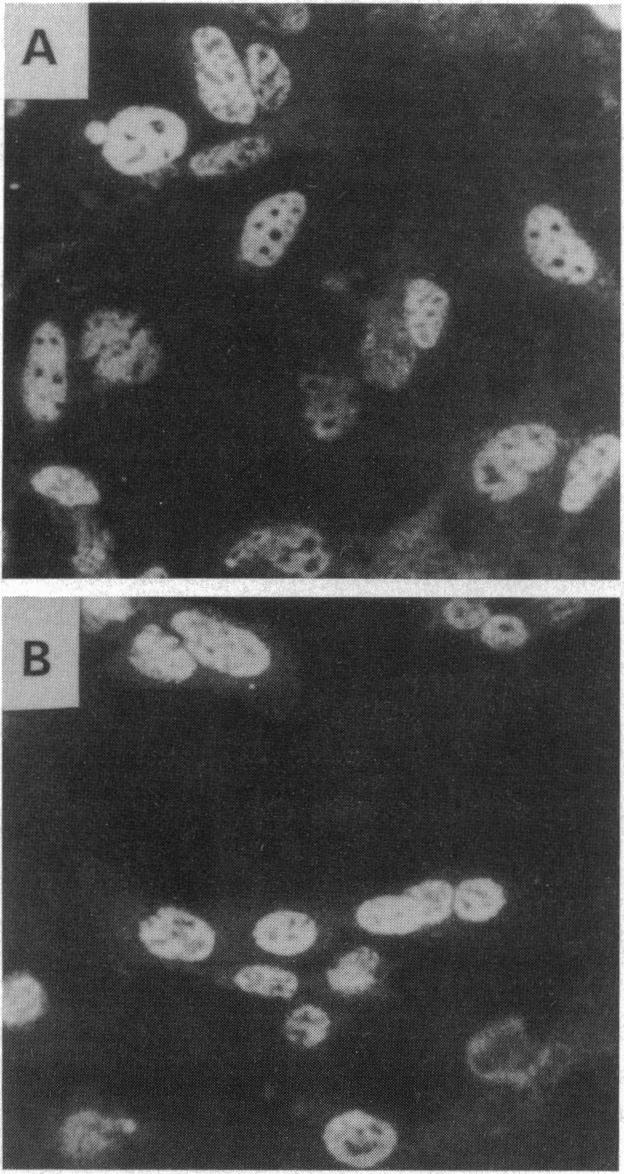
Fibroblast cell lines were established from mouse embryos homozygous for a targeted disruption of the Igf1r gene, encoding the type 1 receptor for insulin-like growth factor I (IGF-I) and from their wild-type littermates. The cells from the wild-type embryos (W cells) grow in serum-free medium supplemented with platelet-derived growth factor, epidermal growth factor, and IGF-I, whereas the cells from Igf1r(-/-) embryos (R- cells) do not, although they grow at a reduced rate in 10% fetal calf serum. The simian virus 40 (SV40) large T antigen, expressed from a transfected plasmid, can transform W cells, which form foci in monolayer cultures and colonies in soft agar (anchorage-independent growth). In contrast, the SV40 large tumor antigen, although normally expressed from the transfected template, is unable to transform R- cells, which remain contact-inhibited and fail to grow in soft agar. The transformed phenotype is restored if the R- cells carrying the SV40 large tumor antigen are stably transfected with a plasmid expressing the human IGF-I receptor. These results demonstrate that signaling via the IGF-I receptor is an indispensable component of the SV40 transformation pathway. This conclusion is further supported from the results of antisense RNA experiments with tumor cell lines showing that interference with the function of the IGF-I receptor has a profound effect on anchorage-independent growth, even under conditions that only modestly affect growth in monolayers.
从胰岛素样生长因子I(IGF-I)1型受体编码基因Igf1r靶向破坏的纯合子小鼠胚胎及其野生型同窝仔鼠中建立了成纤维细胞系。野生型胚胎来源的细胞(W细胞)在添加了血小板衍生生长因子、表皮生长因子和IGF-I的无血清培养基中生长,而Igf1r(-/-)胚胎来源的细胞(R-细胞)则不能,尽管它们在10%胎牛血清中生长速度较慢。从转染质粒表达的猿猴病毒40(SV40)大T抗原可转化W细胞,W细胞在单层培养中形成集落,在软琼脂中形成克隆(不依赖贴壁生长)。相反,SV40大肿瘤抗原虽然通常从转染模板表达,但不能转化R-细胞,R-细胞保持接触抑制,不能在软琼脂中生长。如果携带SV40大肿瘤抗原的R-细胞被稳定转染表达人IGF-I受体的质粒,则可恢复转化表型。这些结果表明,通过IGF-I受体的信号传导是SV40转化途径中不可或缺的组成部分。肿瘤细胞系的反义RNA实验结果进一步支持了这一结论,该实验表明,干扰IGF-I受体的功能对不依赖贴壁生长有深远影响,即使在仅适度影响单层生长的条件下也是如此。