Buetti E
Swiss Institute for Experimental Cancer Research, Epalinges.
Mol Cell Biol. 1994 Feb;14(2):1191-203. doi: 10.1128/mcb.14.2.1191-1203.1994.
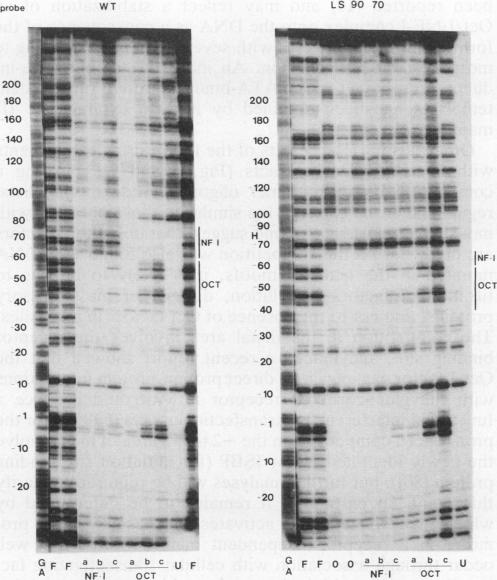
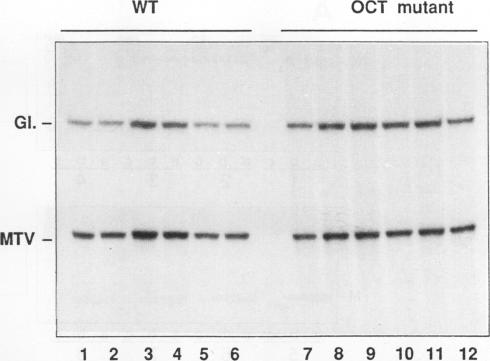
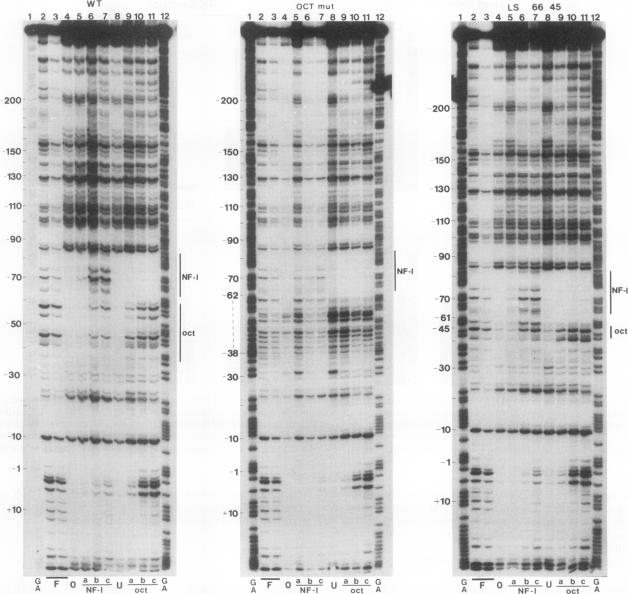
In the mouse mammary tumor virus promoter, a tandem of octamer motifs, recognized by ubiquitous and tissue-restricted Oct transcription factors, is located upstream of the TATA box and next to a binding site for the transcription factor nuclear factor I (NF-I). Their function was investigated with mutant long terminal repeats under different transfection conditions in mouse Ltk- cells and quantitative S1 nuclease mapping of the transcripts. In stable transfectants, which are most representative of the state of proviral DNA with respect to both number of integrated DNA templates and chromatin organization, a long terminal repeat mutant of both octamer sites showed an average 50-fold reduction of the basal transcription level, while the dexamethasone-stimulated level was unaffected. DNase I in vitro footprinting assays with L-cell nuclear protein extracts showed that the mutant DNA was unable to bind octamer factors but had a normal footprint in the NF-I site. I conclude that mouse mammary tumor virus employs the tandem octamer motifs of the viral promoter, recognized by the ubiquitous transcription factor Oct-1, for its basal transcriptional activity and the NF-I binding site, as previously shown, for glucocorticoid-stimulated transcription. A deletion mutant with only one octamer site showed a marked base-level reduction at high copy number but little reduction at low copies of integrated plasmids. The observed transcription levels may depend both on the relative ratio of transcription factors to DNA templates and on the relative affinity of binding sites, as determined by oligonucleotide competition footprinting.
在小鼠乳腺肿瘤病毒启动子中,由普遍存在和组织特异性的Oct转录因子识别的串联八聚体基序,位于TATA框上游,且紧邻转录因子核因子I(NF-I)的结合位点。利用突变的长末端重复序列,在不同转染条件下对小鼠Ltk-细胞进行研究,并对转录本进行定量S1核酸酶作图,以探究它们的功能。在稳定转染细胞中(就整合的DNA模板数量和染色质组织而言,最能代表前病毒DNA的状态),两个八聚体位点的长末端重复突变体显示基础转录水平平均降低了50倍,而地塞米松刺激的水平未受影响。用L细胞的核蛋白提取物进行的DNase I体外足迹分析表明,突变的DNA无法结合八聚体因子,但在NF-I位点有正常的足迹。我得出结论,小鼠乳腺肿瘤病毒利用病毒启动子中由普遍存在的转录因子Oct-1识别的串联八聚体基序进行基础转录活性,以及如先前所示利用NF-I结合位点进行糖皮质激素刺激的转录。仅含有一个八聚体位点的缺失突变体在高拷贝数时显示出明显的基础水平降低,但在整合质粒低拷贝数时降低很少。观察到的转录水平可能既取决于转录因子与DNA模板的相对比例,也取决于结合位点的相对亲和力,这由寡核苷酸竞争足迹法确定。