Rossi E, Floridia G, Casali M, Danesino C, Chiumello G, Bernardi F, Magnani I, Papi L, Mura M, Zuffardi O
Università di Pavia, Italy.
J Med Genet. 1993 Nov;30(11):926-31. doi: 10.1136/jmg.30.11.926.
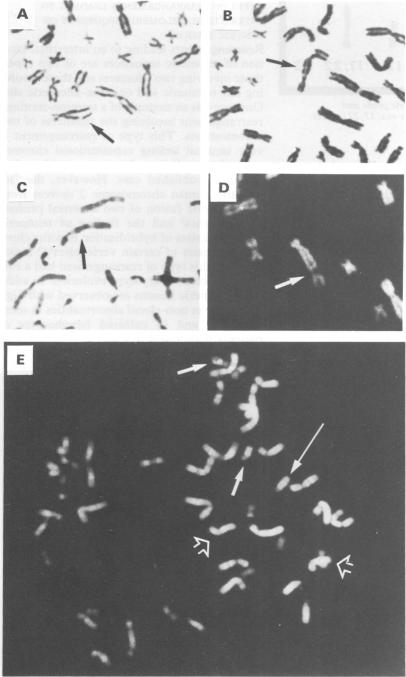
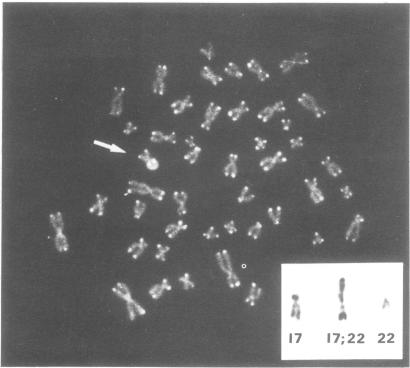
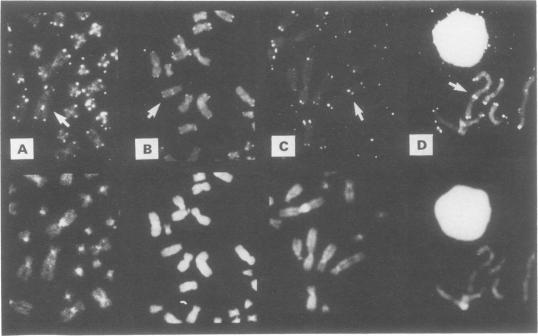
Using in situ hybridisation, we identified interstitial telomeric sequences in seven chromosomal translocations present in normal and in syndromic subjects. Telomeric sequences were also found at the centromeric ends of a 4p and a 4q caused by centric fission of one chromosome 4. We found that rearrangements leading to interstitial telomeric sequences were of three types: (1) termino-terminal rearrangements with fusion of the telomeres of two chromosomes, of which we report one case; (2) rearrangements in which an acentric fragment of one chromosome fuses to the telomere of another chromosome. We describe four cases of Prader-Willi syndrome with the 15q1-qter transposed to the telomeric repeats of different recipient chromosomes; (3) telomere-centromere rearrangements in which telomeric sequences of one chromosome fuse with the centromere of another chromosome. We describe two examples of these rearrangements in which not only telomeric sequences but also remnants of alphoid sequences were found at the fusion point. Instability at the fusion point of the derivative chromosome was found in the Prader-Willi translocations but we were unable to correlate this instability with culture conditions. The two subjects with the termino-terminal rearrangement and the centric fission respectively have normal phenotypes. The two patients with telomere-centromere fusions were unbalanced for the short arm of an acrocentric chromosome and had failure to thrive; one of them also had dysmorphic facies. We postulate that these phenotypes could be the result of uniparental disomy.
通过原位杂交,我们在正常人和综合征患者中存在的7种染色体易位中鉴定出了间质端粒序列。在由一条4号染色体着丝粒分裂导致的4p和4q的着丝粒末端也发现了端粒序列。我们发现导致间质端粒序列的重排有三种类型:(1)两条染色体端粒融合的端端重排,我们报告了其中1例;(2)一条染色体的无着丝粒片段与另一条染色体的端粒融合的重排。我们描述了4例普拉德-威利综合征病例,其中15q1-qter转位到不同受体染色体的端粒重复序列;(3)端粒-着丝粒重排,其中一条染色体的端粒序列与另一条染色体的着丝粒融合。我们描述了这些重排的两个例子,在融合点不仅发现了端粒序列,还发现了α卫星序列的残余。在普拉德-威利易位中发现了衍生染色体融合点的不稳定性,但我们无法将这种不稳定性与培养条件相关联。分别具有端端重排和着丝粒分裂的两名受试者具有正常表型。两名端粒-着丝粒融合患者的近端着丝粒染色体短臂不平衡,生长发育迟缓;其中1人还患有面部畸形。我们推测这些表型可能是单亲二体性的结果。