Bajzer Z, Prendergast F G
Department of Biochemistry and Molecular Biology, Mayo Foundation, Rochester, Minnesota 55905.
Biophys J. 1993 Dec;65(6):2313-23. doi: 10.1016/S0006-3495(93)81325-0.
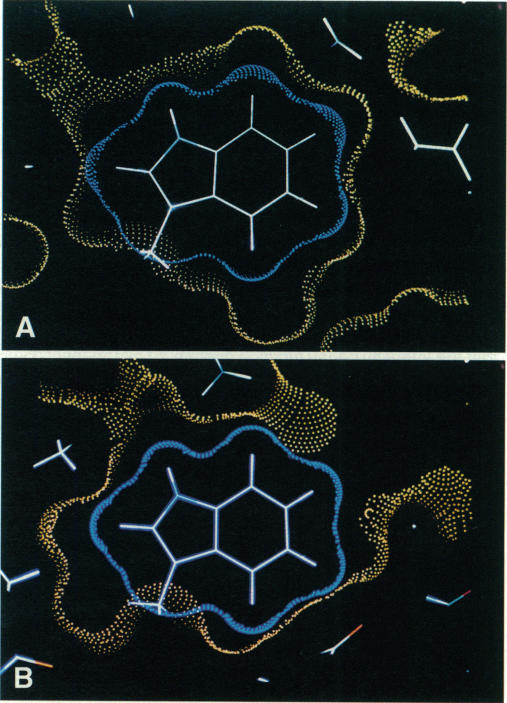
Tryptophan fluorescence intensity decay in proteins is modeled by multiexponential functions characterized by lifetimes and preexponential factors. Commonly, multiple conformations of the protein are invoked to explain the recovery of two or more lifetimes from the experimental data. However, in many proteins the structure seems to preclude the possibility of multiple conformers sufficiently different from one another to justify such an inference. We present here another plausible multiexponential model based on the assumption that an energetically excited donor surrounded by N acceptor molecules decays by specific radiative and radiationless relaxation processes, and by transferring its energy to acceptors present in or close to the protein matrix. If interactions between the acceptors themselves and back energy transfer are neglected, we show that the intensity decay function contain 2N exponential components characterized by the unperturbed donor lifetime, by energy transfer rates and a probability of occurrence for the corresponding process. We applied this model to the fluorescence decay of holo- and apoazurin, ribonuclease T1, and the reduced single tryptophan mutant (W28F) of thioredoxin. Use of a multiexponential model for the analysis of the fluorescence intensity decay can therefore be justified, without invoking multiple protein conformations.
蛋白质中色氨酸荧光强度衰减是通过以寿命和指数前因子为特征的多指数函数来建模的。通常,人们会调用蛋白质的多种构象来解释从实验数据中恢复出两个或更多寿命的现象。然而,在许多蛋白质中,其结构似乎排除了存在足够不同的多种构象从而支持这种推断的可能性。我们在此提出另一种合理的多指数模型,该模型基于这样的假设:一个被N个受体分子包围的能量激发供体通过特定的辐射和无辐射弛豫过程衰变,并将其能量转移到蛋白质基质中或其附近存在的受体上。如果忽略受体自身之间的相互作用和反向能量转移,我们表明强度衰减函数包含2N个指数成分,其特征由未受扰动的供体寿命、能量转移速率以及相应过程的发生概率决定。我们将此模型应用于全铜蓝蛋白和脱辅基铜蓝蛋白、核糖核酸酶T1以及硫氧还蛋白的单色氨酸还原突变体(W28F)的荧光衰减。因此,在不调用多种蛋白质构象的情况下,使用多指数模型来分析荧光强度衰减是合理的。