Tucker B J, Rasch R, Blantz R C
Department of Medicine, University of California, San Diego School of Medicine, La Jolla 92093.
J Clin Invest. 1993 Aug;92(2):686-94. doi: 10.1172/JCI116638.
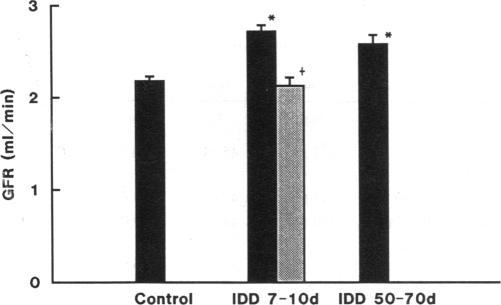
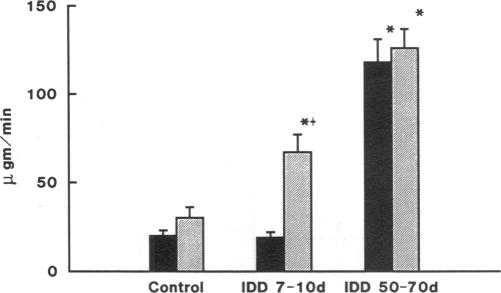
Microalbuminuria (26-250 mg/d) is considered to be an indicator of incipient diabetic nephropathy in humans in insulin-dependent diabetes (IDD). However, before microalbuminuria is observed, glomerular alterations, such as glycosylation of the glomerular basement membrane and glomerular hyperfiltration, in IDD may result in increased filtration of albumin before any observed increase in albumin excretion. Glomerular and tubular albumin kinetics were examined in streptozotocin (65 mg/kg body wt, i.v.) diabetic, Munich-Wistar rats at 7-10 (untreated) and 50-70 d (poorly controlled with small doses of insulin) after the onset of diabetes and compared with nondiabetic controls. Additional rats in each condition received acute lysine treatment to prevent tubular protein reabsorption. Urinary albumin excretion and nonvascular albumin distribution volumes were measured in the renal cortex and compared with morphometric measurements of interstitial space and the proximal tubule to assess intracellular uptake of albumin in the proximal tubule. Urinary albumin excretion under anesthesia was not different in 7-10-d IDD versus controls (19 +/- 3 vs. 20 +/- 3 micrograms/min) but increased in the 50-70-d IDD (118 +/- 13 micrograms/min, P < 0.05). Lysine treatment resulted in increased albumin excretion compared with respective nontreatment in 7-10-d IDD (67 +/- 10 micrograms/min, P < 0.05) but not in controls (30 +/- 6 micrograms/min) or in 50-70-d IDD (126 +/- 11 micrograms/min). Glomerular filtration rate was increased both in 7-10-d IDD (2.7 +/- 0.1 ml/min, P < 0.05) and in 50-70-d IDD (2.6 +/- 0.1 ml/min, P < 0.05) compared with control (2.2 +/- 0.1 ml/min). Calculated urinary space albumin concentrations increased early in IDD with 2.5 +/- 0.4 mg% in 7-10-d IDD and 4.9 +/- 0.6 mg% in 50-70-d IDD compared with control (1.4 +/- 0.3 mg%). The increase in filtration of albumin is in excess of that attributable to hyperfiltration before increased albumin excretion early in diabetes. In 50-70-d IDD, absolute tubular reabsorption of albumin is decreased, correlating to the decrease in brush border height of the proximal tubule.
微量白蛋白尿(26 - 250毫克/天)被认为是胰岛素依赖型糖尿病(IDD)患者早期糖尿病肾病的一个指标。然而,在观察到微量白蛋白尿之前,IDD患者的肾小球改变,如肾小球基底膜糖基化和肾小球高滤过,可能在白蛋白排泄增加之前就导致白蛋白滤过增加。在糖尿病发病后7 - 10天(未治疗)和50 - 70天(用小剂量胰岛素控制不佳)的链脲佐菌素(65毫克/千克体重,静脉注射)糖尿病慕尼黑 - 维斯特大鼠中检测肾小球和肾小管白蛋白动力学,并与非糖尿病对照组进行比较。每种情况下的额外大鼠接受急性赖氨酸治疗以防止肾小管蛋白重吸收。测量肾皮质中的尿白蛋白排泄和非血管白蛋白分布体积,并与间质空间和近端小管的形态学测量结果进行比较,以评估近端小管中白蛋白的细胞内摄取。麻醉下7 - 10天的IDD患者与对照组的尿白蛋白排泄无差异(19±3对20±3微克/分钟),但50 - 70天的IDD患者尿白蛋白排泄增加(118±13微克/分钟,P<0.05)。赖氨酸治疗导致7 - 10天的IDD患者白蛋白排泄增加,与各自未治疗组相比(67±10微克/分钟,P<0.05),但对照组(30±6微克/分钟)或50 - 70天的IDD患者(126±11微克/分钟)未增加。与对照组(2.2±0.1毫升/分钟)相比,7 - 10天的IDD患者(2.7±0.1毫升/分钟,P<0.05)和50 - 70天的IDD患者(2.6±0.1毫升/分钟,P<0.05)的肾小球滤过率均增加。计算得出的尿间隙白蛋白浓度在IDD早期升高,7 - 10天的IDD患者为2.5±0.4毫克%,50 - 70天的IDD患者为4.9±0.6毫克%,而对照组为(1.4±0.3毫克%)。糖尿病早期白蛋白排泄增加之前,白蛋白滤过的增加超过了高滤过所致的增加。在50 - 70天的IDD患者中,白蛋白的绝对肾小管重吸收减少,这与近端小管刷状缘高度的降低相关。