Hermiston T W, Tripp R A, Sparer T, Gooding L R, Wold W S
Department of Molecular Microbiology and Immunology, St. Louis University School of Medicine, Missouri 63104.
J Virol. 1993 Sep;67(9):5289-98. doi: 10.1128/JVI.67.9.5289-5298.1993.
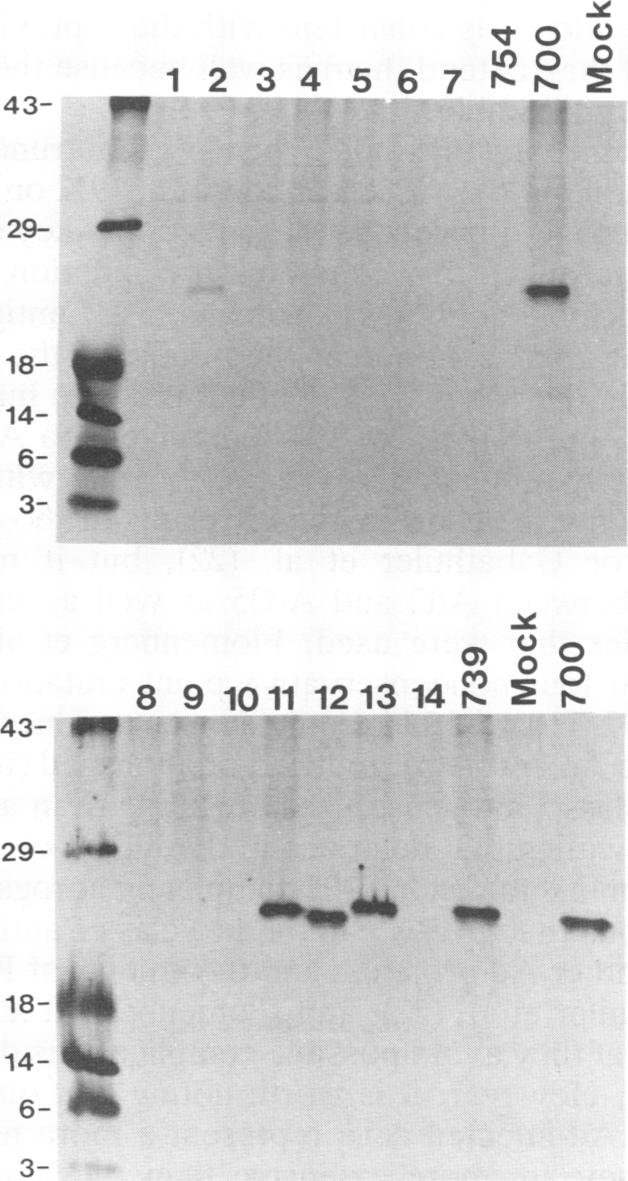
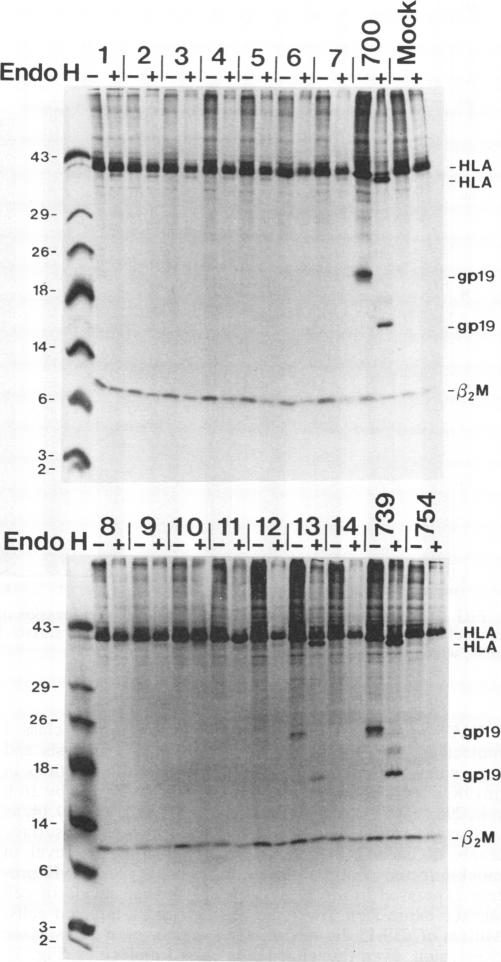
Adenovirus E3-gp19K is a transmembrane glycoprotein, localized in the endoplasmic reticulum (ER), which forms a complex with major histocompatibility complex (MHC) class I antigens and retains them in the ER, thereby preventing cytolysis by cytotoxic T lymphocytes (CTL). The ER lumenal domain of gp19K, residues 1 to 107, is known to be sufficient for binding to class I antigens; the transmembrane and cytoplasmic ER retention domains are located at residues ca. 108 to 127 and 128 to 142, respectively. To identify more precisely which gp19K regions are involved in binding to class I antigens, we constructed 13 in-frame virus deletion mutants (4 to 12 amino acids deleted) in the ER lumenal domain of gp19K, and we analyzed the ability of the mutant proteins to form a complex with class I antigens, retain them in the ER, and prevent cytolysis by adenovirus-specific CTL. All mutant proteins except one (residues 102 to 107 deleted) were defective for these properties, indicating that the ability of gp19K to bind to class I antigens is highly sensitive to mutation. All mutant proteins were stable and were retained in the ER. Sequence comparisons among adenovirus serotypes reveal that the ER lumenal domain of gp19K consists of a variable region (residues 1 to 76) and a conserved region (residues 77 to 98). We show, using the mutant proteins, that the gp19K-specific monoclonal antibody Tw1.3 recognizes a noncontiguous epitope in the variable region and that disruption of the variable region by deletion destroys the epitope. The monoclonal antibody and class I antigen binding results, together with the serotype sequence comparisons, are consistent with the idea that the ER lumenal domain of gp19K has three subdomains that we have termed the ER lumenal variable domain (residues 1 to ca. 77 to 83), the ER lumenal conserved domain (residues ca. 84 to 98), and the ER lumenal spacer domain (residues 99 to 107). We suggest that the ER lumenal variable domain of gp19K has a specific tertiary structure that is important for binding to the polymorphic alpha 1 and alpha 2 domains of class I heavy (alpha) chains. We suggest that the ER lumenal conserved domain of gp19K may interact with some conserved protein, perhaps the highly conserved alpha 3 domain of class I heavy chains. Finally, the ER lumenal spacer domain may allow the ER lumenal variable and conserved domains to extend out from the ER membrane so that they can interact with class I heavy chains.
腺病毒E3 - gp19K是一种跨膜糖蛋白,定位于内质网(ER),它与主要组织相容性复合体(MHC)I类抗原形成复合物,并将它们保留在内质网中,从而防止细胞毒性T淋巴细胞(CTL)介导的细胞溶解。已知gp19K的内质网腔结构域(第1至107位氨基酸残基)足以与I类抗原结合;跨膜和内质网保留的细胞质结构域分别位于约第108至127位和第128至142位氨基酸残基处。为了更精确地确定gp19K的哪些区域参与与I类抗原的结合,我们在gp19K的内质网腔结构域构建了13个读框内病毒缺失突变体(缺失4至12个氨基酸),并分析了突变蛋白与I类抗原形成复合物、将它们保留在内质网中以及防止腺病毒特异性CTL介导细胞溶解的能力。除了一个突变蛋白(缺失第102至107位氨基酸残基)外,所有突变蛋白在这些特性上都有缺陷,这表明gp19K与I类抗原结合的能力对突变高度敏感。所有突变蛋白都很稳定,并保留在内质网中。腺病毒血清型之间的序列比较显示,gp19K的内质网腔结构域由一个可变区(第1至76位氨基酸残基)和一个保守区(第77至98位氨基酸残基)组成。我们利用突变蛋白表明,gp19K特异性单克隆抗体Tw1.3识别可变区中的一个不连续表位,并且通过缺失破坏可变区会破坏该表位。单克隆抗体和I类抗原结合结果,连同血清型序列比较,与以下观点一致:gp19K的内质网腔结构域有三个亚结构域,我们将其称为内质网腔可变结构域(第1至约77至83位氨基酸残基)、内质网腔保守结构域(约第84至98位氨基酸残基)和内质网腔间隔结构域(第99至107位氨基酸残基)。我们认为,gp19K的内质网腔可变结构域具有特定的三级结构,这对于与I类重(α)链的多态性α1和α2结构域结合很重要。我们认为,gp19K的内质网腔保守结构域可能与某种保守蛋白相互作用,也许是I类重链的高度保守的α3结构域。最后,内质网腔间隔结构域可能允许内质网腔可变结构域和保守结构域从内质网膜伸出,以便它们能够与I类重链相互作用。