Shields G F, Schmiechen A M, Frazier B L, Redd A, Voevoda M I, Reed J K, Ward R H
Institute of Arctic Biology, University of Alaska, Fairbanks.
Am J Hum Genet. 1993 Sep;53(3):549-62.
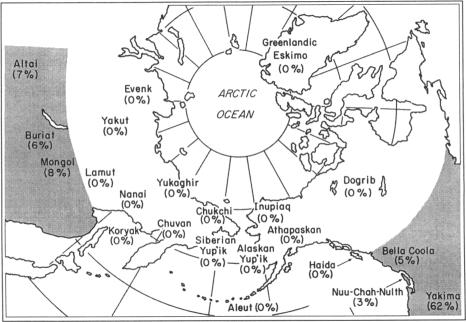
Conventional descriptions of the pattern and process of human entry into the New World from Asia are incomplete and controversial. In order to gain an evolutionary insight into this process, we have sequenced the control region of mtDNA in samples of contemporary tribal populations of eastern Siberia, Alaska, and Greenland and have compared them with those of Amerind speakers of the Pacific Northwest and with those of the Altai of central Siberia. Specifically, we have analyzed sequence diversity in 33 mitochondrial lineages identified in 90 individuals belonging to five Circumpolar populations of Beringia, North America, and Greenland: Chukchi from Siberia, Inupiaq Eskimos and Athapaskans from Alaska, Eskimos from West Greenland, and Haida from Canada. Hereafter, we refer to these five populations as "Circumarctic peoples." These data were then compared with the sequence diversity in 47 mitochondrial lineages identified in a sample of 145 individuals from three Amerind-speaking tribes (Bella Coola, Nuu-Chah-Nulth, and Yakima) of the Pacific Northwest, plus 16 mitochondrial lineages identified in a sample of 17 Altai from central Siberia. Sequence diversity within and among Circumarctic populations is considerably less than the sequence diversity observed within and among the three Amerind tribes. The similarity of sequences found among the geographically dispersed Circumarctic groups, plus the small values of mean pairwise sequence differences within Circumarctic populations, suggest a recent and rapid evolutionary radiation of these populations. In addition, Circumarctic populations lack the 9-bp deletion which has been used to trace various migrations out of Asia, while populations of southeastern Siberia possess this deletion. On the basis of these observations, while the evolutionary affinities of Native Americans extend west to the Circumarctic populations of eastern Siberia, they do not include the Altai of central Siberia.
关于人类从亚洲进入新大陆的模式和过程,传统描述并不完整且存在争议。为了深入了解这一进化过程,我们对西伯利亚东部、阿拉斯加和格陵兰当代部落人群样本中的线粒体DNA控制区进行了测序,并将其与太平洋西北部说美洲印第安语的人群以及西伯利亚中部阿尔泰人群的样本进行了比较。具体而言,我们分析了在属于白令陆桥、北美和格陵兰五个环北极种群的90个人中鉴定出的33个线粒体谱系的序列多样性:来自西伯利亚的楚科奇人、来自阿拉斯加的因纽皮亚克爱斯基摩人和阿萨巴斯卡人、西格陵兰的爱斯基摩人以及来自加拿大的海达族。此后,我们将这五个种群称为“环北极民族”。然后,将这些数据与在来自太平洋西北部三个说美洲印第安语部落(贝拉库拉人、努-查-努尔特人和约基马人)的145个人的样本中鉴定出的47个线粒体谱系的序列多样性进行了比较,再加上在来自西伯利亚中部阿尔泰的17个人的样本中鉴定出的16个线粒体谱系。环北极种群内部和之间的序列多样性明显低于在三个美洲印第安部落内部和之间观察到的序列多样性。在地理上分散的环北极群体中发现的序列相似性,加上环北极种群内平均成对序列差异的较小值,表明这些种群近期经历了快速的进化辐射。此外,环北极种群缺乏用于追踪从亚洲迁出的各种迁徙的9碱基对缺失,而西伯利亚东南部的种群则具有这种缺失。基于这些观察结果,虽然美洲原住民的进化亲缘关系向西延伸至西伯利亚东部的环北极种群,但不包括西伯利亚中部的阿尔泰人。