Ellegren H, Hartman G, Johansson M, Andersson L
Department of Animal Breeding and Genetics, Swedish University of Agricultural Sciences, Uppsala.
Proc Natl Acad Sci U S A. 1993 Sep 1;90(17):8150-3. doi: 10.1073/pnas.90.17.8150.
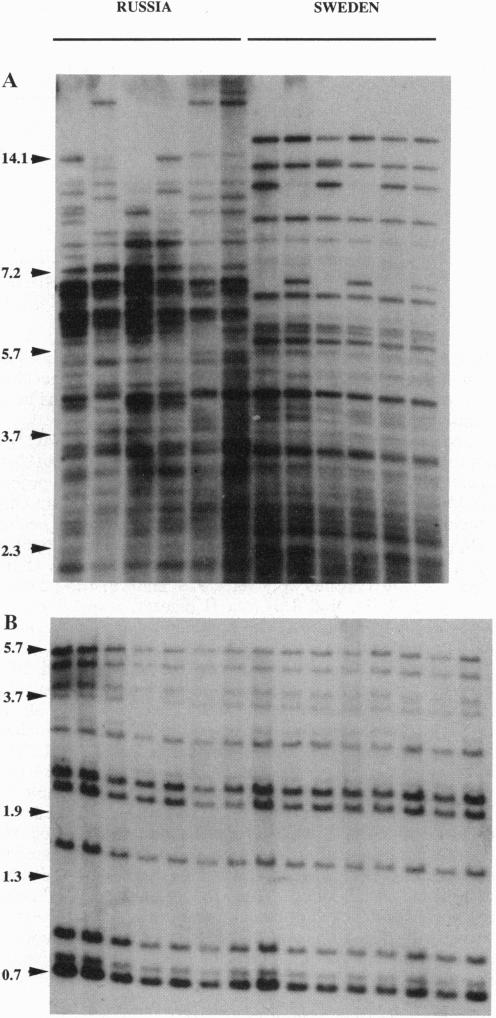
Loss of genetic variation due to population bottlenecks may be a severe threat for the survival of endangered species. Assessment and maintenance of genetic variability are thus crucial for conservation programs related to endangered populations. Scandinavian beavers went through an extensive bottleneck during the last century due to overhunting. In Sweden the species became extirpated but in Norway extinction was avoided by legal protection. Following reintroductions of small numbers of remaining Norwegian animals in 1922-1939, the Swedish population has increased tremendously, now harboring 100,000 animals. We show here that this viable population of beavers possesses extremely low levels of genetic variability at DNA fingerprinting loci and monomorphism at major histocompatibility complex (MHC) class I and class II loci. A similar pattern was also evident among Norwegian beavers but low levels of genetic variability were not a characteristic of the species since Russian conspecifics displayed substantial DNA fingerprinting polymorphism. However, the Russian animals were monomorphic at MHC loci, indicating that the European beaver is exceptional in its low level of MHC variability. The results demonstrate that a conservation program can be successful despite low levels of genetic variation in the founder population.
由于种群瓶颈导致的遗传变异丧失可能是濒危物种生存的严重威胁。因此,评估和维持遗传变异性对于与濒危种群相关的保护计划至关重要。在上个世纪,由于过度捕猎,斯堪的纳维亚海狸经历了一次大规模的瓶颈。在瑞典,该物种灭绝了,但在挪威,通过法律保护避免了灭绝。在1922年至1939年重新引入少量剩余的挪威海狸后,瑞典的海狸种群数量大幅增加,现在有10万只。我们在此表明,这个有生存能力的海狸种群在DNA指纹图谱位点的遗传变异性极低,在主要组织相容性复合体(MHC)I类和II类位点呈单态性。类似的模式在挪威海狸中也很明显,但遗传变异性低并非该物种的特征,因为俄罗斯的同种海狸显示出大量的DNA指纹图谱多态性。然而,俄罗斯的海狸在MHC位点呈单态性,这表明欧洲海狸在MHC变异性低方面是例外的。结果表明,尽管奠基种群的遗传变异水平较低,保护计划仍可能成功。