Johnston S L, Sanderson G, Pattemore P K, Smith S, Bardin P G, Bruce C B, Lambden P R, Tyrrell D A, Holgate S T
Immunopharmacology Group, University of Southampton, United Kingdom.
J Clin Microbiol. 1993 Jan;31(1):111-7. doi: 10.1128/jcm.31.1.111-117.1993.
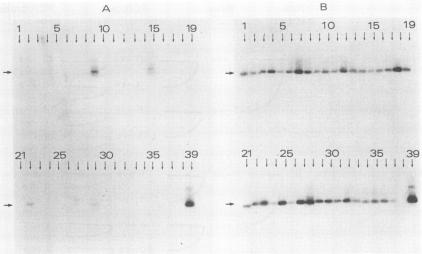
Rhinoviruses and enteroviruses are the major members of the picornavirus genus that cause human disease. We compared the polymerase chain reaction and viral culture for the identification of picornaviruses in nasal aspirates from children during episodes of respiratory symptoms and when asymptomatic and from asymptomatic adults. One hundred eight children, aged 9 to 11 years, completed a year-long study. Within 24 to 48 h of a report of respiratory symptoms, a nasal aspirate was taken in the home. Nasal aspirates were also taken from 65 of the children and from 33 normal adults when they had been free of respiratory symptoms for at least 2 weeks. Picornaviruses were isolated by culture for three passages in Ohio HeLa cells in rolling tubes at 33 degrees C and pH 7.0. For the polymerase chain reaction, duplicate 50-microliters samples were amplified with conserved primers from the 5' noncoding region. Picornaviruses generated approximately 380-bp bands in agarose gel electrophoresis; the specificity of these bands was confirmed by filter hybridization with a conserved internal probe. Picornaviruses were isolated by culture in 47 (46 rhinoviruses) of 292 symptomatic episodes (16%), whereas the polymerase chain reaction identified picornavirus genomic material in 146 episodes (50%), including all but one of the culture-positive episodes. As for asymptomatic samples, eight (12%) children and two (4%) adults were positive by the polymerase chain reaction, whereas only one child's specimen was positive by culture. This polymerase chain reaction assay represents a clear advance in the identification of picornavirus infection, with a detection rate threefold greater than the virus culture method.
鼻病毒和肠道病毒是引起人类疾病的微小核糖核酸病毒属的主要成员。我们比较了聚合酶链反应和病毒培养法,用于鉴定出现呼吸道症状时、无症状时儿童以及无症状成年人鼻洗液中的微小核糖核酸病毒。108名9至11岁的儿童完成了一项为期一年的研究。在报告呼吸道症状后的24至48小时内,在家采集鼻洗液。当65名儿童和33名正常成年人至少2周没有呼吸道症状时,也采集了鼻洗液。微小核糖核酸病毒通过在33摄氏度和pH值7.0的滚动管中于俄亥俄州HeLa细胞中培养三代进行分离。对于聚合酶链反应,用来自5'非编码区的保守引物对50微升的重复样品进行扩增。微小核糖核酸病毒在琼脂糖凝胶电泳中产生约380碱基对的条带;这些条带的特异性通过与保守内部探针的滤膜杂交得以证实。在292次有症状发作中,有47次(46次为鼻病毒)通过培养分离出微小核糖核酸病毒(16%),而聚合酶链反应在146次发作中鉴定出微小核糖核酸病毒基因组物质(50%),包括除一次培养阳性发作外的所有发作。至于无症状样本,8名(12%)儿童和2名(4%)成年人通过聚合酶链反应呈阳性,而只有一名儿童的标本通过培养呈阳性。这种聚合酶链反应检测法在微小核糖核酸病毒感染的鉴定方面代表了明显的进步,其检测率比病毒培养法高三倍。