Volpers C, Sapp M, Komly C A, Richalet-Secordel P, Streeck R E
Institut für Medizinische Mikrobiologie, Universität Mainz, Germany.
J Virol. 1993 Apr;67(4):1927-35. doi: 10.1128/JVI.67.4.1927-1935.1993.
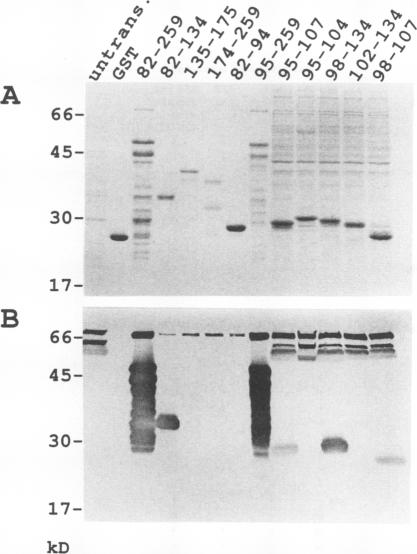
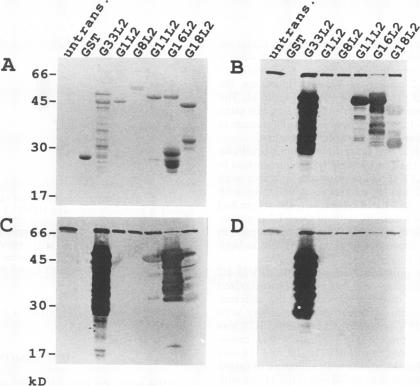
Human papillomavirus type 33 (HPV33) is associated with malignant tumors of the cervix. In an attempt to develop immunological probes for HPV33 infections, antisera against various bacterial fusion proteins carrying sequences of the minor capsid protein encoded by L2 were raised in animals. Antigenic determinants on the HPV33 L2 protein were identified by using truncated fusion proteins and were classified as type specific or cross-reactive with respect to HPV1, -8, -11, -16, and -18. Cross-reactive epitopes map to amino acids 98 to 107 or to amino acids 102 to 112 and 107 to 117, respectively, depending on the fusion protein used for immunization. Antibodies directed toward these epitopes detect L2 proteins of HPV11, -16, and -18, but not of HPV1 and -8, in Western immunoblots and enzyme-linked immunosorbent assays. HPV33 L2 amino acids 82 to 94 and 117 to 130 induce type-specific antibodies, with the major response directed to amino acids 117 to 130. By using a synthetic peptide corresponding to L2 amino acids 117 to 130, high-titered, type-specific antisera were obtained. These antisera should be useful as immunological probes for HPV33 infection.
人乳头瘤病毒33型(HPV33)与宫颈癌相关。为了开发用于HPV33感染的免疫探针,针对携带由L2编码的次要衣壳蛋白序列的各种细菌融合蛋白的抗血清在动物体内产生。通过使用截短的融合蛋白鉴定HPV33 L2蛋白上的抗原决定簇,并根据其与HPV1、-8、-11、-16和-18的关系分为型特异性或交叉反应性。交叉反应性表位分别定位于氨基酸98至107或氨基酸102至112和107至117,这取决于用于免疫的融合蛋白。在蛋白质免疫印迹和酶联免疫吸附测定中,针对这些表位的抗体可检测HPV11、-16和-18的L2蛋白,但不能检测HPV1和-8的L2蛋白。HPV33 L2的氨基酸82至94和117至第十三0诱导型特异性抗体,主要反应针对氨基酸117至130。通过使用对应于L2氨基酸117至130的合成肽,获得了高滴度的型特异性抗血清。这些抗血清可用作HPV33感染的免疫探针。