
起搏诱导的充血性心力衰竭时右心房和左心室中心脏鸟苷5'-三磷酸结合蛋白的下调
Downregulation of cardiac guanosine 5'-triphosphate-binding proteins in right atrium and left ventricle in pacing-induced congestive heart failure.
作者信息
Roth D A, Urasawa K, Helmer G A, Hammond H K
机构信息
Veterans Affairs Medical Center, San Diego, California 92161.
出版信息
J Clin Invest. 1993 Mar;91(3):939-49. doi: 10.1172/JCI116315.
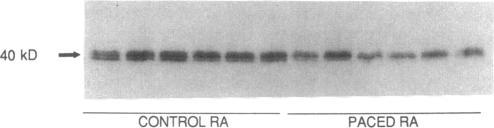
The extent to which congestive heart failure (CHF) is dependent upon increased levels of the cardiac inhibitory GTP-binding protein (Gi), and the impact of CHF on the cardiac stimulatory GTP-binding protein (Gs) and mechanisms by which Gs may change remain unexplored. We have addressed these unsettled issues using pacing-induced CHF in pigs to examine physiological, biochemical, and molecular features of the right atrium (RA) and left ventricle (LV). CHF was associated with an 85 +/- 20% decrease in LV segment shortening (P < 0.001) and a 3.5-fold increase (P = 0.006) in the ED50 for isoproterenol-stimulated heart rate responsiveness. Myocardial beta-adrenergic receptor number was decreased 54% in RA (P = 0.004) and 57% in LV (P < 0.001), and multiple measures of adenylyl cyclase activity were depressed 49 +/- 8% in RA (P < 0.005), and 44 +/- 9% in LV (P < 0.001). Quantitative immunoblotting established that Gi and Gs were decreased in RA (Gi: 59% reduction; P < 0.0001; Gs: 28% reduction; P < 0.007) and LV (Gi: 35% reduction; P < 0.008; Gs: 28% reduction; P < 0.01) after onset of CHF. Reduced levels of Gi and Gs were confirmed by ADP ribosylation studies, and diminished function of Gs was established in reconstitution studies. Steady state levels for Gs alpha mRNA were increased in RA and unchanged in LV, and significantly more GS alpha was found in the supernatant (presumably cytosolic) fraction in RA and LV membrane homogenates after CHF, suggesting that increased Gs degradation, rather than decreased Gs synthesis, is the mechanism by which Gs is downregulated. We conclude that cardiac Gi content poorly predicts adrenergic responsiveness or contractile function, that decreased Gs is caused by increased degradation rather than decreased synthesis, and that alterations in beta-adrenergic receptors, adenylyl cyclase, and GTP-binding proteins are uniform in RA and LV in this model of congestive heart failure.
充血性心力衰竭(CHF)在多大程度上依赖于心脏抑制性GTP结合蛋白(Gi)水平的升高,以及CHF对心脏刺激性GTP结合蛋白(Gs)的影响和Gs可能发生变化的机制尚未得到探索。我们利用猪的起搏诱导性CHF来研究右心房(RA)和左心室(LV)的生理、生化和分子特征,从而解决这些未解决的问题。CHF与LV节段缩短减少85±20%(P<0.001)以及异丙肾上腺素刺激的心率反应性的ED50增加3.5倍(P = 0.006)相关。心肌β-肾上腺素能受体数量在RA中减少54%(P = 0.004),在LV中减少57%(P<0.001),腺苷酸环化酶活性的多项测量值在RA中降低49±8%(P<0.005),在LV中降低44±9%(P<0.001)。定量免疫印迹表明,CHF发作后,RA和LV中的Gi和Gs均减少(Gi:减少59%;P<0.0001;Gs:减少28%;P<0.007)以及(Gi:减少35%;P<0.008;Gs:减少28%;P<0.01)。ADP核糖基化研究证实了Gi和Gs水平的降低,并且在重组研究中确定了Gs功能的减弱。RA中Gsα mRNA的稳态水平升高,LV中不变,并且CHF后RA和LV膜匀浆的上清液(可能是胞质)部分中发现的GSα明显更多,这表明Gs下调的机制是Gs降解增加而非Gs合成减少。我们得出结论,心脏Gi含量不能很好地预测肾上腺素能反应性或收缩功能,Gs减少是由降解增加而非合成减少引起的,并且在这种充血性心力衰竭模型中,RA和LV中β-肾上腺素能受体、腺苷酸环化酶和GTP结合蛋白的改变是一致的。




 Zotero 插件