Groisman E A, Ochman H
Department of Molecular Microbiology, Washington University School of Medicine, St. Louis, MO 63110.
EMBO J. 1993 Oct;12(10):3779-87. doi: 10.1002/j.1460-2075.1993.tb06056.x.
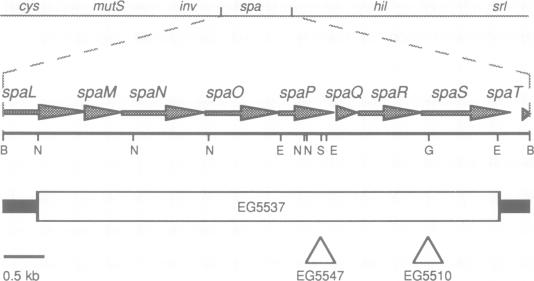
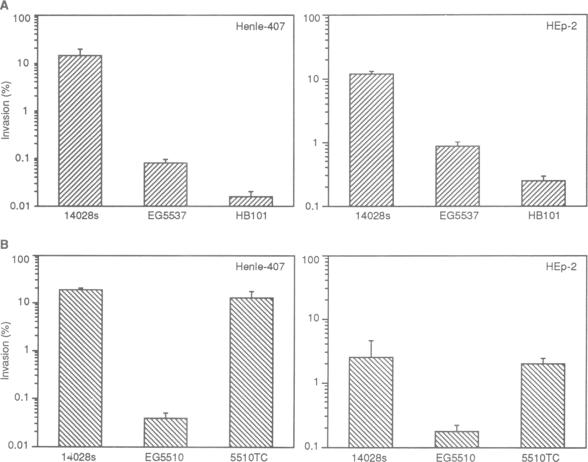
The enteric pathogens Salmonella typhimurium and Shigella flexneri differ in most virulence attributes including infectivity, pathology and host range. We have identified a new assemblage of genes responsible for invasion properties of Salmonella which is remarkably similar in order, arrangement and sequence to the gene cluster controlling the presentation of surface antigens (spa) on the virulence plasmid of Shigella. In Salmonella, this chromosomally encoded complex consists of over 12 genes, mutations in which abolish bacterial entry into epithelial cells. Although these genera use distinct invasion antigens, a non-invasive spa mutant of Salmonella could be rescued by the corresponding Shigella homolog. While spa promotes equivalent functions in Shigella and Salmonella, this constellation of genes has been acquired independently by each genus and displays motifs used by diverse antigen export systems including those required for flagellar assembly and protein secretion.
肠道病原体鼠伤寒沙门氏菌和福氏志贺氏菌在大多数毒力特性上存在差异,包括感染性、病理学和宿主范围。我们已经鉴定出一组负责沙门氏菌侵袭特性的新基因组合,其顺序、排列和序列与控制志贺氏菌毒力质粒上表面抗原(spa)呈现的基因簇非常相似。在沙门氏菌中,这种染色体编码的复合体由超过12个基因组成,其中的突变会消除细菌进入上皮细胞的能力。尽管这些菌属使用不同的侵袭抗原,但沙门氏菌的非侵袭性spa突变体可以被相应的志贺氏菌同源物拯救。虽然spa在志贺氏菌和沙门氏菌中促进等效功能,但每个菌属独立获得了这组基因,并展示了多种抗原输出系统使用的基序,包括鞭毛组装和蛋白质分泌所需的基序。