Firulli B A, Anderson G R, Stoler D L, Estes S D
Department of Molecular and Cellular Biology, Roswell Park Cancer Institute, Buffalo, New York 14263-0001.
J Virol. 1993 Nov;67(11):6857-62. doi: 10.1128/JVI.67.11.6857-6862.1993.
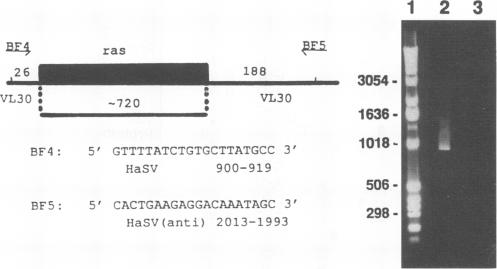
VL30 elements are associated with cancer by their overexpression in rodent malignancies, their induction in a fibroblast response to anoxia which shares features with the malignant phenotype, and their presence recombined into Harvey murine sarcoma virus (HaSV) and Kirsten murine sarcoma virus. These sarcoma viruses contain ras oncogenes flanked on both sides by retrotransposon VL30 element sequences, in turn flanked by mouse leukemia virus sequences. Three very basic questions have existed about the VL30 element sequences found in sarcoma viruses: (i) how did they become recombined, (ii) what are their exact boundaries, and (iii) why are they there? To help decipher the nature of VL30 elements in sarcoma viruses, we examined VL30 clones isolated from an anoxic fibroblast cDNA library and independently by polymerase chain reaction cloning from rat cell DNA. Sequence comparisons with HaSV revealed that HaSV was formed by the substitution of 0.7 kb of VL30 sequences by 0.9 kb of c-Ha-ras sequences, with this event possibly facilitated by the presence of an identical Alu-like repeat found upstream of the 5' recombination point in both the VL30 element and c-Ha-ras. Recombination occurred 42 bases beyond the Alu-like sequences in VL30 and 1596 bases beyond them in c-Ha-ras, at position 926 of HaSV. The 3' ras-VL30 recombination event in HaSV occurred within a seven-base region of shared sequence identity, between HaSV bases 1825 and 1825 and 1831. Recombination between Moloney leukemia virus (MoLV) and VL30 appears to have occurred at a point corresponding to base 218 or 219 of MoLV and was near a TAR-like VL30 sequence; such recombination at the 3' end was between positions 7445 and 7456 of MoLV (HaSV positions 4694 to 4703). Kirsten murine sarcoma virus was found to be closely analogous to HaSV, and limited similar features were also seen with Rasheed sarcoma virus.
VL30元件与癌症相关,原因在于它们在啮齿动物恶性肿瘤中过度表达,在成纤维细胞对缺氧的反应中被诱导(这种反应与恶性表型有共同特征),以及它们存在于重组进哈维鼠肉瘤病毒(HaSV)和柯斯顿鼠肉瘤病毒中的情况。这些肉瘤病毒含有ras癌基因,其两侧为反转录转座子VL30元件序列,而VL30元件序列两侧又为小鼠白血病病毒序列。关于在肉瘤病毒中发现的VL30元件序列,存在三个非常基本的问题:(i)它们是如何发生重组的,(ii)它们的确切边界是什么,以及(iii)它们为什么会在那里?为了帮助解读肉瘤病毒中VL30元件的性质,我们检查了从缺氧成纤维细胞cDNA文库中分离出的VL30克隆,以及独立地通过聚合酶链反应从大鼠细胞DNA中克隆得到的VL30克隆。与HaSV的序列比较显示,HaSV是由0.9 kb的c-Ha-ras序列取代0.7 kb的VL30序列形成的,这一事件可能因在VL30元件和c-Ha-ras的5'重组点上游发现的相同的类Alu重复序列而得以促进。重组发生在VL30中类Alu序列下游42个碱基处以及c-Ha-ras中类Alu序列下游1596个碱基处,位于HaSV的第926位。HaSV中3'端的ras-VL30重组事件发生在一个具有共有序列同一性的七碱基区域内,位于HaSV的第1825位和1831位之间。莫洛尼白血病病毒(MoLV)与VL30之间的重组似乎发生在对应于MoLV第218位或219位碱基的位置,并且靠近一个类TAR的VL30序列;这种3'端的重组发生在MoLV的第7445位和7456位之间(HaSV的第4694位至4703位)。发现柯斯顿鼠肉瘤病毒与HaSV非常相似,并且在拉希德肉瘤病毒中也观察到了有限的类似特征。