Somogyi P, Jenner A J, Brierley I, Inglis S C
Department of Pathology, University of Cambridge, United Kingdom.
Mol Cell Biol. 1993 Nov;13(11):6931-40. doi: 10.1128/mcb.13.11.6931-6940.1993.
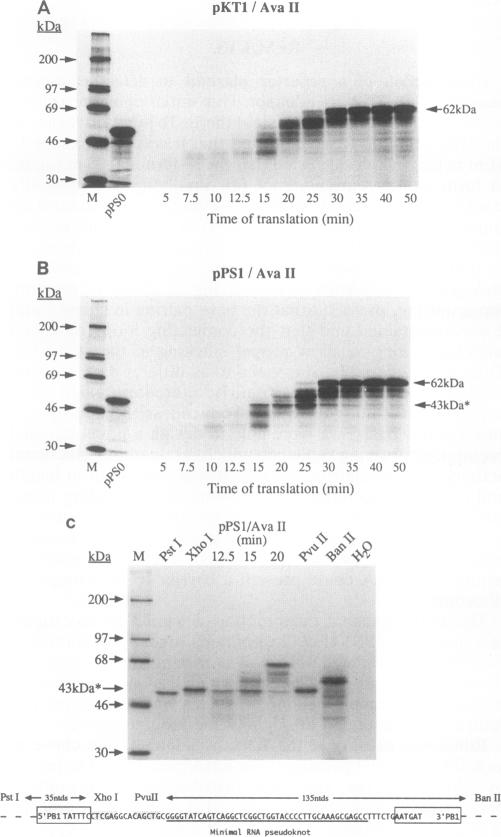
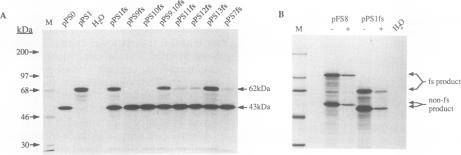
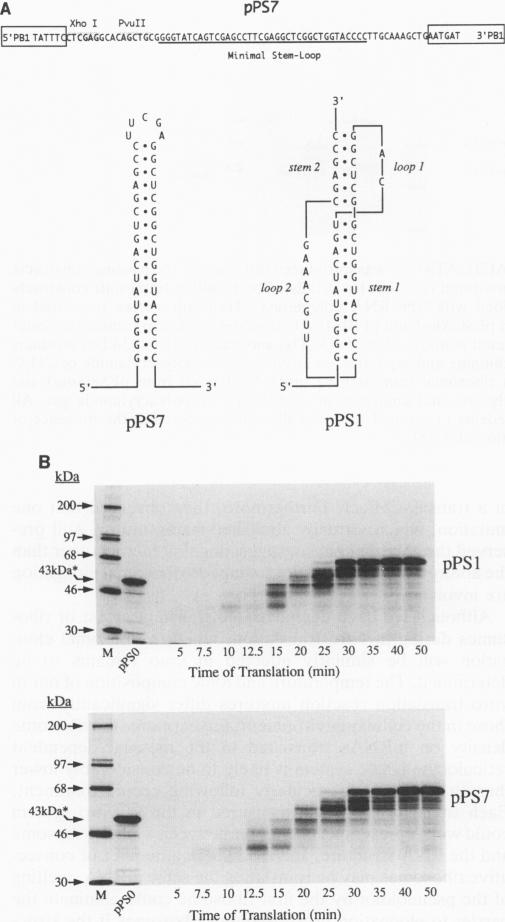
The genomic RNA of the coronavirus infectious bronchitis virus contains an efficient ribosomal frameshift signal which comprises a heptanucleotide slippery sequence followed by an RNA pseudoknot structure. The presence of the pseudoknot is essential for high-efficiency frameshifting, and it has been suggested that its function may be to slow or stall the ribosome in the vicinity of the slippery sequence. To test this possibility, we have studied translational elongation in vitro on mRNAs engineered to contain a well-defined pseudoknot-forming sequence. Insertion of the pseudoknot at a specific location within the influenza virus PB1 mRNA resulted in the production of a new translational intermediate corresponding to the size expected for ribosomal arrest at the pseudoknot. The appearance of this protein was transient, indicating that it was a true paused intermediate rather than a dead-end product, and mutational analysis confirmed that its appearance was dependent on the presence of a pseudoknot structure within the mRNA. These observations raise the possibility that a pause is required for the frameshift process. The extent of pausing at the pseudoknot was compared with that observed at a sequence designed to form a simple stem-loop structure with the same base pairs as the pseudoknot. This structure proved to be a less effective barrier to the elongating ribosome than the pseudoknot and in addition was unable to direct efficient ribosomal frameshifting, as would be expected if pausing plays an important role in frameshifting. However, the stem-loop was still able to induce significant pausing, and so this effect alone may be insufficient to account for the contribution of the pseudoknot to frameshifting.
传染性支气管炎冠状病毒的基因组RNA含有一个有效的核糖体移码信号,该信号由一个七核苷酸的滑序列和一个RNA假结结构组成。假结的存在对于高效移码至关重要,有人认为其功能可能是使核糖体在滑序列附近减速或停滞。为了验证这种可能性,我们研究了在体外对经改造含有明确假结形成序列的mRNA进行的翻译延伸。在流感病毒PB1 mRNA的特定位置插入假结导致产生了一种新的翻译中间体,其大小与假结处核糖体停滞预期的大小一致。这种蛋白质的出现是短暂的,表明它是一个真正的暂停中间体而非终产物,突变分析证实其出现依赖于mRNA中假结结构的存在。这些观察结果提出了移码过程需要停顿的可能性。将在假结处的停顿程度与在设计形成与假结具有相同碱基对的简单茎环结构的序列处观察到的停顿程度进行了比较。结果证明,这种结构对延伸核糖体的阻碍作用比假结小并且无法指导高效的核糖体移码,正如如果停顿在移码中起重要作用所预期的那样。然而,茎环仍然能够诱导显著的停顿,因此仅这种效应可能不足以解释假结对移码的贡献。