Woodcock C L, Grigoryev S A, Horowitz R A, Whitaker N
Department of Biology, University of Massachusetts, Amherst 01003.
Proc Natl Acad Sci U S A. 1993 Oct 1;90(19):9021-5. doi: 10.1073/pnas.90.19.9021.
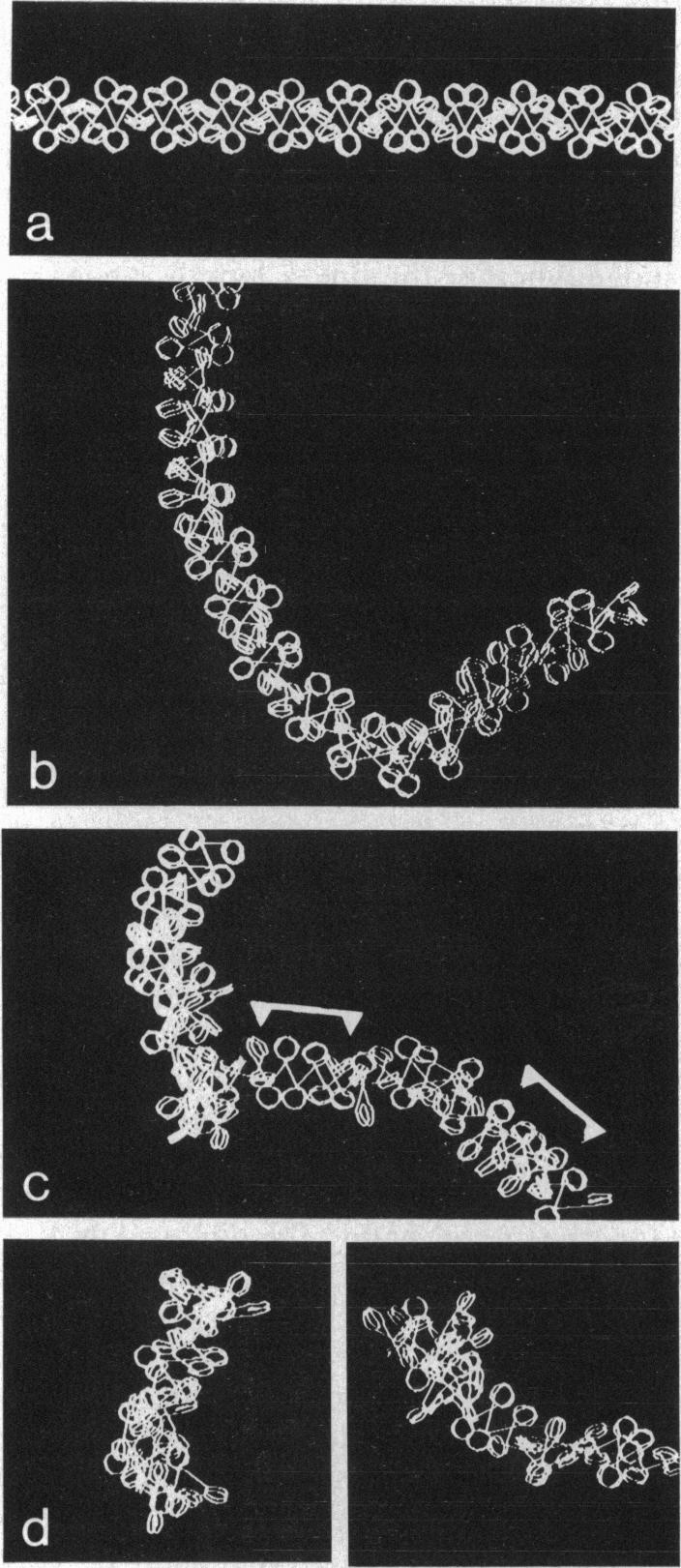
The "30-nm" chromatin fibers, as observed in eukaryotic nuclei, are considered a discrete level in a hierarchy of DNA folding. At present, there is considerable debate as to how the nucleosomes and linker DNA are organized within chromatin fibers, and a number of models have been proposed, many of which are based on helical symmetry and imply specific contacts between nucleosomes. However, when observed in nuclei or after isolation, chromatin fibers show considerable structural irregularity. In the present study, chromatin folding is considered solely in terms of the known properties of the nucleosome-linker unit, taking into account the relative rotation between consecutive nucleosomes that results from the helical twist of DNA. Model building based on this premise, and with a constant length of linker DNA between consecutive nucleosomes, results in a family of fiber- and ribbon-like structures. When the linker length between nucleosomes is allowed to vary, as occurs in nature, fibers showing the types of irregularity observed in nuclei and in isolated chromatin are created. The potential application of the model in determining the three-dimensional organization of chromatin in which nucleosome positions are known is discussed.
在真核细胞核中观察到的“30纳米”染色质纤维被认为是DNA折叠层级中的一个离散水平。目前,关于核小体和连接DNA在染色质纤维中是如何组织的存在相当多的争论,并且已经提出了许多模型,其中许多基于螺旋对称性并暗示核小体之间的特定接触。然而,当在细胞核中观察或分离后,染色质纤维显示出相当大的结构不规则性。在本研究中,仅根据核小体-连接单元的已知特性来考虑染色质折叠,同时考虑到由DNA螺旋扭曲导致的连续核小体之间的相对旋转。基于这一前提并在连续核小体之间具有恒定长度连接DNA的情况下构建模型,会产生一系列纤维状和带状结构。当允许核小体之间的连接长度变化时,就像在自然界中发生的那样,会产生显示出在细胞核和分离的染色质中观察到的那种不规则类型的纤维。讨论了该模型在确定已知核小体位置的染色质三维组织方面的潜在应用。