Kaye K M, Izumi K M, Kieff E
Department of Medicine, Harvard Medical School, Brigham and Women's Hospital, Boston, MA 02115.
Proc Natl Acad Sci U S A. 1993 Oct 1;90(19):9150-4. doi: 10.1073/pnas.90.19.9150.
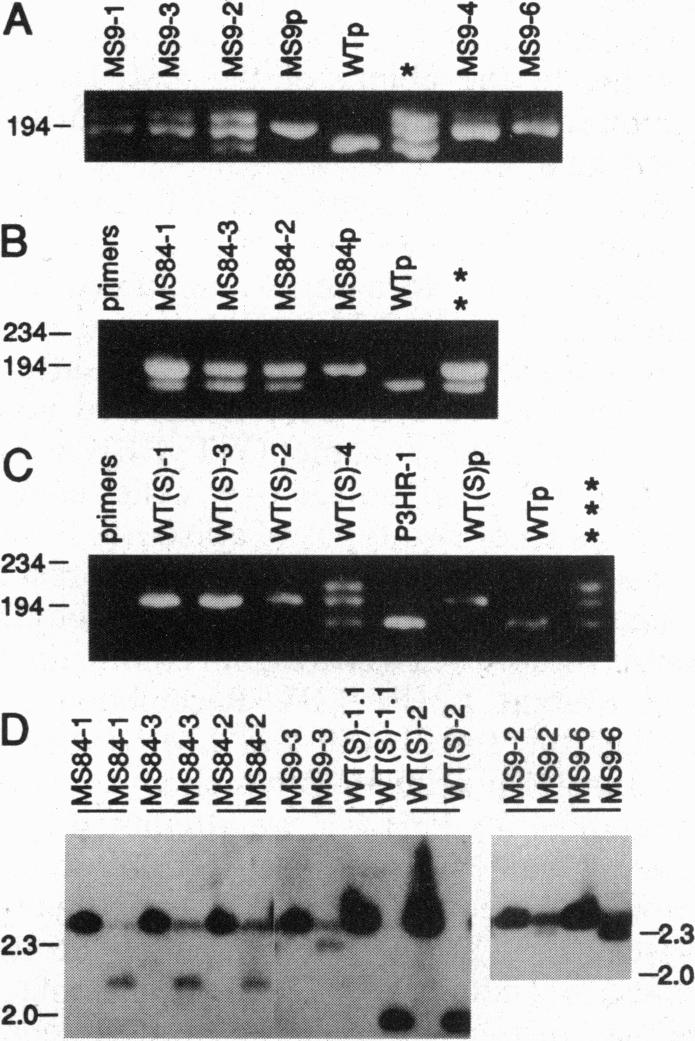
The gene encoding latent-infection membrane protein 1 (LMP1) was specifically mutated in Epstein-Barr virus (EBV) recombinants by inserting a nonsense linker after codon 9 or codon 84 or into an intron 186 bp 3' to the latter insertion site. EBV recombinants with the LMP1 intron mutation were wild type for LMP1 expression and for growth transformation of primary B lymphocytes. In contrast, EBV recombinants with the mutations in the LMP1 open reading frame expressed N-terminally truncated crossreactive proteins and could initiate or maintain primary B-lymphocyte transformation only when wild-type LMP1 was provided in trans by a coinfecting, transformation-defective EBV, P3HR-1. These data indicate that LMP1 is essential for EBV-mediated transformation of primary B lymphocytes, that the first 43 amino acids are critical for LMP1's function, and that codon 44-initiated LMP1 does not have a dominant negative effect on transformation.
通过在第9或84密码子后插入无义连接子,或将其插入内含子(位于后者插入位点下游186 bp处),编码潜伏感染膜蛋白1(LMP1)的基因在爱泼斯坦-巴尔病毒(EBV)重组体中发生特异性突变。具有LMP1内含子突变的EBV重组体在LMP1表达和原代B淋巴细胞生长转化方面为野生型。相比之下,LMP1开放阅读框发生突变的EBV重组体表达N端截短的交叉反应蛋白,并且只有在共感染的、转化缺陷型EBV(P3HR-1)反式提供野生型LMP1时,才能启动或维持原代B淋巴细胞转化。这些数据表明,LMP1对于EBV介导的原代B淋巴细胞转化至关重要,前43个氨基酸对LMP1的功能至关重要,并且第44密码子起始的LMP1对转化没有显性负效应。