Pierrard J, Ludden P W, Roberts G P
Department of Bacteriology, University of Wisconsin-Madison 53706.
J Bacteriol. 1993 Mar;175(5):1358-66. doi: 10.1128/jb.175.5.1358-1366.1993.
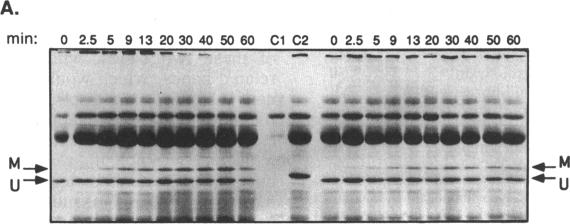
In the photosynthetic bacterium Rhodobacter capsulatus, nitrogenase activity is regulated by ADP-ribosylation of component II in response to the addition of ammonium to cultures or to the removal of light. The ammonium stimulus results in a fast and almost complete inhibition of the in vivo acetylene reduction activity, termed switch-off, which is reversed after the ammonium is exhausted. In the present study of the response of cells to ammonium, ADP-ribosylation of component II occurred but could not account for the extent and timing of the inhibition of activity. The presence of an additional response was confirmed with strains expressing mutant component II proteins; although these proteins are not a substrate for ADP-ribosylation, the strains continued to exhibit a switch-off response to ammonium. This second regulatory response of nitrogenase to ammonium was found to be synchronous with ADP-ribosylation and was responsible for the bulk of the observed effects on nitrogenase activity. In comparison, ADP-ribosylation in R. capsulatus was found to be relatively slow and incomplete but responded independently to both known stimuli, darkness and ammonium. Based on the in vitro nitrogenase activity of both the wild type and strains whose component II proteins cannot be ADP-ribosylated, it seems likely that the second response blocks either the ATP or the electron supply to nitrogenase.
在光合细菌荚膜红细菌中,固氮酶活性通过组分II的ADP核糖基化进行调节,以响应向培养物中添加铵或去除光照。铵刺激导致体内乙炔还原活性快速且几乎完全抑制,称为关闭,在铵耗尽后这种抑制作用会逆转。在目前对细胞对铵的反应的研究中,组分II发生了ADP核糖基化,但这并不能解释活性抑制的程度和时间。通过表达突变体组分II蛋白的菌株证实了存在额外的反应;尽管这些蛋白不是ADP核糖基化的底物,但这些菌株对铵仍表现出关闭反应。发现固氮酶对铵的这种第二种调节反应与ADP核糖基化同步,并且是观察到的对固氮酶活性的大部分影响的原因。相比之下,发现荚膜红细菌中的ADP核糖基化相对缓慢且不完全,但对已知的两种刺激,即黑暗和铵,有独立反应。根据野生型和其组分II蛋白不能进行ADP核糖基化的菌株的体外固氮酶活性,第二种反应似乎可能阻断了向固氮酶的ATP供应或电子供应。