Llinás R, Ribary U
Department of Physiology and Biophysics, New York University Medical Center, NY 10016.
Proc Natl Acad Sci U S A. 1993 Mar 1;90(5):2078-81. doi: 10.1073/pnas.90.5.2078.
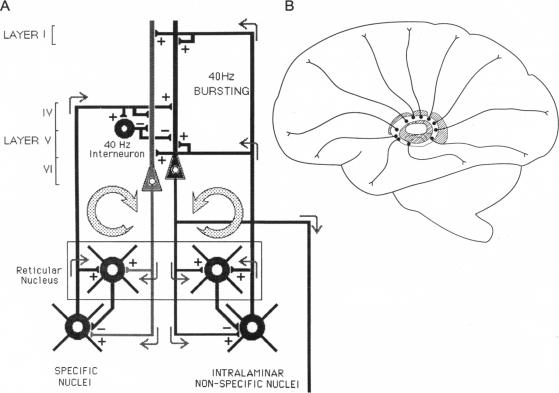
Magnetic recording from five normal human adults demonstrates large 40-Hz coherent magnetic activity in the awake and in rapid-eye-movement (REM) sleep states that is very reduced during delta sleep (deep sleep characterized by delta waves in the electroencephalogram). This 40-Hz magnetic oscillation has been shown to be reset by sensory stimuli in the awake state. Such resetting is not observed during REM or delta sleep. The 40 Hz in REM sleep is characterized, as is that in the awake state, by a fronto-occipital phase shift over the head. This phase shift has a maximum duration of approximately 12-13 msec. Because 40-Hz oscillation is seen in wakefulness and in dreaming, we propose it to be a correlate of cognition, probably resultant from coherent 40-Hz resonance between thalamocortical-specific and nonspecific loops. Moreover, we proposed that the specific loops give the content of cognition, and a nonspecific loop gives the temporal binding required for the unity of cognitive experience.
对五名正常成年人的磁记录显示,在清醒和快速眼动(REM)睡眠状态下存在大量40赫兹的相干磁活动,而在慢波睡眠(以脑电图中的慢波为特征的深度睡眠)期间这种活动会大幅减少。已证明这种40赫兹的磁振荡在清醒状态下会被感觉刺激重置。在REM睡眠或慢波睡眠期间未观察到这种重置现象。REM睡眠中的40赫兹与清醒状态下的情况一样,其特征是头部出现额枕相移。这种相移的最大持续时间约为12 - 13毫秒。由于在清醒和做梦状态下都能看到40赫兹振荡,我们认为它是认知的一个相关因素,可能是丘脑皮质特异性和非特异性环路之间40赫兹相干共振的结果。此外,我们提出特异性环路赋予认知内容,而非特异性环路赋予认知体验统一性所需的时间绑定。