Baler R, Dahl G, Voellmy R
Department of Biochemistry and Molecular Biology, University of Miami School of Medicine, Florida 33101.
Mol Cell Biol. 1993 Apr;13(4):2486-96. doi: 10.1128/mcb.13.4.2486-2496.1993.
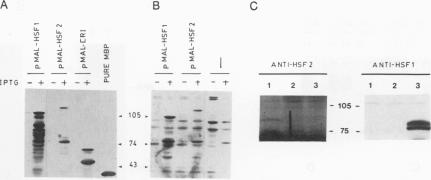
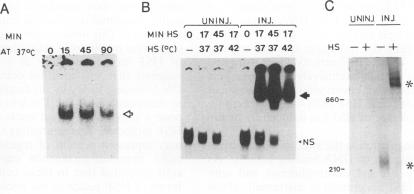
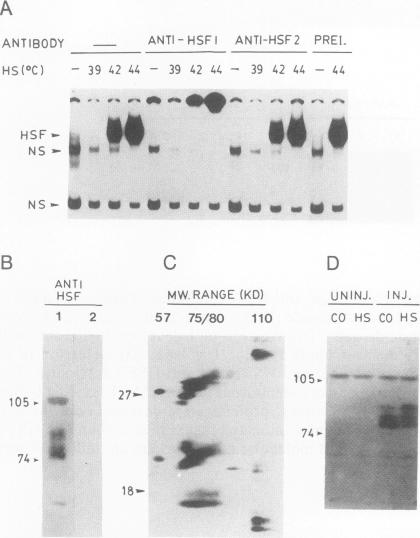
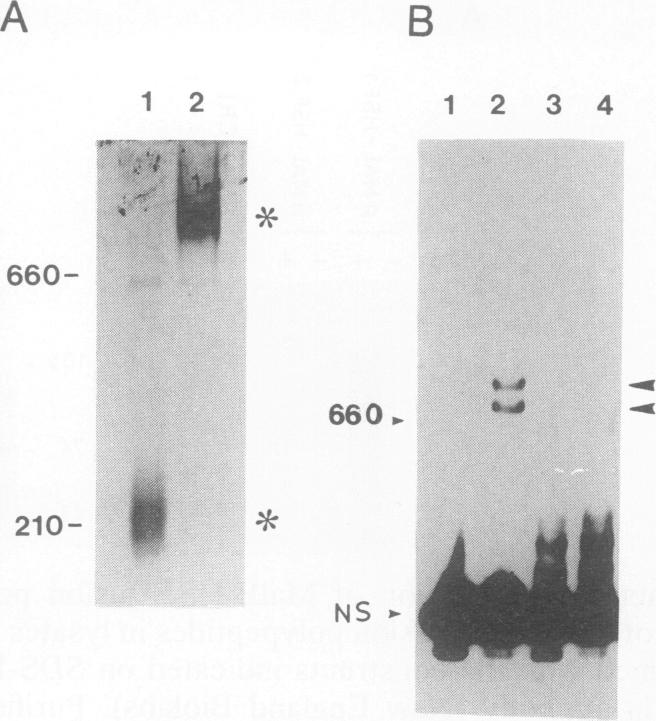
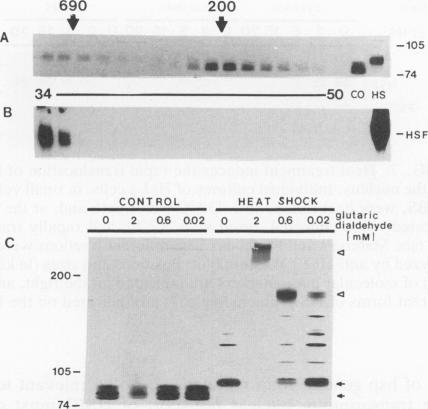
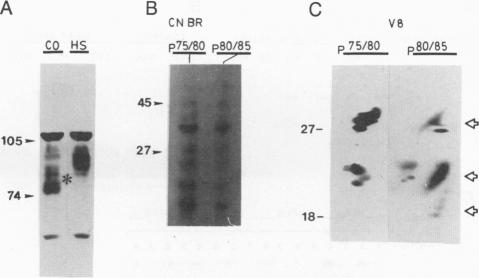
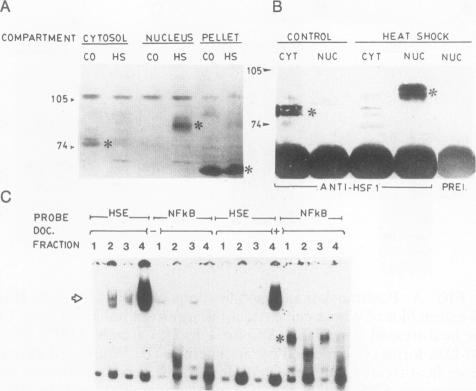
Transcriptional activity of heat shock (hsp) genes is controlled by a heat-activated, group-specific transcription factor(s) recognizing arrays of inverted repeats of the element NGAAN. To date genes for two human factors, HSF1 and HSF2, have been isolated. To define their properties as well as the changes they undergo during heat stress activation, we prepared polyclonal antibodies to these factors. Using these tools, we have shown that human HeLa cells constitutively synthesize HSF1, but we were unable to detect HSF2. In unstressed cells HSF1 is present mainly in complexes with an apparent molecular mass of about 200 kDa, unable to bind to DNA. Heat treatment induces a shift in the apparent molecular mass of HSF1 to about 700 kDa, concomitant with the acquisition of DNA-binding ability. Cross-linking experiments suggest that this change in complex size may reflect the trimerization of monomeric HSF1. Human HSF1 expressed in Xenopus oocytes does not bind DNA, but derepression of DNA-binding activity, as well as oligomerization of HSF1, occurs during heat treatment at the same temperature at which hsp gene expression is induced in this organism, suggesting that a conserved Xenopus protein(s) plays a role in this regulation. Inactive HSF1 resides in the cytoplasm of human cells; on activation it rapidly translocates to a soluble nuclear fraction, and shortly thereafter it becomes associated with the nuclear pellet. On heat shock, activatable HSF1, which might already have been posttranslationally modified in the unstressed cell, undergoes further modification. These different process provide multiple points of regulation of hsp gene expression.
热休克(hsp)基因的转录活性受一种热激活的、识别NGAAN元件反向重复序列阵列的组特异性转录因子控制。迄今为止,已分离出两种人类因子HSF1和HSF2的基因。为了确定它们的特性以及它们在热应激激活过程中所经历的变化,我们制备了针对这些因子的多克隆抗体。利用这些工具,我们发现人类HeLa细胞组成性地合成HSF1,但无法检测到HSF2。在未受应激的细胞中,HSF1主要以表观分子量约为200 kDa的复合物形式存在,无法与DNA结合。热处理导致HSF1的表观分子量转变为约700 kDa,同时获得DNA结合能力。交联实验表明,复合物大小的这种变化可能反映了单体HSF1的三聚化。在非洲爪蟾卵母细胞中表达的人类HSF1不与DNA结合,但在热处理过程中,在该生物体中诱导hsp基因表达的相同温度下,DNA结合活性的去抑制以及HSF1的寡聚化发生,这表明一种保守的非洲爪蟾蛋白在这种调节中起作用。无活性的HSF1存在于人类细胞的细胞质中;激活后,它迅速转运到可溶性核部分,此后不久它与核沉淀结合。热休克时,可能在未受应激的细胞中已经进行了翻译后修饰的可激活HSF1会进一步修饰。这些不同的过程为hsp基因表达提供了多个调节点。