Balligand J L, Ungureanu D, Kelly R A, Kobzik L, Pimental D, Michel T, Smith T W
Department of Medicine, Brigham and Women's Hospital, Boston, Massachusetts 02115.
J Clin Invest. 1993 May;91(5):2314-9. doi: 10.1172/JCI116461.
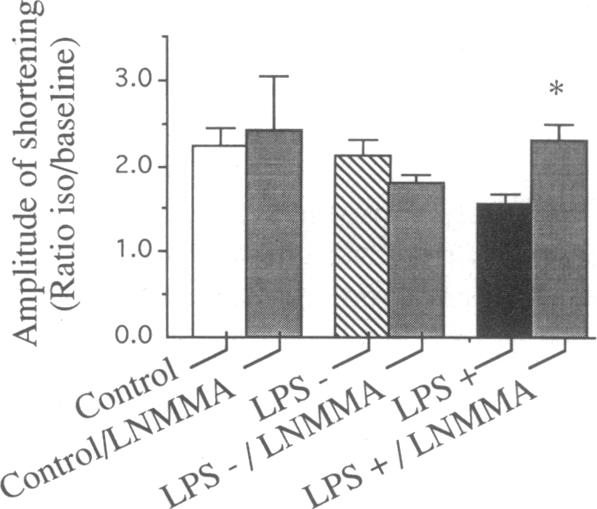
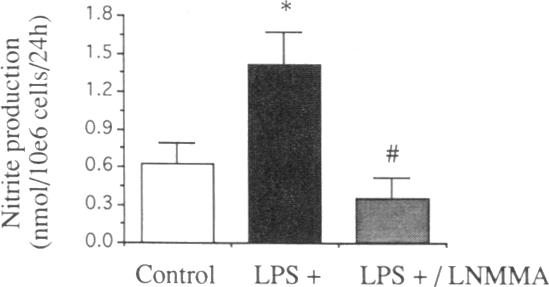
The mechanism by which soluble mediators of immune cell origin depress myocardial contractility, either globally as in systemic sepsis, or regionally in areas of inflammatory myocardial infiltrates, remains unclear. When freshly isolated ventricular myocytes from adult rat hearts were preincubated for at least 24 h in medium conditioned by endotoxin (LPS)-activated rat alveolar macrophages, their subsequent inotropic response to the beta-adrenergic agonist isoproterenol was reduced from 225 +/- 19% to 155 +/- 10% of the baseline amplitude of shortening (mean +/- SEM, P < 0.05). Neither baseline contractile function nor the contractile response to high extracellular calcium were affected. To determine whether an endogenous nitric-oxide (NO)-signaling pathway within ventricular myocytes was responsible for their decreased responsiveness to isoproterenol, the L-arginine analogue L-NMMA was added to the preincubation medium. While L-NMMA did not affect baseline contractile function or the response of control myocytes to isoproterenol, it completely restored the positive inotropic response to isoproterenol in myocytes preincubated in LPS-activated macrophage medium. Release of NO by ventricular myocytes following exposure to activated macrophage medium was detected as an increase in cGMP content in a reporter-cell (RFL-6) bioassay and also as increased nitrite content in myocyte-conditioned medium. Thus, the depressed contractile response of adult rat ventricular myocytes to beta-adrenergic agonists by a 24-h exposure to soluble inflammatory mediators is mediated at least in party by induction of an autocrine NO signaling pathway.
免疫细胞来源的可溶性介质降低心肌收缩力的机制仍不清楚,这种降低在全身脓毒症中是全身性的,在炎症性心肌浸润区域则是局部性的。当将成年大鼠心脏新分离的心室肌细胞在内毒素(LPS)激活的大鼠肺泡巨噬细胞条件培养液中预孵育至少24小时后,它们随后对β-肾上腺素能激动剂异丙肾上腺素的变力反应从缩短基线幅度的225±19%降至155±10%(平均值±标准误,P<0.05)。基线收缩功能和对高细胞外钙的收缩反应均未受影响。为了确定心室肌细胞内的内源性一氧化氮(NO)信号通路是否是其对异丙肾上腺素反应性降低的原因,将L-精氨酸类似物L-NMMA添加到预孵育培养基中。虽然L-NMMA不影响基线收缩功能或对照肌细胞对异丙肾上腺素的反应,但它完全恢复了在LPS激活的巨噬细胞培养基中预孵育的肌细胞对异丙肾上腺素的正性变力反应。在报告细胞(RFL-6)生物测定中,检测到暴露于激活的巨噬细胞培养基后的心室肌细胞释放NO表现为cGMP含量增加,在肌细胞条件培养液中也表现为亚硝酸盐含量增加。因此,成年大鼠心室肌细胞经24小时暴露于可溶性炎症介质后对β-肾上腺素能激动剂的收缩反应降低至少部分是由自分泌NO信号通路的诱导介导的。