Kolattukudy P E, Lee J D, Rogers L M, Zimmerman P, Ceselski S, Fox B, Stein B, Copelan E A
Ohio State Biotechnology Center, Ohio State University, Columbus 43210.
Infect Immun. 1993 Jun;61(6):2357-68. doi: 10.1128/iai.61.6.2357-2368.1993.
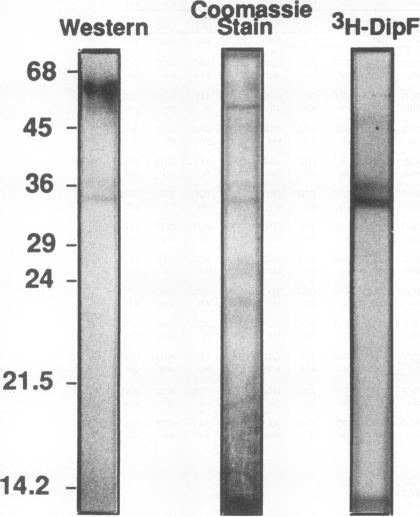
A number of isolates of Aspergillus fumigatus obtained from the hospital environment produced extracellular elastolytic activity. This activity was found to be catalyzed by a single 33-kDa protein which was purified and characterized to be a serine protease. A. fumigatus, when grown on the insoluble structural material obtained from murine and bovine lung, produced the same extracellular 33-kDa elastolytic protease, indicating that this enzyme is likely to be produced when the organism infects the lung. Polymerase chain reaction with an oligonucleotide primer based on the N-terminal amino acid sequence of the elastolytic enzyme yielded a cDNA which was cloned and sequenced. The active serine motif showed more similarity to subtilisin than to mammalian elastase. The amino acid sequence showed 80% identity to the alkaline protease from Aspergillus oryzae. Screening of hospital isolates of Aspergillus flavus showed great variation in the production of elastolytic activity and a much lower level of activity than that produced by A. fumigatus. The elastolytic protease from A. flavus was shown to be a serine protease susceptible to modification and inactivation by active serine and histidine-directed reagents. This protease cross-reacted with the antibodies prepared against the elastolytic protease from A. fumigatus. Immunogold localization of the elastolytic enzyme showed that A. fumigatus germinating and penetrating into the lungs of neutropenic mice secreted the elastolytic protease. An elastase-deficient mutant generated from a highly virulent isolate of A. fumigatus caused drastically reduced mortality when nasally introduced into the lung of neutropenic mice. All of the evidence suggests that extracellular elastolytic protease is a significant virulence factor in invasive aspergillosis.
从医院环境中分离得到的一些烟曲霉菌株具有细胞外弹性蛋白酶活性。发现这种活性由一种单一的33 kDa蛋白质催化,该蛋白质经纯化和鉴定为丝氨酸蛋白酶。烟曲霉菌在从小鼠和牛肺中获得的不溶性结构材料上生长时,会产生相同的细胞外33 kDa弹性蛋白酶,这表明该酶可能在该生物体感染肺部时产生。基于弹性蛋白酶的N端氨基酸序列的寡核苷酸引物进行聚合酶链反应,得到一个cDNA,将其克隆并测序。活性丝氨酸基序与枯草杆菌蛋白酶的相似性高于与哺乳动物弹性蛋白酶的相似性。氨基酸序列与米曲霉的碱性蛋白酶有80%的同一性。对黄曲霉菌株的医院分离株进行筛选,结果显示其弹性蛋白酶活性差异很大,且活性水平远低于烟曲霉菌株。黄曲霉的弹性蛋白酶被证明是一种丝氨酸蛋白酶,易被活性丝氨酸和组氨酸导向试剂修饰和失活。这种蛋白酶与针对烟曲霉弹性蛋白酶制备的抗体发生交叉反应。弹性蛋白酶的免疫金定位显示,在中性粒细胞减少小鼠肺部发芽并侵入的烟曲霉分泌弹性蛋白酶。从高毒力烟曲霉菌株产生的弹性蛋白酶缺陷型突变体经鼻腔接种到中性粒细胞减少小鼠肺部时,死亡率大幅降低。所有证据表明,细胞外弹性蛋白酶是侵袭性曲霉病的一个重要毒力因子。