Wentworth P, Datta A, Blakey D, Boyle T, Partridge L J, Blackburn G M
Department of Chemistry, Krebs Institute for Biomolecular Research, University of Sheffied, United Kingdom.
Proc Natl Acad Sci U S A. 1996 Jan 23;93(2):799-803. doi: 10.1073/pnas.93.2.799.
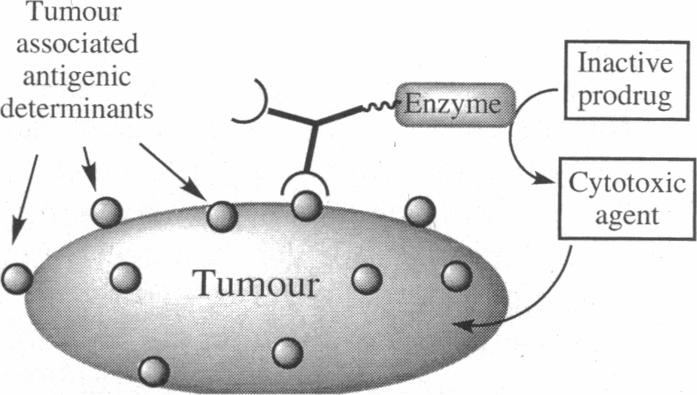
Antibody-directed enzyme prodrug therapy, ADEPT, is a recent approach to targeted cancer chemotherapy intended to diminish the nonspecific toxicity associated with many commonly used chemotherapeutic agents. Most ADEPT systems incorporate a bacterial enzyme, and thus their potential is reduced because of the immunogenicity of that component of the conjugate. This limitation can be circumvented by the use of a catalytic antibody, which can be "humanized," in place of the bacterial enzyme catalyst. We have explored the scope of such antibody-directed "abzyme" prodrug therapy, ADAPT, to evaluate the potential for a repeatable targeted cancer chemotherapy. We report the production of a catalytic antibody that can hydrolyze the carbamate prodrug 4-[N,N-bis(2-chloroethyl)]aminophenyl-N-[(1S)-(1,3- dicarboxy)propyl]carbamate (1) to generate the corresponding cytotoxic nitrogen mustard (Km = 201 microM, kcat = 1.88 min-1). In vitro studies with this abzyme, EA11-D7, and prodrug 1 lead to a marked reduction in viability of cultured human colonic carcinoma (LoVo) cells relative to appropriate controls. In addition, we have found a good correlation between antibody catalysis as determined by this cytotoxicity assay in vitro and competitive binding studies of candidate abzymes to the truncated transition-state analogue ethyl 4-nitrophenylmethylphosphonate. This cell-kill assay heralds a general approach to direct and rapid screening of antibody libraries for catalysts.
抗体导向酶前药疗法(ADEPT)是一种针对癌症的化疗新方法,旨在减少与许多常用化疗药物相关的非特异性毒性。大多数ADEPT系统都包含一种细菌酶,因此由于缀合物中该成分的免疫原性,其潜力受到限制。使用可“人源化”的催化抗体代替细菌酶催化剂可以规避这一限制。我们探索了这种抗体导向的“抗体酶”前药疗法(ADAPT)的范围,以评估可重复的靶向癌症化疗的潜力。我们报道了一种催化抗体的产生,它可以水解氨基甲酸酯前药4-[N,N-双(2-氯乙基)]氨基苯基-N-[(1S)-(1,3-二羧基)丙基]氨基甲酸酯(1),生成相应的细胞毒性氮芥(Km = 201 microM,kcat = 1.88 min-1)。用这种抗体酶EA11-D7和前药1进行的体外研究表明,相对于适当的对照,培养的人结肠癌(LoVo)细胞的活力显著降低。此外,我们发现通过这种体外细胞毒性测定确定的抗体催化作用与候选抗体酶与截短的过渡态类似物4-硝基苯基甲基膦酸乙酯的竞争性结合研究之间存在良好的相关性。这种细胞杀伤测定预示着一种直接快速筛选抗体文库以寻找催化剂的通用方法。