Sundstedt A, Sigvardsson M, Leanderson T, Hedlund G, Kalland T, Dohlsten M
Pharmacia Oncology Immunology, Lund, Sweden.
Proc Natl Acad Sci U S A. 1996 Feb 6;93(3):979-84. doi: 10.1073/pnas.93.3.979.
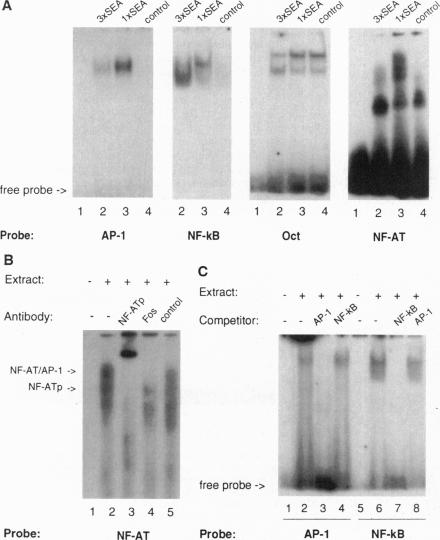
Anergy is a major mechanism to ensure antigen-specific tolerance in T lymphocytes in the adult. In vivo, anergy has mainly been studied at the cellular level. In this study, we used the T-cell-activating superantigen staphylococcal enterotoxin A (SEA) to investigate molecular mechanisms of T-lymphocyte anergy in vivo. Injection of SEA to adult mice activates CD4+ T cells expressing certain T-cell receptor (TCR) variable region beta-chain families and induces strong and rapid production of interleukin 2 (IL-2). In contrast, repeated injections of SEA cause CD4+ T-cell deletion and anergy in the remaining CD4+ T cells, characterized by reduced expression of IL-2 at mRNA and protein levels. We analyzed expression of AP-1, NF-kappa B, NF-AT, and octamer binding transcription factors, which are known to be involved in the regulation of IL-2 gene promoter activity. Large amounts of AP-1 and NF-kappa B and significant quantities of NF-AT were induced in SEA-activated CD4+ spleen T cells, whereas Oct-1 and Oct-2 DNA binding activity was similar in both resting and activated T cells. In contrast, anergic CD4+ T cells contained severely reduced levels of AP-1 and Fos/Jun-containing NF-AT complexes but expressed significant amounts of NF-kappa B and Oct binding proteins after SEA stimulation. Resolution of the NF-kappa B complex demonstrated predominant expression of p50-p65 heterodimers in activated CD4+ T cells, while anergic cells mainly expressed the transcriptionally inactive p50 homodimer. These alterations of transcription factors are likely to be responsible for repression of IL-2 in anergic T cells.
无反应性是成年个体中确保T淋巴细胞抗原特异性耐受的主要机制。在体内,无反应性主要在细胞水平进行研究。在本研究中,我们使用T细胞激活超抗原葡萄球菌肠毒素A(SEA)来研究体内T淋巴细胞无反应性的分子机制。向成年小鼠注射SEA可激活表达某些T细胞受体(TCR)可变区β链家族的CD4+T细胞,并诱导白细胞介素2(IL-2)的强烈且快速产生。相比之下,重复注射SEA会导致CD4+T细胞缺失以及剩余CD4+T细胞出现无反应性,其特征是IL-2在mRNA和蛋白质水平的表达降低。我们分析了AP-1、NF-κB、NF-AT和八聚体结合转录因子的表达,已知这些因子参与IL-2基因启动子活性的调节。SEA激活的CD4+脾T细胞中诱导产生了大量的AP-1和NF-κB以及大量的NF-AT,而Oct-1和Oct-2的DNA结合活性在静息和活化T细胞中相似。相比之下,无反应性CD4+T细胞中AP-1和含Fos/Jun的NF-AT复合物水平严重降低,但在SEA刺激后表达大量的NF-κB和Oct结合蛋白。NF-κB复合物的解析表明,活化的CD4+T细胞中主要表达p50-p65异二聚体,而无反应性细胞主要表达转录无活性的p50同二聚体。这些转录因子的改变可能是无反应性T细胞中IL-2表达受抑制的原因。