Kanety H, Kattan M, Goldberg I, Kopolovic J, Ravia J, Menczer J, Karasik A
Institute of Endocrinology, Chaim Sheba Medical Center, Tel-Hashomer, Israel.
Br J Cancer. 1996 May;73(9):1069-73. doi: 10.1038/bjc.1996.206.
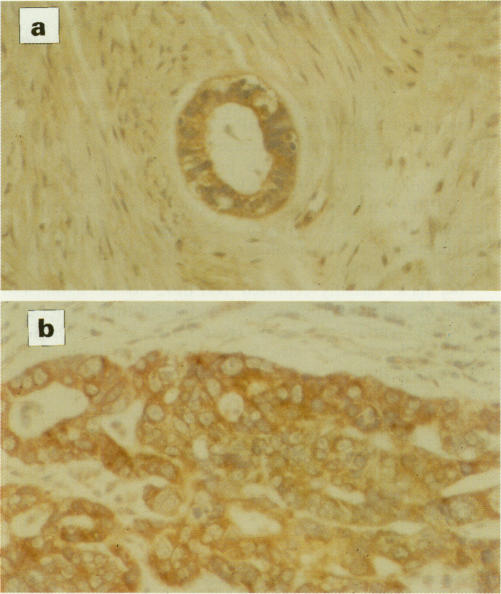
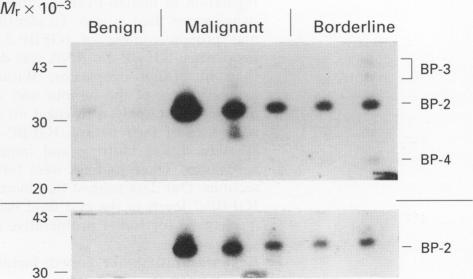
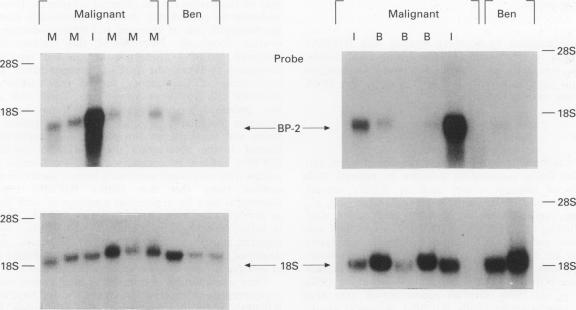
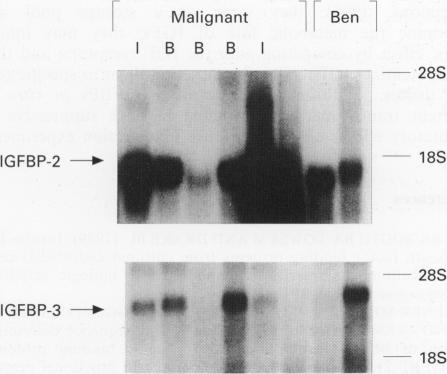
Expression of insulin-like growth factor-I (IGF-I), its receptor and IGF-binding proteins (IGFBPs) by ovarian cancer cells and its mitogenic effect on these cells in vitro, suggest that IGF-I may have a role in regulation of human ovarian cancer. We have recently shown IGFBP-2 to be markedly elevated in malignant ovarian cyst fluid in vivo. To identify the origin of increased IGFBP-2 in these cyst fluids, the gene expression and protein content of IGFBP-2 were investigated in 14 malignant and four benign epithelial ovarian neoplasms. IGFBP-2 mRNA was detected in all ovarian specimens and was 2- to 30-fold higher in malignant than in benign neoplasms. Within the malignant tissues IGFBP-2 mRNA levels correlated with the aggressiveness of the tumour and were higher in invasive tumours than in those with borderline pathology. Southern blot analysis revealed no amplification of IGFBP-2 gene in the DNA samples from ovarian tumours regardless of their nature. IGFBP-2 was the major binding protein in tissue extracts, as measured by both Western ligand blotting and immunoblotting, and was significantly higher in malignant than in benign neoplasms. These findings were further supported by immunohistochemical detection of IGFBP-2 in tumour sections. Our data suggest that increased local production by the tumour in vivo is responsible for the increased IGFBP-2 levels in the cyst fluid bathing the ovarian malignancy. This may represent an autocrine regulatory mechanism for IGF-I proliferative effect of ovarian cancer.
胰岛素样生长因子-I(IGF-I)及其受体和IGF结合蛋白(IGFBPs)在卵巢癌细胞中的表达及其在体外对这些细胞的促有丝分裂作用,提示IGF-I可能在人类卵巢癌的调控中发挥作用。我们最近发现,在体内恶性卵巢囊肿液中IGFBP-2显著升高。为了确定这些囊肿液中IGFBP-2升高的来源,我们对14例恶性和4例良性上皮性卵巢肿瘤中IGFBP-2的基因表达和蛋白含量进行了研究。在所有卵巢标本中均检测到IGFBP-2 mRNA,其在恶性肿瘤中的表达比良性肿瘤高2至30倍。在恶性组织中,IGFBP-2 mRNA水平与肿瘤的侵袭性相关,侵袭性肿瘤中的水平高于交界性病理肿瘤。Southern印迹分析显示,无论卵巢肿瘤的性质如何,其DNA样本中IGFBP-2基因均未扩增。通过Western配体印迹和免疫印迹检测发现,IGFBP-2是组织提取物中的主要结合蛋白,在恶性肿瘤中的含量显著高于良性肿瘤。肿瘤切片中IGFBP-2的免疫组化检测进一步支持了这些发现。我们的数据表明,肿瘤在体内局部产生增加是卵巢恶性肿瘤周围囊肿液中IGFBP-2水平升高的原因。这可能代表了一种IGF-I对卵巢癌增殖作用的自分泌调节机制。