Johnstone I L, Barry J D
Wellcome Unit of Molecular Parasitology, University of Glasgow, Anderson College, UK.
EMBO J. 1996 Jul 15;15(14):3633-9.
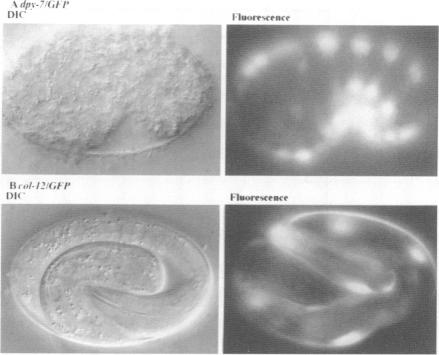
The nematode Caenorhabditis elegans is contained within a multifunctional exoskeleton, the cuticle, that contains a large number of distinct collagens. As the nematode proceeds from the egg through four larval stages to the adult, transition between larval stages is marked by synthesis of a new cuticle and subsequent moulting of the old one. This is a cyclically repeated developmental event, frequently described as the moulting cycle. We have examined the temporal expression of a group of six genes encoding distinct cuticular collagens. As expected, mRNA abundance for each of the six genes tested is found to oscillate, peaking once during each larval stage. Unexpectedly, the periods of abundance for each gene do not coincide, different genes being expressed at different times relative to one another within the moulting cycle. We detect a programme of temporally distinct waves of collagen gene expression, the precise pattern of which is repeated during each of the four larval stages. This multiphasic pattern of oscillating cuticular collagen gene expression indicates an unexpected complexity of temporal control during the nematode moulting cycle and has implications for collagen trimerization and cuticle synthesis.
线虫秀丽隐杆线虫被包裹在一个多功能的外骨骼——角质层内,角质层含有大量不同的胶原蛋白。随着线虫从卵经过四个幼虫阶段发育为成虫,幼虫阶段之间的转变以新角质层的合成以及随后旧角质层的蜕变为标志。这是一个周期性重复的发育事件,通常被称为蜕皮周期。我们研究了一组六个编码不同角质层胶原蛋白的基因的时间表达情况。正如预期的那样,所测试的六个基因中的每一个的mRNA丰度都呈振荡变化,在每个幼虫阶段都有一次峰值。出乎意料的是,每个基因的丰度峰值期并不一致,不同基因在蜕皮周期内相对于彼此在不同时间表达。我们检测到了胶原蛋白基因表达在时间上不同阶段的一个程序,其精确模式在四个幼虫阶段的每一个阶段都会重复。角质层胶原蛋白基因表达这种多相振荡模式表明线虫蜕皮周期中时间控制存在意想不到的复杂性,并且对胶原蛋白三聚化和角质层合成有影响。