Fiebiger E, Maurer D, Holub H, Reininger B, Hartmann G, Woisetschläger M, Kinet J P, Stingl G
Department of Dermatology, Division of Immunology, Allergy and Infectious Diseases, University of Vienna Medical School, Austria.
J Clin Invest. 1995 Dec;96(6):2606-12. doi: 10.1172/JCI118325.
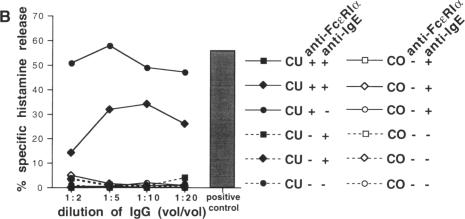
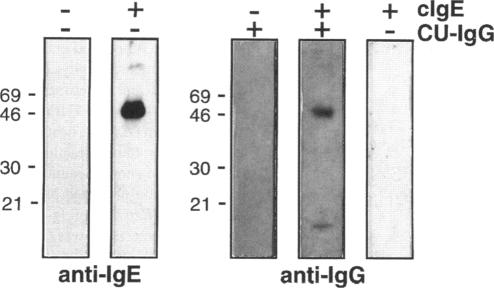
While it is well established that acute allergic urticaria is caused by degranulation of skin mast cells occurring after allergen/IgE-dependent cross-linking of high affinity IgE receptors (FcepsilonRI), the pathophysiologic mechanisms operative in chronic urticaria (CU) are less well understood. Some evidence points to the existence of histamine-releasing activity in the serum of CU patients which possibly acts via triggering of FcepsilonRI. In this study, we aimed to better characterize this anti-FcepsilonRIalpha reactivity of CU patients using affinity-purified, IgE-depleted IgG fractions of such individuals (CU-IgG). Using immobilized, recombinant soluble FcepsilonRIalpha as a a reaction target for Western blot studies, we found that 12/32 (37%) CU-IgG serum samples exhibited IgG autoreactivity against FcepsilonRI- alpha. These findings were confirmed by experiments demonstrating that immunoblot-reactive, but not immunoblot-nonreactive, CU-IgG preparations precipitated the FcepsilonRIalpha from FcepsilonRI- alphagamma-transfected cells. No anti-FcepsilonRIalpha reactivity was observed in IgG fractions from atopic dermatitis (AD) patients (0/15) or healthy control individuals (CO:0/15). As opposed to the selective occurrence of IgG anti-Fc epsilon RI alpha autoantibodies in CU patients, IgG anti-IgE antibodies were detected in all groups investigated (CU: 69%; AD: 73%; CO: 26%). While both types of autoantibodies can exhibit histamine-releasing properties, not all of the autoantibodies proved to be functional in vitro. Our results indicate that the occurrence of IgG anti-FcepsilonRIalpha reactivity defines an autoimmune-mediated subentity of CU and provide a basis for the development of new diagnostic procedures and, perhaps, therapeutic strategies for this disease.
虽然急性过敏性荨麻疹是由变应原/IgE依赖的高亲和力IgE受体(FcepsilonRI)交联后皮肤肥大细胞脱颗粒引起,这一点已得到充分证实,但慢性荨麻疹(CU)的病理生理机制仍不太清楚。一些证据表明,CU患者血清中存在组胺释放活性,可能通过触发FcepsilonRI发挥作用。在本研究中,我们旨在使用此类个体(CU-IgG)的亲和纯化、IgE耗尽的IgG组分,更好地表征CU患者的这种抗FcepsilonRIalpha反应性。使用固定化的重组可溶性FcepsilonRIalpha作为蛋白质印迹研究的反应靶点,我们发现12/32(37%)的CU-IgG血清样本表现出针对FcepsilonRI-alpha的IgG自身反应性。实验证实了这些发现,即免疫印迹反应性而非免疫印迹无反应性的CU-IgG制剂可从FcepsilonRI-alphaγ转染细胞中沉淀出FcepsilonRIalpha。在特应性皮炎(AD)患者(0/15)或健康对照个体(CO:0/15)的IgG组分中未观察到抗FcepsilonRIalpha反应性。与CU患者中IgG抗FcepsilonRIalpha自身抗体的选择性出现相反,在所有研究组中均检测到IgG抗IgE抗体(CU:69%;AD:73%;CO:26%)。虽然这两种自身抗体都可表现出组胺释放特性,但并非所有自身抗体在体外都被证明具有功能。我们的结果表明,IgG抗FcepsilonRIalpha反应性的出现定义了CU的一种自身免疫介导的亚实体,并为开发针对该疾病的新诊断程序以及可能的治疗策略提供了基础。