Racila E, Hsueh R, Marches R, Tucker T F, Krammer P H, Scheuermann R H, Uhr J W
Department of Microbiology and Cancer Immunobiology Center, University of Texas Southwestern Medical Center, Dallas 75235, USA.
Proc Natl Acad Sci U S A. 1996 Mar 5;93(5):2165-8. doi: 10.1073/pnas.93.5.2165.
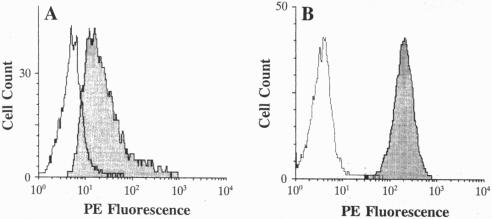
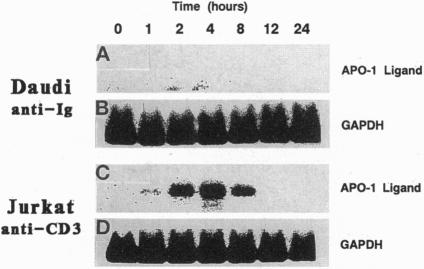
Signal transduction initiated by crosslinking of antigen-specific receptors on T- and B-lymphoma cells induces apoptosis. In T-lymphoma cells, such crosslinking results in upregulation of the APO-1 ligand, which then interacts with induced or constitutively expressed APO-1, thereby triggering apoptosis. Here we show that crosslinking the membrane immunoglobulin on human lymphoma cells (Daudi) (that constitutively express APO-1) does not induce synthesis of APO-1 ligand. Further, a noncytotoxic fragment of anti-APO-1 antibody that blocks T-cell-receptor-mediated apoptosis in T-lymphoma cells does not block anti-mu-induced apoptosis. Hence, in B-lymphoma cells, apoptosis induced by signaling via membrane IgM is not mediated by the APO-1 ligand.
T 细胞和 B 淋巴瘤细胞上抗原特异性受体交联引发的信号转导可诱导细胞凋亡。在 T 淋巴瘤细胞中,这种交联导致 APO-1 配体上调,然后其与诱导表达或组成性表达的 APO-1 相互作用,从而触发细胞凋亡。在此我们表明,交联人淋巴瘤细胞(Daudi)(组成性表达 APO-1)上的膜免疫球蛋白不会诱导 APO-1 配体的合成。此外,抗 APO-1 抗体的一个无细胞毒性片段可阻断 T 淋巴瘤细胞中 T 细胞受体介导的细胞凋亡,但不会阻断抗 μ 诱导的细胞凋亡。因此,在 B 淋巴瘤细胞中,通过膜 IgM 信号传导诱导的细胞凋亡不是由 APO-1 配体介导的。