Morrison E H, Ferguson M W, Bayliss M T, Archer C W
Anatomy Unit, School of Molecular and Medical Biosciences, University of Wales College of Cardiff, UK.
J Anat. 1996 Aug;189 ( Pt 1)(Pt 1):9-22.
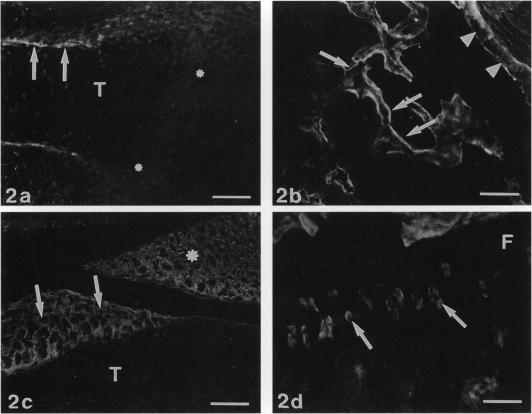
Articular cartilage is both morphologically and biochemically heterogeneous. Its susceptibility to degenerative diseases such as arthritis and its limited repair capacity have made cartilage the focus of intense study; surprisingly, little is known of its development. Using a panel of specific antibodies, we have documented the temporal and spatial patterns of collagen types I, II, III, VI and X in the developing knee cartilage of the marsupial Monodelphis domestica from parturition to adulthood. Type I collagen was initially detected in the presumptive articular cartilage of the epiphyses in addition to the perichondrium. By 14 d postparturition, type I collagen was not detectable in the epiphyseal cartilage apart from insertion sites of ligaments and tendons of the joint. Similarly, type III collagen was detected at insertion sites of the major ligaments and tendons and within the perichondrium/periosteum but was never detected in the cartilage per se. Type II collagen was predictably distributed throughout the cartilage matrix and was also detected in the perichondrium. Type VI collagen was widely distributed throughout the cartilage matrix at parturition, but during development became restricted to a pericellular location particularly towards the presumptive articular cartilage, i.e. the epiphysis. Interestingly, generalised matrix immunopositivity was only retained in the hypertrophic cartilage of the secondary centre of ossification. After the formation of the secondary centre, type VI collagen became localised pericellularly in the deeper regions of the articular cartilage but was absent in the cartilage of the growth plate. Type X collagen showed a novel distribution pattern. In addition to being synthesised by hypertrophic chondrocytes, this collagen type was also expressed transiently by some cells at the presumptive articular surface. Furthermore, these surface chondrocytes also stained histochemically for alkaline phosphatase, suggesting that they were terminally differentiated. The fate of these terminally differentiated cells is unknown.
关节软骨在形态和生化方面均具有异质性。它对诸如关节炎等退行性疾病的易感性及其有限的修复能力,使得软骨成为深入研究的焦点;令人惊讶的是,人们对其发育过程知之甚少。我们使用一组特异性抗体,记录了有袋动物家短尾负鼠从分娩到成年期发育过程中膝关节软骨中I、II、III、VI和X型胶原蛋白的时空分布模式。I型胶原蛋白最初除了在软骨膜中被检测到外,还在骨骺的假定关节软骨中被检测到。产后14天时,除了关节韧带和肌腱的插入部位外,骨骺软骨中未检测到I型胶原蛋白。同样,III型胶原蛋白在主要韧带和肌腱的插入部位以及软骨膜/骨膜内被检测到,但在软骨本身中从未被检测到。II型胶原蛋白如预期那样分布于整个软骨基质中,并且在软骨膜中也被检测到。VI型胶原蛋白在分娩时广泛分布于整个软骨基质中,但在发育过程中局限于细胞周围位置,尤其是朝向假定的关节软骨,即骨骺。有趣的是,普遍的基质免疫阳性仅保留在次生骨化中心的肥大软骨中。次生骨化中心形成后,VI型胶原蛋白在关节软骨较深区域的细胞周围定位,但在生长板软骨中不存在。X型胶原蛋白呈现出一种新的分布模式。除了由肥大软骨细胞合成外,这种胶原蛋白类型还在假定关节表面的一些细胞中短暂表达。此外,这些表面软骨细胞碱性磷酸酶组织化学染色也呈阳性,表明它们已终末分化。这些终末分化细胞的命运尚不清楚。