Holthöfer H, Reivinen J, Solin M L, Haltia A, Miettinen A
Department of Bacteriology and Immunology, Haartman Institute, University of Helsinki, Finland.
Am J Pathol. 1996 Sep;149(3):1009-15.
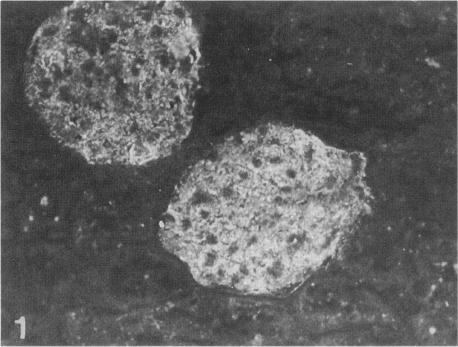
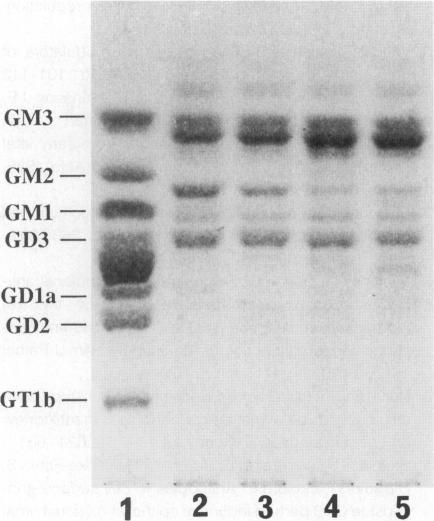
Puromycin aminonucleoside nephrosis (PAN) is a model for human minimal change nephropathy induced in rats by injection of puromycin. In PAN, defective sialylation of a major sialoprotein of podocytes, podocalyxin, has been demonstrated and the consequent decrease of anionic charge suggested as a causative factor for increased glomerular permeability and proteinuria. Whether defective sialylation is a general feature of PAN affecting also glomerular glycosphingolipids is not known. We have shown that rat glomeruli are rich in disialogangliosides GD3 and O-acetyl GD3, the functions of which are not known. Here, we made a sequential analysis of the glomerular gangliosides, especially of GD3 and its O-acetyl derivative in acute PAN using immunohistochemical and biochemical techniques and compared the results with another rat model of glomerular disease, Heymann nephritis. The prominent immunohistochemical finding was the almost total disappearance of glomerular O-acetyl GD3 and a substantial decrease of its precursor GD3 peaking at 10 days after injection of puromycin. Segmental areas lacking these gangliosides remained in glomeruli still at 30 days after injection. The response was dose dependent. Semiquantitative analysis by thin layer chromatograms showed that O-acetyl GD3 was decreased by 41% already at 3 days and by 60% at 10 days after injection of puromycin. Also GD3, the immediate precursor of O-acetyl GD3, was decreased by 20 and 19%, respectively, at 3 and 10 days after injection. At 3 days after injection, overt proteinuria had not started. At these times, no other changes were observed in the glomerular gangliosides. The decrease of glomerular GD3 and O-acetyl GD3 indicates a decrease of GD3 synthase activity and perhaps of O-acetyltransferase activity in PAN nephrosis. As these changes preceded the overt proteinuria, they may have a causal relationship to it. In the glomeruli of Heymann nephritic rats, no similar changes were seen, suggesting that the sialylation defect is not due to proteinuria but is a consequence of targeted puromycin action on cells.
嘌呤霉素氨基核苷肾病(PAN)是通过向大鼠注射嘌呤霉素诱导的人类微小病变肾病模型。在PAN中,已证实足细胞主要唾液酸蛋白podocalyxin的唾液酸化缺陷,并且由此导致的阴离子电荷减少被认为是肾小球通透性增加和蛋白尿的致病因素。唾液酸化缺陷是否是PAN的一个普遍特征,也影响肾小球糖鞘脂,目前尚不清楚。我们已经表明,大鼠肾小球富含双唾液酸神经节苷脂GD3和O-乙酰基GD3,其功能尚不清楚。在这里,我们使用免疫组织化学和生化技术对急性PAN中的肾小球神经节苷脂,特别是GD3及其O-乙酰基衍生物进行了序列分析,并将结果与另一种肾小球疾病大鼠模型海曼肾炎进行了比较。突出的免疫组织化学发现是肾小球O-乙酰基GD3几乎完全消失,其前体GD3在注射嘌呤霉素后10天达到峰值时大幅下降。在注射后30天,肾小球中仍存在缺乏这些神经节苷脂的节段区域。这种反应是剂量依赖性的。薄层色谱图的半定量分析表明,注射嘌呤霉素后3天,O-乙酰基GD3已经下降了41%,10天时下降了60%。同样,O-乙酰基GD3的直接前体GD3在注射后3天和10天分别下降了20%和19%。注射后3天,明显的蛋白尿尚未开始。在这些时候,肾小球神经节苷脂没有观察到其他变化。肾小球GD3和O-乙酰基GD3的减少表明PAN肾病中GD3合酶活性以及可能的O-乙酰转移酶活性降低。由于这些变化先于明显的蛋白尿出现,它们可能与之存在因果关系。在海曼肾炎大鼠的肾小球中,未观察到类似变化,这表明唾液酸化缺陷不是由蛋白尿引起的,而是嘌呤霉素对细胞的靶向作用的结果。