Cross E R, Hyams K C
Infectious Disease Threat Assessment Division, Naval Medical Research Institute, Bethesda, MD 20889-5607, USA.
Environ Health Perspect. 1996 Jul;104(7):724-7. doi: 10.1289/ehp.96104724.
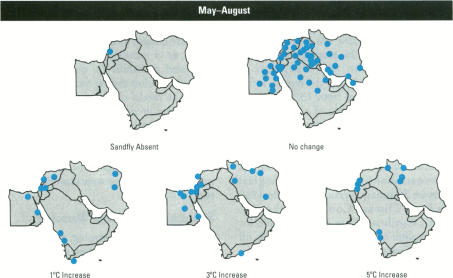
The distribution of Phlebotomus papatasi in Southwest Asia is thought to be highly dependent on temperature and relative humidity. A discriminant analysis model based on weather data and reported vector surveys was developed to predict the seasonal and geographic distribution of P. papatasi in this region. To simulate global warming, temperature values for 115 weather stations were increased by 1 degree C, 3 degrees C, and 5 degrees C, and the outcome variable coded as unknown in the model. Probability of occurrence values were then predicted for each location with a weather station. Stations with positive probability of occurrence values for May, June, July, and August were considered locations where two or more life cycles of P. papatasi could occur and which could support endemic transmission of leishmaniasis and sandfly fever. Among 115 weather stations, 71 (62%) would be considered endemic with current temperature conditions; 14 (12%) additional stations could become endemic with an increase of 1 degree C; 17 (15%) more with a 3 degrees C increase; and 12 (10%) more (all but one station) with a 5 degrees C increase. In addition to increased geographic distribution, seasonality of disease transmission could be extended throughout 12 months of the year in 7 (6%) locations with at least a 3 degrees C rise in temperature and in 29 (25%) locations with a 5 degrees C rise.
在亚洲西南部,巴氏白蛉的分布被认为高度依赖于温度和相对湿度。基于气象数据和已报告的病媒调查,开发了一种判别分析模型,以预测该地区巴氏白蛉的季节和地理分布。为模拟全球变暖,将115个气象站的温度值分别提高了1摄氏度、3摄氏度和5摄氏度,并将模型中的结果变量编码为未知。然后预测每个有气象站的地点的出现概率值。5月、6月、7月和8月出现概率值为正的气象站被视为可能出现两个或更多巴氏白蛉生命周期且可能支持利什曼病和白蛉热地方性传播的地点。在115个气象站中,在当前温度条件下,71个(62%)将被视为地方性区域;温度升高1摄氏度时,另外14个(12%)气象站可能会成为地方性区域;温度升高3摄氏度时,再有17个(15%)气象站会成为地方性区域;温度升高5摄氏度时,又有12个(10%)气象站(除一个气象站外全部)会成为地方性区域。除了地理分布增加外,在温度至少升高3摄氏度的7个(6%)地点和温度升高5摄氏度的29个(25%)地点,疾病传播的季节性可能会延长至全年12个月。