
具有弯曲序列的超螺旋DNA的布朗动力学模拟
Brownian dynamics simulations of supercoiled DNA with bent sequences.
作者信息
Chirico G, Langowski J
机构信息
Dipartimento di Fisica, Università degli Studi di Milano, Italy.
出版信息
Biophys J. 1996 Aug;71(2):955-71. doi: 10.1016/S0006-3495(96)79299-8.
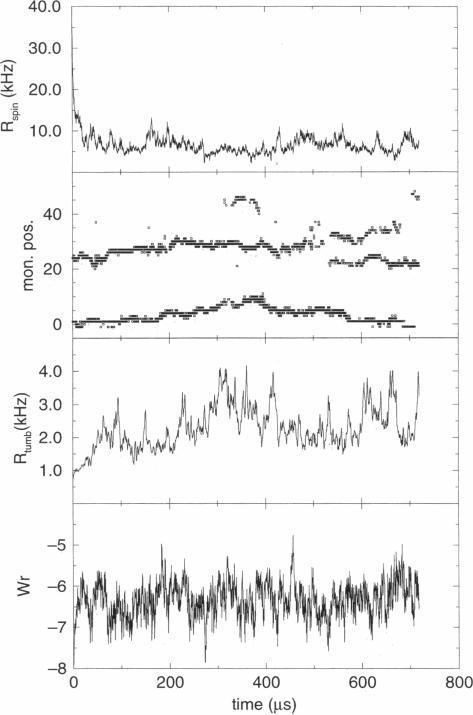
The recently presented Brownian dynamics model for superhelical DNA is extended to include local curvature of the DNA helix axis. Here we analyze the effect of a permanent bend on the structure and dynamics of an 1870-bp superhelix with delta Lk = -10. Furthermore, we define quantitative expressions for computing structural parameters such as loop positions, superhelix diameter, and plectonemic content for trajectories of superhelical DNA, and assess the convergence toward global equilibrium. The structural fluctuations in an interwound superhelix, as reflected in the change in end loop positions, seem to occur by destruction/creation of loops rather than by a sliding motion of the DNA around its contour. Their time scale is on the order of 30-100 microseconds. A permanent bend changes the structure and the internal motions of the DNA drastically. The position of the end loop is fixed at the permanent bend, and the local motions of the chain are enhanced near the loops. A displacement of the bend from the end loop to a position inside the plectonemic part of the superhelix results in the formation of a new loop and the disappearance of the old one; we estimate the time involved in this process to be about 0.5 ms.
最近提出的用于超螺旋DNA的布朗动力学模型得到了扩展,以纳入DNA螺旋轴的局部曲率。在此,我们分析了一个永久性弯曲对一个具有ΔLk = -10的1870碱基对超螺旋的结构和动力学的影响。此外,我们定义了用于计算超螺旋DNA轨迹的结构参数(如环位置、超螺旋直径和螺旋结构含量)的定量表达式,并评估向全局平衡的收敛情况。如末端环位置变化所反映的,缠绕超螺旋中的结构波动似乎是通过环的破坏/形成而非DNA围绕其轮廓的滑动运动发生的。其时间尺度约为30 - 100微秒。一个永久性弯曲会极大地改变DNA的结构和内部运动。末端环的位置固定在永久性弯曲处,并且链的局部运动在环附近增强。弯曲从末端环向超螺旋螺旋结构部分内部的一个位置的位移会导致形成一个新环并使旧环消失;我们估计这个过程所需的时间约为0.5毫秒。

 Zotero 插件