Bak Y T, Kim J H, Lee C H
Division of Gastroenterology, Korea University Guro Hospital, Seoul, Korea.
Korean J Intern Med. 1996 Jun;11(2):151-6. doi: 10.3904/kjim.1996.11.2.151.
To evaluate the effect of cisapride on the total and segmental colonic transit times (CTT's) and on the clinical symptoms in patients with chronic idiopathic constipation, and to elucidate whether the correction of the CTT parallels the symptomatic improvement.
An open prospective trial of cisapride, 10 mg t.i.d. orally for 8 weeks, was done in 25 adult patients (M: F6: 19) with chronic idiopathic constipation of 1 year or longer duration. CTT was measured at baseline and after 8 weeks of cisapride therapy. Frequency, consistency and difficulty in passage of bowel movements were evaluated at baseline and after 2, 4 and 8 weeks of cisapride therapy.
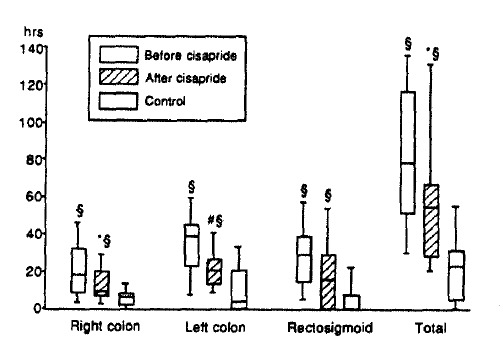
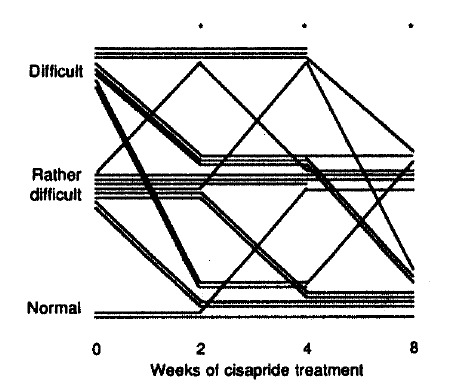
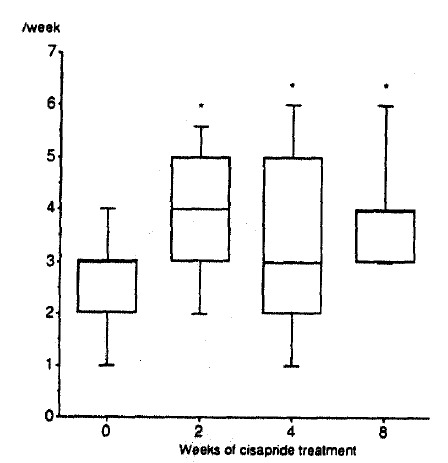
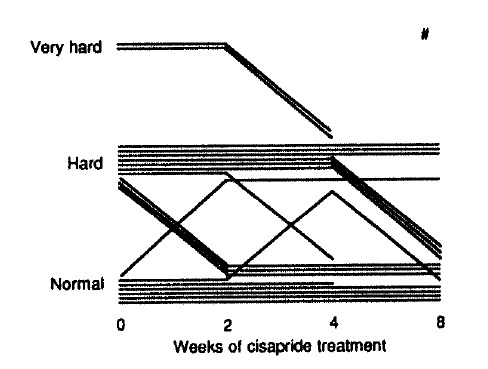
19 cases continued to participate until the end of 4 weeks of therapy and 15 cases completed the entire 8 weeks' trial. No serious side effect was experienced during the study period. Total and right segmental CTT's shortened with 8 weeks of cisapride treatment. Defecation frequency increased and difficulty in stool passage improved with 2 to 8 weeks of treatment. Stool consistency had a tendency toward normal after 8 weeks of treatment (p = 0.06). The global response was excellent in 7 cases (46.7%), good in 5 (33.3%) and poor in 3 (20.0%). If all dropped-out cases were assumed to be poor responders, the good or excellent responders after 8 weeks of cisapride might be 48.0% of all recruited patients. The response to cisapride could not be predicted by the various clinical parameters of the patients.
Cisapride is an effective drug in at least half of the patients with chronic idiopathic constipation.
评估西沙必利对慢性特发性便秘患者的全结肠和节段性结肠转运时间(CTT)以及临床症状的影响,并阐明CTT的改善是否与症状改善平行。
对25例成年慢性特发性便秘患者(男6例,女19例)进行了一项开放性前瞻性试验,口服西沙必利10mg,每日3次,共8周。这些患者便秘病史均在1年及以上。在基线期以及西沙必利治疗8周后测量CTT。在基线期以及西沙必利治疗2周、4周和8周后评估排便频率、大便稠度和排便困难程度。
19例患者持续参与治疗直至4周疗程结束,15例患者完成了整个8周的试验。研究期间未出现严重副作用。西沙必利治疗8周后,全结肠和右半结肠CTT缩短。治疗2至8周后,排便频率增加,排便困难情况改善。治疗8周后,大便稠度有趋于正常的倾向(p = 0.06)。总体反应为优的有7例(46.7%),良的有5例(33.3%),差的有3例(20.0%)。如果将所有退出试验的病例都视为反应不佳者,那么西沙必利治疗8周后反应良好或优秀的患者可能占所有招募患者的48.0%。患者的各种临床参数无法预测对西沙必利的反应。
西沙必利对至少一半的慢性特发性便秘患者是一种有效的药物。