Turbay D, Wechsler S B, Blanchard K M, Izumo S
Department of Internal Medicine, University of Michigan Medical Center, Ann Arbor 48109-0644, USA.
Mol Med. 1996 Jan;2(1):86-96.
Csx/Nkx2.5, a murine nonclustered homeobox gene expressed primarily in the heart, has significant sequence similarity to the Drosophila tinman gene. Tinman is essential for heart and gut formation in Drosophila. Targeted mutation in the mouse gene, Csx/Nkx2.5, arrests cardiac development during early embryonic stages, suggesting an evolutionary conservation in cardiogenesis.
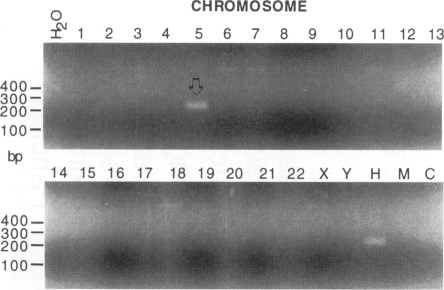
We have isolated and characterized a human homolog, hCsx, from an adult cardiac cDNA library. Northern blotting and ribonuclease protection was used to define the pattern of expression during normal development and in disease states. Chromosomal localization of the gene was determined by somatic cell hybrid analysis and fluorescent in situ hybridization.
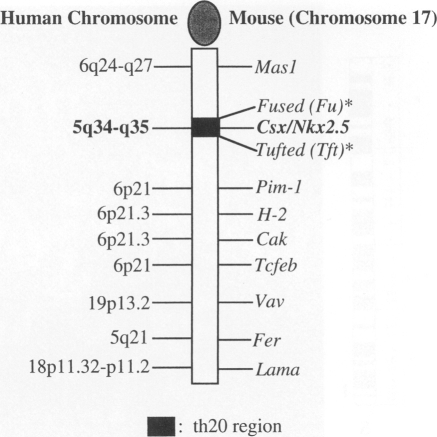
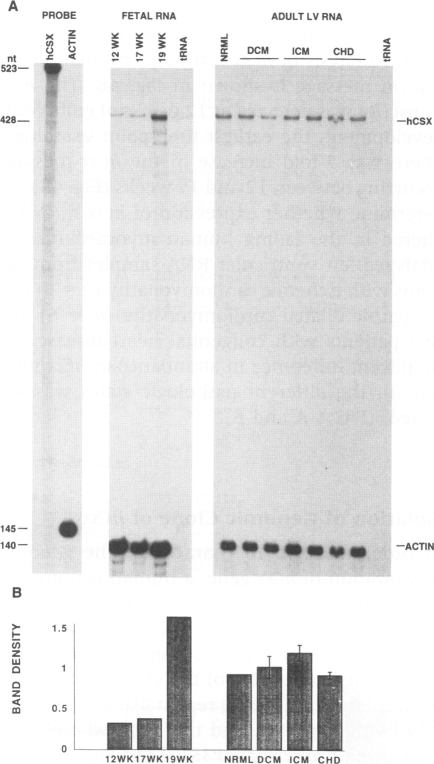
The predicted amino acid sequence of hCsx has 87% overall homology to the murine gene with 100% identity in the homeodomain. The homeodomain sequence of hCsx is 95% identical to its Xenopus homolog, and 65% to tinman. hCsx mRNA was detected exclusively in the heart. hCsx transcript was detected at 12 weeks in human embryonic heart, the earliest time point examined, and was up-regulated 5-fold between 12 and 19 weeks. There was no significant alteration of hCsx message level in the myocardium of 14 patients with end stage heart failure compared to a normal control. The human gene mapped to the distal portion of chromosome 5, the 5q34-q35 region. This defines a new synteny region between human chromosome 5q and the t-locus of mouse chromosome 17, where the mouse Csx gene is located.
hCsx, the human homolog of Drosophila tinman, is expressed in heart in a tissue restricted manner. Distal 5q trisomies produce several phenotypic abnormalities, including a high incidence of congenital heart disease. Isolation of the hCsx gene will allow further studies of mutations in this gene and their potential associations with some forms of congenital heart disease in humans.
Csx/Nkx2.5是一种主要在心脏中表达的小鼠非成簇同源框基因,与果蝇的tinman基因具有显著的序列相似性。Tinman对果蝇心脏和肠道的形成至关重要。小鼠基因Csx/Nkx2.5的靶向突变会在胚胎早期阶段阻止心脏发育,这表明在心脏发生过程中存在进化保守性。
我们从成人心脏cDNA文库中分离并鉴定了一种人类同源物hCsx。采用Northern印迹法和核糖核酸酶保护法来确定其在正常发育和疾病状态下的表达模式。通过体细胞杂交分析和荧光原位杂交确定该基因的染色体定位。
hCsx的预测氨基酸序列与小鼠基因的总体同源性为87%,在同源结构域中具有100%的同一性。hCsx的同源结构域序列与其非洲爪蟾同源物的同一性为95%,与tinman的同一性为65%。hCsx mRNA仅在心脏中检测到。在人类胚胎心脏12周时检测到hCsx转录本,这是检测的最早时间点,并且在12至19周之间上调了5倍。与正常对照相比,14例终末期心力衰竭患者心肌中的hCsx信息水平没有显著改变。人类基因定位于5号染色体的远端,即5q34 - q35区域。这定义了人类5号染色体q臂与小鼠17号染色体t位点之间的一个新的同线性区域,小鼠的Csx基因位于该区域。
hCsx是果蝇tinman的人类同源物,以组织限制性方式在心脏中表达。5号染色体q臂远端三体产生多种表型异常,包括先天性心脏病的高发病率。hCsx基因的分离将有助于进一步研究该基因的突变及其与人类某些形式先天性心脏病的潜在关联。