Peterson B S, Bronen R A, Duncan C C
Yale Child Study Center, New Haven, CT, USA.
J Neurol Neurosurg Psychiatry. 1996 Nov;61(5):497-505. doi: 10.1136/jnnp.61.5.497.
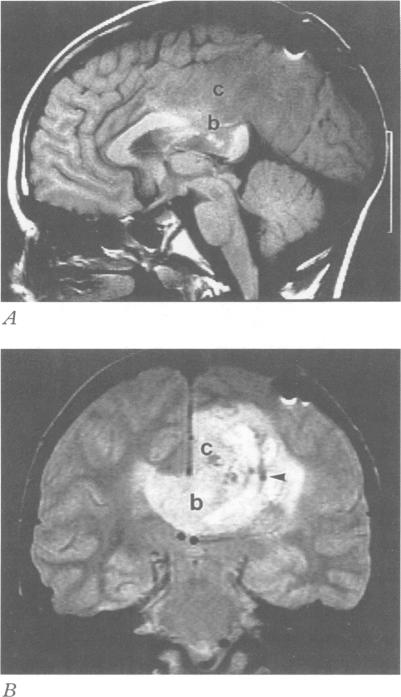
To correlate behaviour manifestations with tumour location in three children who had Gilles de la Tourette's syndrome (GTS), obsessive-compulsive disorder (OCD), and primary cerebral malignancies.
Cases were ascertained from a chart review in a GTS and OCD specialty clinic. For each case the temporal progression of change in neuropsychiatric symptoms was qualitatively correlated with radiographic documentation of tumour progression.
The change in symptom severities during tumour progression and treatment, together with prior neurobiological studies of GTS, suggest that the ventral striatum, corpus callosum, thalamus, and midbrain are potentially important neural substrates in the formation or modulation of tic symptoms. The limbic system, including the hypothalamus and cingulate, and the caudate nucleus, seem to be important in the neurobiology of OCD. All structures are neuroanatomically and functionally related to the corticostriato-thalamocortical circuitry that is thought to subserve symptom generation in both GTS and OCD.
Although the malignancies were not likely to have caused the tic and OCD symptoms in these children, the locations of these intracranial lesions provide important clues in identifying brain regions that may contribute to the determination of tic and OCD severities.
在三名患有抽动秽语综合征(GTS)、强迫症(OCD)和原发性脑恶性肿瘤的儿童中,将行为表现与肿瘤位置相关联。
通过在一家GTS和OCD专科诊所查阅病历确定病例。对于每个病例,神经精神症状变化的时间进程与肿瘤进展的影像学记录进行定性关联。
肿瘤进展和治疗期间症状严重程度的变化,以及先前对GTS的神经生物学研究表明,腹侧纹状体、胼胝体、丘脑和中脑可能是抽动症状形成或调节的重要神经基质。包括下丘脑和扣带回在内的边缘系统以及尾状核,在OCD的神经生物学中似乎很重要。所有结构在神经解剖学和功能上都与皮质纹状体 - 丘脑 - 皮质回路相关,该回路被认为在GTS和OCD的症状产生中起作用。
虽然这些恶性肿瘤不太可能导致这些儿童的抽动和OCD症状,但这些颅内病变的位置为识别可能有助于确定抽动和OCD严重程度的脑区提供了重要线索。