Oudejans J J, Dukers D F, Jiwa N M, van den Brule A J, Grässer F A, de Bruin P C, Horstman A, Vos W, van Gorp J, Middeldorp J M, Meijer C J
Department of Pathology, Free University Hospital, Amsterdam, The Netherlands.
J Clin Pathol. 1996 Nov;49(11):897-902. doi: 10.1136/jcp.49.11.897.
To determine levels of expression of Epstein-Barr virus (EBV) nuclear antigen 1 (EBNA1) in benign and malignant tissues harbouring EBV in relation to EBNA1 promoter usage.
Expression of EBNA1 was investigated by means of immunohistochemistry using a mixture of two EBNA1 specific monoclonal antibodies, 1H4-1 and 2B4-1. The presence of EBV was detected by EBER1/2 RNA in situ hybridisation. Detection of promoter specific EBNA1 transcripts was by RT-PCR analysis.
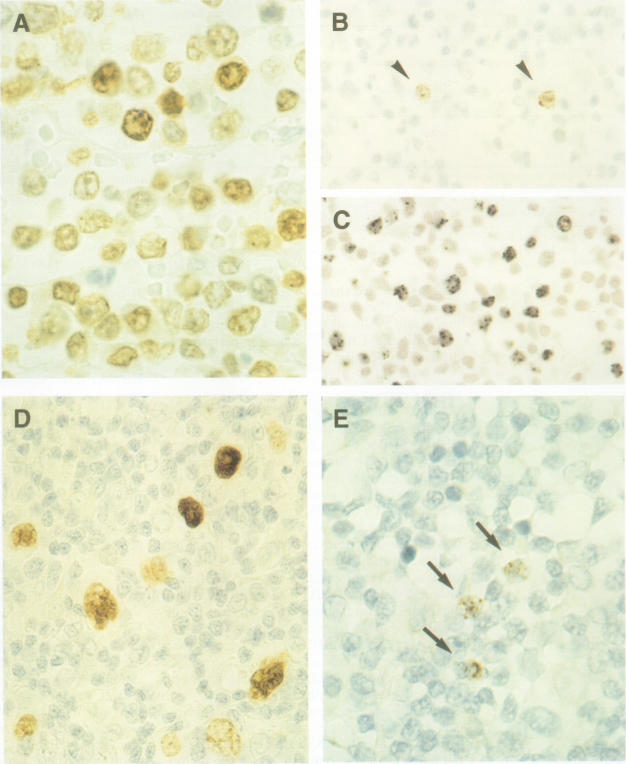
EBNA1 positive cells were detected in all 20 EBV associated B cell lymphomas, 18 of which had arisen in immunocompromised patients; in eight of nine EBV associated T cell lymphomas; in 11 of 27 EBV positive cases of Hodgkin's disease; and in reactive lymphoid tissue harbouring EBV, including four cases of infectious mononucleosis. A diffuse EBNA1 staining pattern was observed in most of the EBV associated B cell lymphomas and was comparable with the EBER1/2 staining pattern. In the T cell lymphomas the number of EBNA1 positive cells was usually considerably less than the number of EBER1/2 positive ones. RT-PCR analysis revealed that in tumours with restricted EBNA1 expression-that is, T cell lymphomas and Hodgkin's disease lesions, EBNA1 transcripts were usually generated only by the F/Q promoter, whereas in B cell lymphomas EBNA1 transcripts were usually generated by both the C/W and F/Q promoters.
EBNA1 is expressed in all types of tissue harbouring EBV, but the level of expression varies greatly. This may be the result of differential promoter usage.
确定携带爱泼斯坦-巴尔病毒(EBV)的良性和恶性组织中EBV核抗原1(EBNA1)的表达水平,并探讨其与EBNA1启动子使用情况的关系。
使用两种EBNA1特异性单克隆抗体1H4-1和2B4-1的混合物,通过免疫组织化学法研究EBNA1的表达。采用EBER1/2 RNA原位杂交检测EBV的存在。通过逆转录聚合酶链反应(RT-PCR)分析检测启动子特异性EBNA1转录本。
在所有20例EBV相关的B细胞淋巴瘤中均检测到EBNA1阳性细胞,其中18例发生于免疫功能低下的患者;在9例EBV相关的T细胞淋巴瘤中的8例;在27例EBV阳性的霍奇金病病例中的11例;以及在携带EBV的反应性淋巴组织中,包括4例传染性单核细胞增多症。在大多数EBV相关的B细胞淋巴瘤中观察到弥漫性EBNA1染色模式,且与EBER1/2染色模式相似。在T细胞淋巴瘤中,EBNA1阳性细胞的数量通常远少于EBER1/2阳性细胞的数量。RT-PCR分析显示,在EBNA1表达受限的肿瘤(即T细胞淋巴瘤和霍奇金病病变)中,EBNA1转录本通常仅由F/Q启动子产生,而在B细胞淋巴瘤中,EBNA1转录本通常由C/W和F/Q启动子共同产生。
EBNA1在所有携带EBV的组织类型中均有表达,但表达水平差异很大。这可能是启动子使用差异的结果。