Kukuljan M, Vergara L, Stojilkovic S S
Department of Physiology and Biophysics, Faculty of Medicine, University of Chile.
Biophys J. 1997 Feb;72(2 Pt 1):698-707. doi: 10.1016/s0006-3495(97)78706-x.
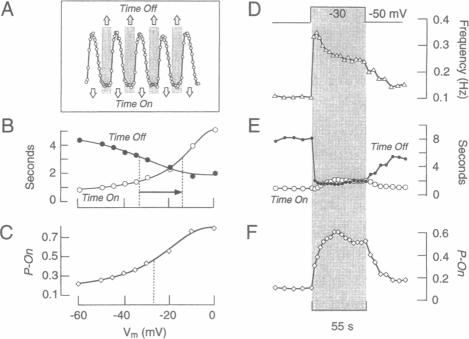
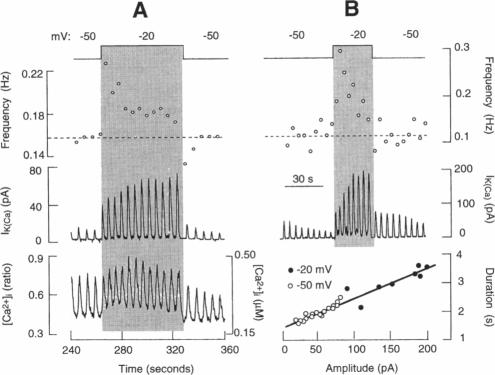
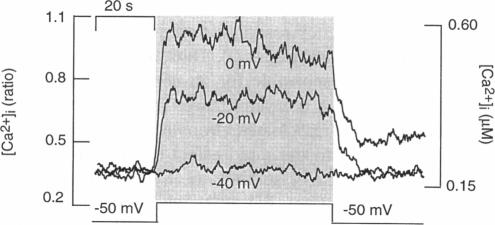
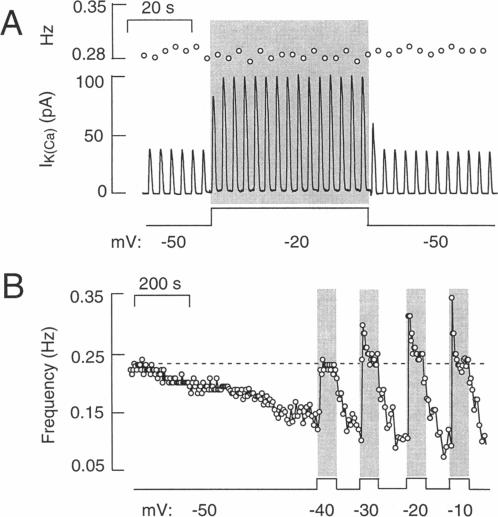
Inositol 1,4,5-trisphosphate (InsP3) binds to its receptor channels and causes liberation of Ca2+ from intracellular stores, frequently in an oscillatory manner. In addition to InsP3, the activation and inactivation properties of these intracellular channels are controlled by Ca2+. We studied the influence of Ca2+ entry on the kinetics of InsP3-triggered oscillations in cytosolic calcium ([Ca2+]i) in gonadotrophs stimulated with gonadotropin-releasing hormone, an agonist that activates InsP3 production. The natural expression of voltage-gated Ca2+ channels (VGCC) in these cells was employed to manipulate Ca2+ entry by voltage clamping the cells at different membrane potentials (Vm). Under physiological conditions, the frequency of the GnRH-induced oscillations increased with time, while the amplitude decreased, until both reached stable values. However, in cells with Vm held at -50 mV or lower, both parameters progressively decreased until the signal was abolished. These effects were reverted by a depolarization of the membrane positive to -45 mV in both agonist- and InsP3-stimulated gonadotrophs. Depolarization also led to an increase in the fraction of time during which the [Ca2+]i remained elevated; this effect originated from both an increase in the mean duration of spikes and a decrease in the interval between spikes. The frequency and amplitude of spiking depended on the activity of VGCC, but displayed different temporal courses and voltage relationships. The depolarization-driven recovery of the frequency was instantaneous, whereas the recovery of the amplitude of spiking was more gradual. The midpoints of the Vm sensitivity curve for amplitude and duration of spiking (-15 mV) were close to the value observed for L-type Ca2+ current and for depolarization-induced increase in [Ca2+]i, whereas this parameter was much lower (-35 mV) for interval between spikes and frequency of oscillations. These observations are compatible with at least two distinct effects of Ca2+ entry on the sustained [Ca2+]i oscillations. Calcium influx facilitates its liberation from intracellular stores by a direct and instantaneous action on the release mechanism. It also magnifies the Ca2+ signal and decreases the frequency because of its gradual effect on the reloading of intracellular stores.
肌醇1,4,5 -三磷酸(InsP3)与其受体通道结合,导致Ca2+从细胞内储存库释放,通常呈振荡方式。除了InsP3,这些细胞内通道的激活和失活特性受Ca2+控制。我们研究了Ca2+内流对促性腺激素释放激素刺激的促性腺细胞中InsP3触发的胞质钙([Ca2+]i)振荡动力学的影响,促性腺激素释放激素是一种激活InsP3产生的激动剂。利用这些细胞中电压门控Ca2+通道(VGCC)的天然表达,通过将细胞钳制在不同膜电位(Vm)来操纵Ca2+内流。在生理条件下,GnRH诱导的振荡频率随时间增加,而振幅减小,直到两者达到稳定值。然而,在Vm保持在-50 mV或更低的细胞中,这两个参数逐渐降低,直到信号消失。在激动剂和InsP3刺激的促性腺细胞中,膜去极化至-45 mV以上可逆转这些效应。去极化还导致[Ca2+]i保持升高的时间比例增加;这种效应源于尖峰平均持续时间的增加和尖峰之间间隔的减小。尖峰的频率和振幅取决于VGCC的活性,但表现出不同的时间进程和电压关系。去极化驱动的频率恢复是瞬时的,而尖峰振幅的恢复则较为缓慢。尖峰振幅和持续时间的Vm敏感性曲线中点(-15 mV)接近L型Ca2+电流和去极化诱导的[Ca2+]i增加所观察到的值,而尖峰之间的间隔和振荡频率的该参数则低得多(-35 mV)。这些观察结果与Ca2+内流对持续的[Ca2+]i振荡至少有两种不同的作用相符。钙内流通过对释放机制的直接和瞬时作用促进其从细胞内储存库释放。它还放大了Ca2+信号并降低了频率,因为它对细胞内储存库的重新装载有逐渐的影响。