Chernova M N, Jiang L, Crest M, Hand M, Vandorpe D H, Strange K, Alper S L
Molecular Medicine Unit, Beth Israel Hospital, Boston, Massachusetts 02215, USA.
J Gen Physiol. 1997 Mar;109(3):345-60. doi: 10.1085/jgp.109.3.345.
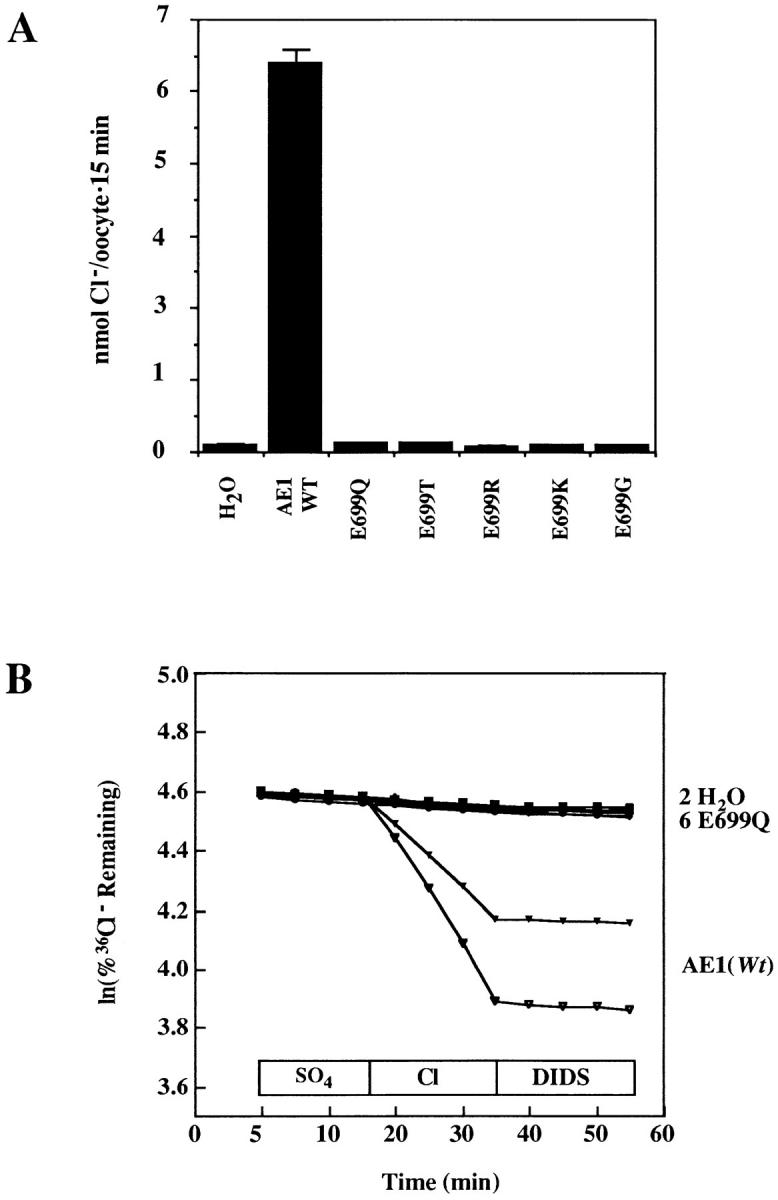
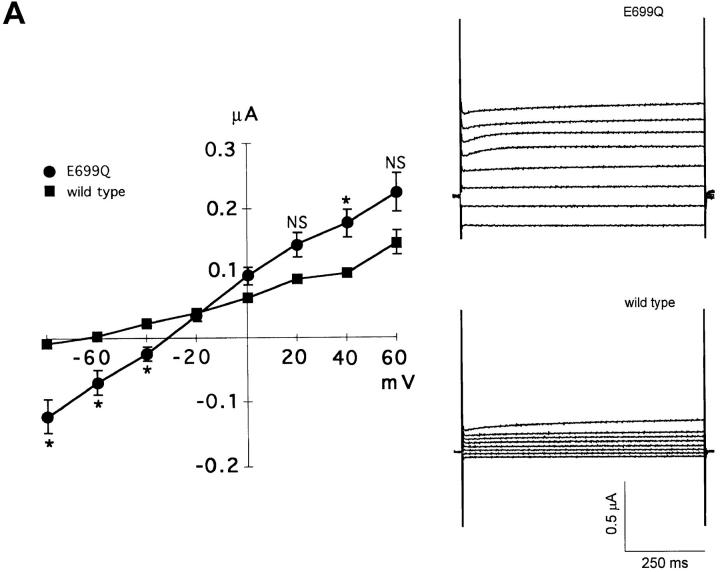
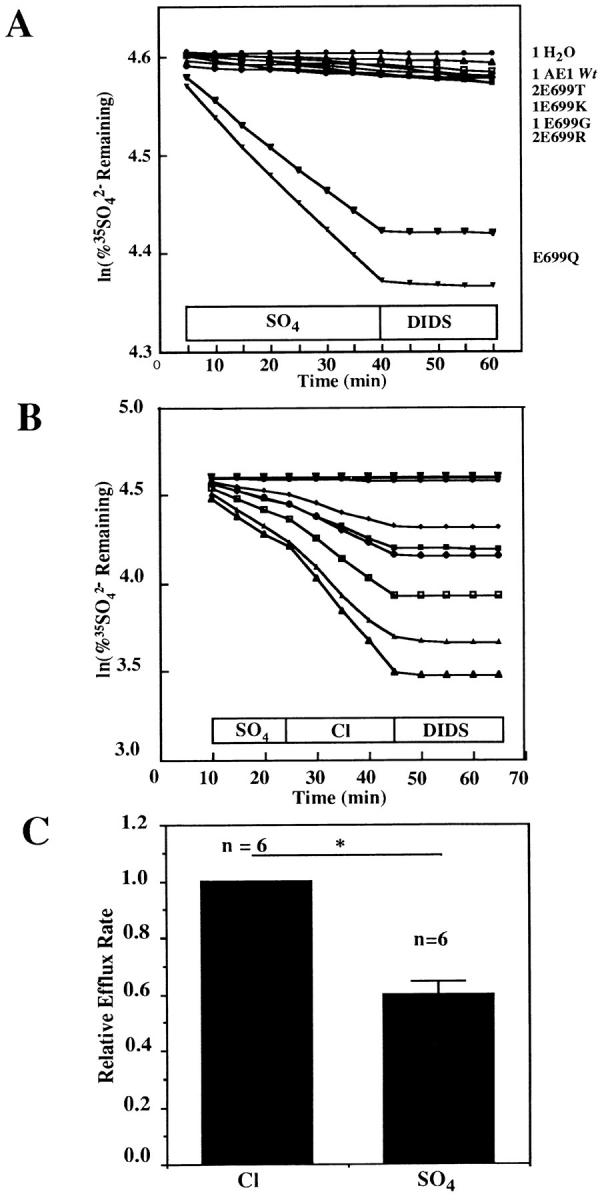
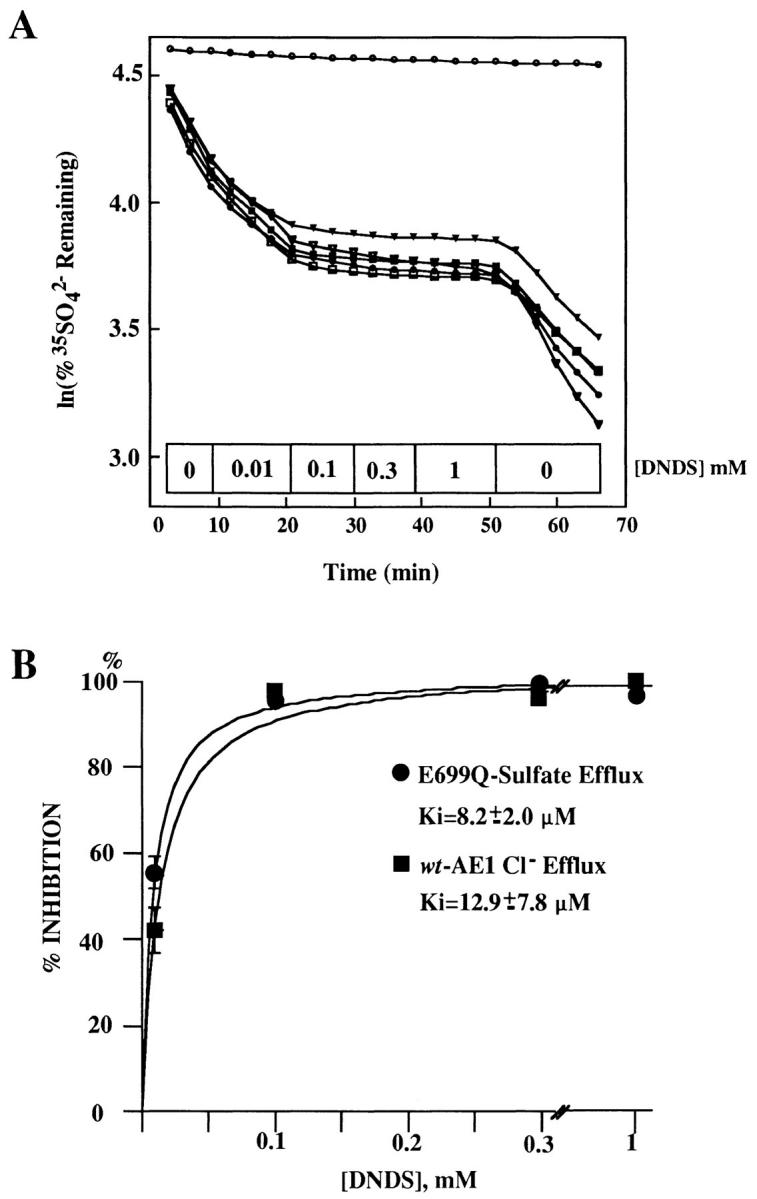
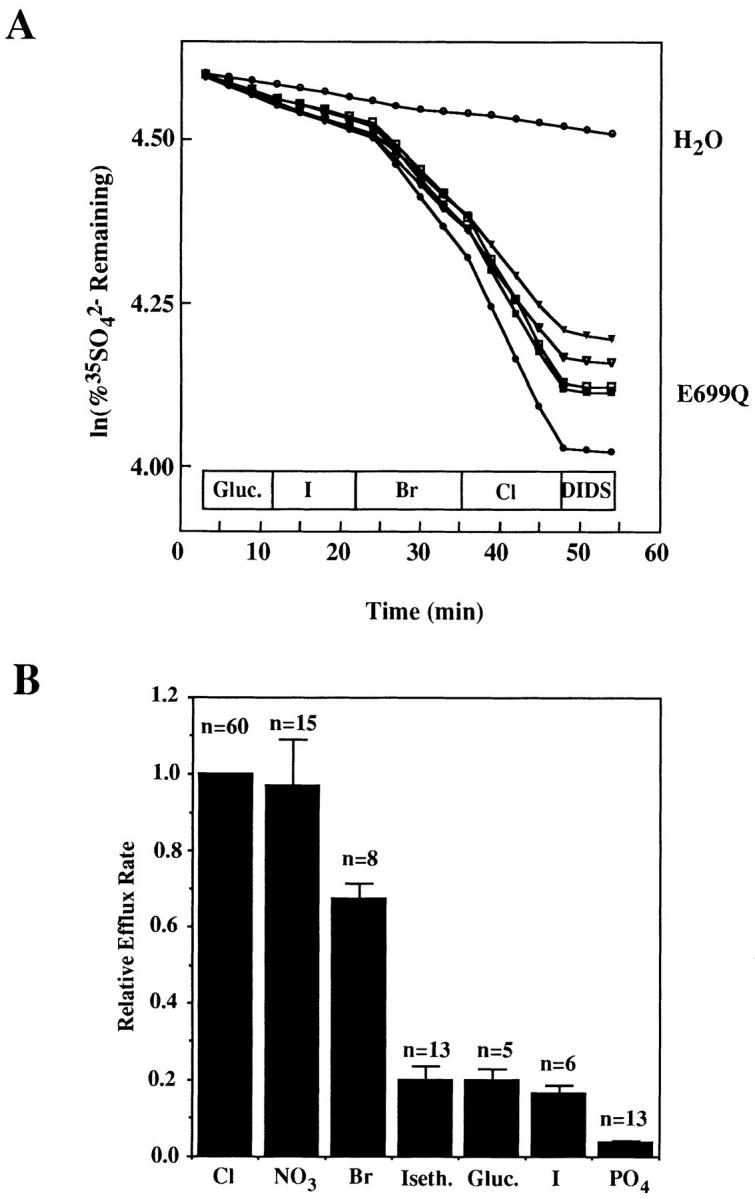
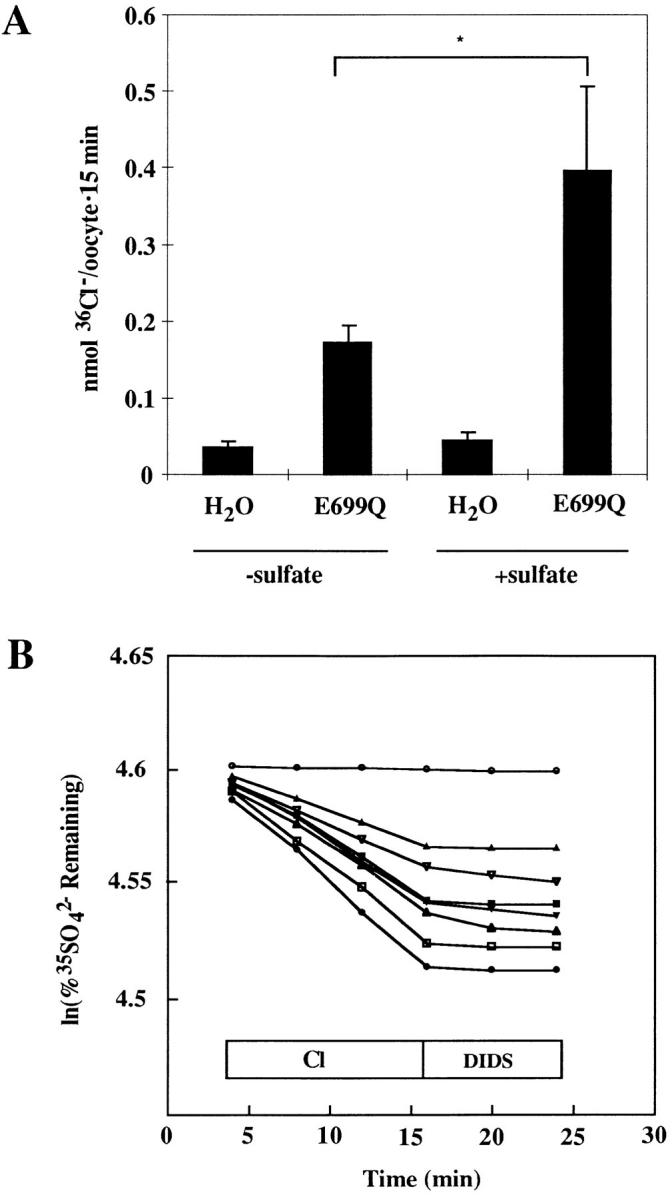
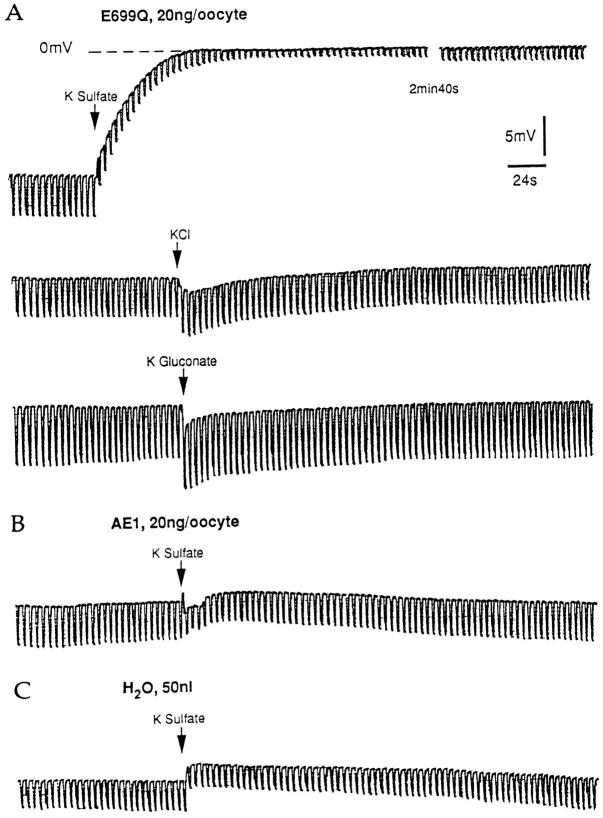
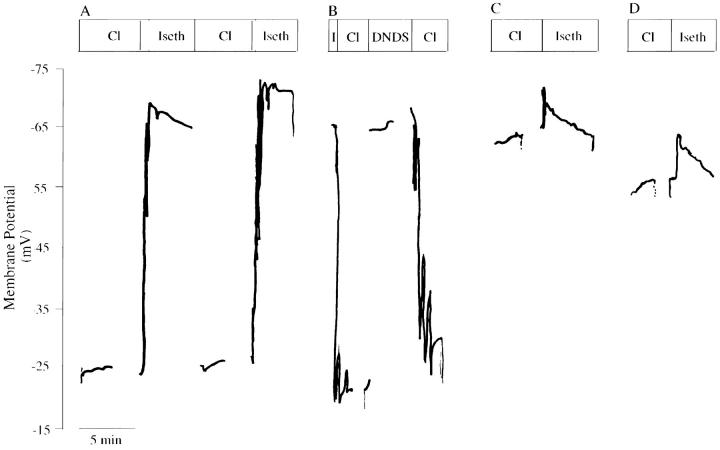
Functional evaluation of chemically modified human erythrocytes has led to the proposal that amino acid residue E681 of the band 3 anion exchanger AE1 lies on the anion translocation pathway and is a proton carrier required for H+/SO4(2-) cotransport. We have tested in Xenopus oocytes the functional consequences of mutations in the corresponding residue E699 of mouse AE1. Most mutations tested abolished AE1-mediated Cl- influx and efflux. Only the E699Q mutation increased stilbene disulfonate-sensitive efflux and influx of SO4(2-). E699Q-mediated Cl- influx was activated by elevation of intracellular SO4(2-), but E699Q-mediated Cl- efflux was undetectable. The DNDS (4,4'-dinitrostilbene-2,2'-disulfonic acid) sensitivity of E699Q-mediated SO4(2-) efflux was indistinguishable from that of wt AE1-mediated Cl- efflux. The extracellular anion selectivity of E699Q-mediated SO4(2-) efflux was similar to that of wt AE1-mediated Cl- efflux. The stoichiometry of E699Q-mediated exchange of extracellular Cl- with intracellular SO4(2-) was 1:1. Whereas SO4(2-) injection into oocytes expressing wt AE1 produced little change in membrane potential or resistance, injection of SO4(2-), but not of Cl- or gluconate, into oocytes expression E699Q depolarized the membrane by 17 mV and decreased membrane resistance by 66%. Replacement of bath Cl- with isethionate caused a 28-mV hyperpolarization in SO4(2-)-loaded oocytes expressing E699Q, but had no effect on oocytes expressing wt AE1. Extracellular Cl(-)-dependent depolarization of SO4(2-)-preloaded oocytes was blocked by DNDS. AE1 E699Q-mediated inward current measured in the presence of extracellular Cl- was of magnitude sufficient to account for measured 35SO4(2-) efflux. Thus, AE1 E699Q-mediated SO4(2-)/Cl- exchange operated largely, if not exclusively, as an electrogenic, asymmetric, 1:1 anion exchange. The data confirm the proposal that E699 resides on or contributes to the integrity of the anion translocation pathway of AE1. A single amino acid change in the sequence of AE1 converted electroneutral to electrogenic anion exchange without alteration of SO4(2-)/Cl- exchange stoichiometry.
对化学修饰的人红细胞进行功能评估后,有人提出带3阴离子交换蛋白AE1的氨基酸残基E681位于阴离子转运途径上,是H⁺/SO₄²⁻共转运所需的质子载体。我们在非洲爪蟾卵母细胞中测试了小鼠AE1相应残基E699发生突变的功能后果。所测试的大多数突变都消除了AE1介导的Cl⁻内流和外流。只有E699Q突变增加了二苯乙烯二磺酸盐敏感的SO₄²⁻外流和内流。E699Q介导的Cl⁻内流通过细胞内SO₄²⁻浓度升高而被激活,但E699Q介导的Cl⁻外流无法检测到。E699Q介导的SO₄²⁻外流对4,4'-二硝基二苯乙烯-2,2'-二磺酸(DNDS)的敏感性与野生型AE1介导的Cl⁻外流的敏感性没有区别。E699Q介导的SO₄²⁻外流的细胞外阴离子选择性与野生型AE1介导的Cl⁻外流的选择性相似。E699Q介导的细胞外Cl⁻与细胞内SO₄²⁻交换的化学计量比为1:1。向表达野生型AE1的卵母细胞注射SO₄²⁻对膜电位或电阻几乎没有影响,而向表达E699Q的卵母细胞注射SO₄²⁻(而非Cl⁻或葡萄糖酸盐)会使膜去极化17 mV,并使膜电阻降低66%。用羟乙基磺酸替代浴液中的Cl⁻会使表达E699Q的SO₄²⁻负载卵母细胞超极化28 mV,但对表达野生型AE1的卵母细胞没有影响。细胞外Cl⁻依赖性的SO₄²⁻预负载卵母细胞去极化被DNDS阻断。在细胞外存在Cl⁻的情况下测量的AE1 E699Q介导的内向电流大小足以解释所测量的³⁵SO₄²⁻外流。因此,AE1 E699Q介导的SO₄²⁻/Cl⁻交换在很大程度上(如果不是完全)作为一种电生的、不对称的1:1阴离子交换起作用。这些数据证实了E699位于AE1的阴离子转运途径上或对其完整性有贡献的提议。AE1序列中的单个氨基酸变化将电中性阴离子交换转变为电生阴离子交换,而不改变SO₄²⁻/Cl⁻交换的化学计量比。