Veneziale C M
Biochem J. 1977 Aug 15;166(2):155-66. doi: 10.1042/bj1660155.
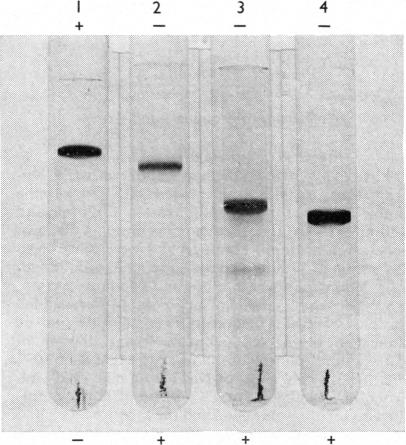
Four intrinsic soluble proteins are synthesized and secreted by sexually mature guinea-pig seminal-vesicle mucosa, which comprises a monolayer of a homogeneous columnar epithelial cell. All four proteins can be extracted readily in 154mm-NaCl from the organ's luminal constituents in which they are present in high concentration. They are referred to as proteins 1, 2, 3 and 4 in order of their elution during DEAE-cellulose column chromatography. Specific primary antibodies were harvested from goats that had been inoculated with the purified vesicular proteins; secondary antibodies were obtained from a donkey inoculated with goat gamma-globulins. Double-antibody-immunoprecipitation techniques were developed to precipitate the vesicular proteins. Thus proteins newly synthesized from (14)C-labelled amino acids could be precipitated and the incorporated radioactivity assessed. Isolated seminal-vesicle mucosa, incubated in only a buffered salt solution containing glucose, readily synthesized the soluble secreted proteins from added [(14)C]lysine plus [(14)C]glycine, [(14)C]histidine plus [(14)C]glutamate, [(14)C]glutamine alone and [(14)C]arginine alone. The rates of incorporation (d.p.m./mg of total soluble protein) of labelled lysine and glycine and of labelled arginine were linear with time over 180min. With the other labelled precursors, rates diminished between 60 and 180min. Labelled protein could be detected after only 10-15min of incubation. Only 4-9% of the newly synthesized protein remained associated with the mucosa; the remainder was found in the cell-free incubation medium. The isolated seminal-vesicle mucosal preparation will provide a unique opportunity to study the synthesis and secretion of abundant cell-specific proteins by this androgen-dependent tissue.
性成熟的豚鼠精囊黏膜可合成并分泌四种内在可溶性蛋白,该黏膜由单层均匀的柱状上皮细胞组成。所有这四种蛋白都能很容易地从器官腔内容物中用154mM氯化钠提取出来,它们在其中以高浓度存在。按照它们在DEAE-纤维素柱层析中的洗脱顺序,它们被称为蛋白1、2、3和4。从接种了纯化的精囊蛋白的山羊中收获特异性一抗;二抗则从接种了山羊γ-球蛋白的驴中获得。开发了双抗体免疫沉淀技术来沉淀精囊蛋白。因此,由[¹⁴C]标记氨基酸新合成的蛋白能够被沉淀下来,并对掺入的放射性进行评估。分离的精囊黏膜在仅含有葡萄糖的缓冲盐溶液中孵育时,能很容易地从添加的[¹⁴C]赖氨酸加[¹⁴C]甘氨酸、[¹⁴C]组氨酸加[¹⁴C]谷氨酸、单独的[¹⁴C]谷氨酰胺以及单独的[¹⁴C]精氨酸中合成可溶性分泌蛋白。标记的赖氨酸和甘氨酸以及标记的精氨酸的掺入率(每分钟衰变数/每毫克总可溶性蛋白)在180分钟内与时间呈线性关系。对于其他标记前体,掺入率在60到180分钟之间下降。孵育仅10 - 15分钟后就能检测到标记蛋白。新合成的蛋白中只有4 - 9%仍与黏膜结合;其余的则存在于无细胞孵育培养基中。分离的精囊黏膜制剂将为研究这种雄激素依赖性组织中丰富的细胞特异性蛋白的合成和分泌提供一个独特的机会。