Zimmerman P A, Buckler-White A, Alkhatib G, Spalding T, Kubofcik J, Combadiere C, Weissman D, Cohen O, Rubbert A, Lam G, Vaccarezza M, Kennedy P E, Kumaraswami V, Giorgi J V, Detels R, Hunter J, Chopek M, Berger E A, Fauci A S, Nutman T B, Murphy P M
Laboratory of Parasitic Diseases, National Institute of Allergy and Infectious Diseases, National Institutes of Health, Bethesda, Maryland 20892-0425, USA.
Mol Med. 1997 Jan;3(1):23-36.
CC chemokine receptor 5 (CCR5) is a cell entry cofactor for macrophage-tropic isolates of human immunodeficiency virus-1 (HIV-1). Recently, an inactive CCR5 allele (designated here as CCR5-2) was identified that confers resistance to HIV-1 infection in homozygotes and slows the rate of progression to AIDS in heterozygotes. The reports conflict on the effect of heterozygous CCR5-2 on HIV-1 susceptibility, and race and risk levels have not yet been fully analyzed. Here we report our independent identification of CCR5-2 and test its effects on HIV-1 pathogenesis in individuals with contrasting clinical outcomes, defined race, and quantified risk.
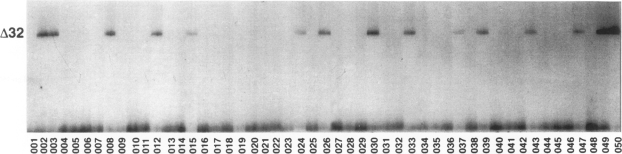
Mutant CCR5 alleles were sought by directed heteroduplex analysis of genomic DNA from random blood donors. Genotypic frequencies were then determined in (1) random blood donors from North America, Asia, and Africa; (2) HIV-1+ individuals; and (3) highly exposed-seronegative homosexuals with quantified risk.
CCR5-2 was the only mutant allele found. It was common in Caucasians, less common in other North American racial groups, and not detected in West Africans or Tamil Indians. Homozygous CCR5-2 frequencies differed reciprocally in highly exposed-seronegative (4.5%, n = 111) and HIV-1-seropositive (0%, n = 614) Caucasians relative to Caucasian random blood donors (0.8%, n = 387). This difference was highly significant (p < 0.0001). By contrast, heterozygous CCR5-2 frequencies did not differ significantly in the same three groups (21.6, 22.6, and 21.7%, respectively). A 55% increase in the frequency of heterozygous CCR5-2 was observed in both of two cohorts of Caucasian homosexual male, long-term nonprogressors compared with other HIV-1+ Caucasian homosexuals (p = 0.006) and compared with Caucasian random blood donors. Moreover, Kaplan-Meier estimates indicated that CCR5-2 heterozygous seroconvertors had a 52.6% lower risk of developing AIDS than homozygous wild-type seroconvertors.
The data suggest that homozygous CCR5-2 is an HIV-1 resistance factor in Caucasians with complete penetrance, and that heterozygous CCR5-2 slows the rate of disease progression in infected Caucasian homosexuals. Since the majority (approximately 96%) of highly exposed-seronegative individuals tested are not homozygous for CCR5-2, other resistance factors must exist. Since CCR5-2 homozygotes have no obvious clinical problems, CCR5 may be a good target for the development of novel antiretroviral therapy.
CC趋化因子受体5(CCR5)是人类免疫缺陷病毒1型(HIV-1)嗜巨噬细胞株进入细胞的辅助因子。最近,发现了一种无活性的CCR5等位基因(此处命名为CCR5-2),该等位基因使纯合子对HIV-1感染具有抗性,并减缓杂合子发展为艾滋病的速度。关于杂合性CCR5-2对HIV-1易感性的影响,各报告之间存在冲突,且种族和风险水平尚未得到充分分析。在此,我们报告我们对CCR5-2的独立鉴定,并在具有不同临床结局、明确种族和量化风险的个体中测试其对HIV-1发病机制的影响。
通过对随机献血者的基因组DNA进行定向异源双链分析来寻找突变的CCR5等位基因。然后在以下人群中确定基因型频率:(1)来自北美、亚洲和非洲的随机献血者;(2)HIV-1阳性个体;(3)风险量化的高暴露血清阴性同性恋者。
CCR5-2是唯一发现的突变等位基因。它在白种人中常见,在其他北美种族群体中较少见,在西非人和泰米尔印度人中未检测到。相对于白种人随机献血者(0.8%,n = 387),高暴露血清阴性(4.5%,n = 111)和HIV-1血清阳性(0%,n = 614)的白种人中,纯合子CCR5-2频率呈相反差异。这种差异具有高度显著性(p < 0.0001)。相比之下,杂合子CCR5-2频率在上述三组中无显著差异(分别为21.6%、22.6%和21.7%)。与其他HIV-1阳性白种人同性恋者相比(p = 0.006),以及与白种人随机献血者相比,在两组白种人同性恋男性长期不进展者队列中,杂合子CCR5-2频率均增加了55%。此外,Kaplan-Meier估计表明,CCR5-2杂合子血清转化者患艾滋病的风险比纯合野生型血清转化者低52.6%。
数据表明,纯合子CCR5-2是白种人中具有完全外显率的HIV-1抗性因子,杂合子CCR5-2减缓了受感染白种人同性恋者的疾病进展速度。由于所检测的大多数(约96%)高暴露血清阴性个体并非CCR5-2纯合子,因此必定存在其他抗性因子。由于CCR5-2纯合子没有明显的临床问题,CCR5可能是开发新型抗逆转录病毒疗法的良好靶点。