Vahle J L, Haynes J S, Andrews J J
Department of Veterinary Pathology, College of Veterinary Medicine, Iowa State University, Ames, USA.
Can J Vet Res. 1997 Jul;61(3):200-6.
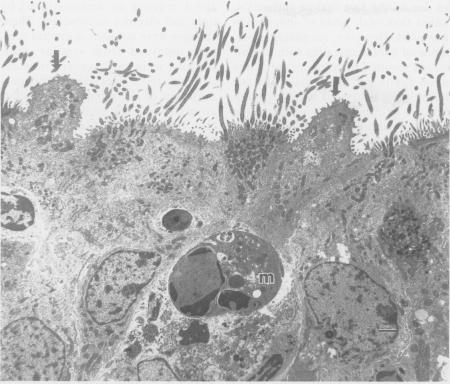
Twenty-three cesarean derived, colostrum deprived pigs were obtained at 5 wk of age and inoculated intranasally with either 1.4 x 10(8) colony forming units of Haemophilus parasuis or sterile phosphate buffered saline. Pigs were euthanized at 4, 8, 12, 18, 26, or 36 h post-inoculation and tissues from the oropharynx and respiratory tract were obtained for qualitative bacterial culture, immunohistochemistry for H. parasuis antigens, and light and transmission electron microscopy. Haemophilus parasuis was consistently isolated from the nasal cavity (17/17, 100%) and trachea (13/17, 76%) and rarely isolated from the lung (3/17, 18%) and blood stream (1/17, 6%) of infected pigs. Antigens of H. parasuis were sporadically detected on the nasal mucosa (6/17, 35%) and trachea (8/17, 47%). Light microscopic lesions included submucosal and intraepithelial infiltrates of neutrophils and infrequent, patchy loss of cilia. Ultrastructural changes in nasal mucosal epithelial cells included cell protrusion, loss of cilia, and dilation of the cytocavitary network. Bacteria were infrequently identified and were either within an amorphous material at the apical surface of the cilia or were between individual cilia. These results suggest H. parasuis associates with the nasal mucosa and can induce a suppurative rhinitis with nasal mucosal epithelial cell degeneration. This process may represent an initial event in the pathogenesis of H. parasuis infection of swine.
选取23头5周龄剖腹产且未接触初乳的仔猪,经鼻内接种1.4×10⁸ 嗜肺副猪嗜血杆菌菌落形成单位或无菌磷酸盐缓冲盐水。在接种后4、8、12、18、26或36小时对仔猪实施安乐死,并获取口咽部和呼吸道组织用于定性细菌培养、嗜肺副猪嗜血杆菌抗原的免疫组织化学检测以及光学显微镜和透射电子显微镜检查。在感染猪的鼻腔(17/17,100%)和气管(13/17,76%)中持续分离到嗜肺副猪嗜血杆菌,而在肺(3/17,18%)和血流(1/17,6%)中很少分离到。在鼻黏膜(6/17,35%)和气管(8/17,47%)中偶尔检测到嗜肺副猪嗜血杆菌抗原。光学显微镜下的病变包括黏膜下和上皮内嗜中性粒细胞浸润以及偶尔出现的散在性纤毛缺失。鼻黏膜上皮细胞的超微结构变化包括细胞突起、纤毛缺失和细胞腔网络扩张。细菌很少被识别,要么存在于纤毛顶端表面的无定形物质中,要么存在于单个纤毛之间。这些结果表明,嗜肺副猪嗜血杆菌与鼻黏膜相关联,并可诱发伴有鼻黏膜上皮细胞变性的化脓性鼻炎。这一过程可能是猪感染嗜肺副猪嗜血杆菌发病机制中的初始事件。