Grant C M, MacIver F H, Dawes I W
Cooperative Research Centre for Food Industry Innovation, School of Biochemistry and Molecular Genetics, University of New South Wales, Sydney, Australia.
Mol Biol Cell. 1997 Sep;8(9):1699-707. doi: 10.1091/mbc.8.9.1699.
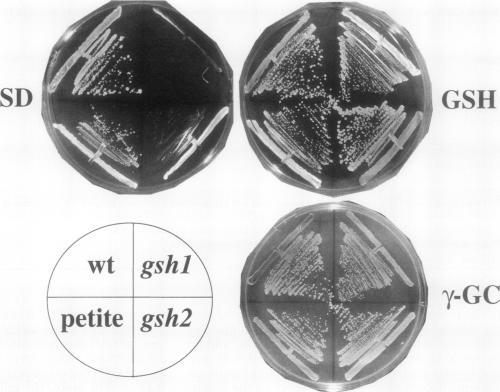
Glutathione (GSH) synthetase (Gsh2) catalyzes the ATP-dependent synthesis of GSH from gamma-glutamylcysteine (gamma-Glu-Cys) and glycine. GSH2, encoding the Saccharomyces cerevisiae enzyme, was isolated and used to construct strains that either lack or overproduce Gsh2. The identity of GSH2 was confirmed by the following criteria: 1) the predicted Gsh2 protein shared 37-39% identity and 58-60% similarity with GSH synthetases from other eukaryotes, 2) increased gene dosage of GSH2 resulted in elevated Gsh2 enzyme activity, 3) a strain deleted for GSH2 was dependent on exogenous GSH for wild-type growth rates, and 4) the gsh2 mutant lacked GSH and accumulated the dipeptide gamma-Glu-Cys intermediate in GSH biosynthesis. Overexpression of GSH2 had no effect on cellular GSH levels, whereas overexpression of GSH1, encoding the enzyme for the first step in GSH biosynthesis, lead to an approximately twofold increase in GSH levels, consistent with Gsh1 catalyzing the rate-limiting step in GSH biosynthesis. In contrast to a strain deleted for GSH1, which lacks both GSH and gamma-Glu-Cys, the strain deleted for GSH2 was found to be unaffected in mitochondrial function as well as resistance to oxidative stress induced by hydrogen peroxide, tert-butyl hydroperoxide, and the superoxide anion. Furthermore, gamma-Glu-Cys was at least as good as GSH in protecting yeast cells against an oxidant challenge, providing the first evidence that gamma-Glu-Cys can act as an antioxidant and substitute for GSH in a eukaryotic cell. However, the dipeptide could not fully substitute for the essential function of GSH in the cell as shown by the poor growth of the gsh2 mutant on minimal medium. We suggest that this function may be the detoxification of harmful intermediates that are generated during normal cellular metabolism.
谷胱甘肽(GSH)合成酶(Gsh2)催化由γ-谷氨酰半胱氨酸(γ-Glu-Cys)和甘氨酸通过ATP依赖性合成GSH。编码酿酒酵母该酶的GSH2被分离出来,并用于构建缺失或过量表达Gsh2的菌株。GSH2的身份通过以下标准得以确认:1)预测的Gsh2蛋白与其他真核生物的GSH合成酶具有37-39%的同一性和58-60%的相似性;2)GSH2基因剂量的增加导致Gsh2酶活性升高;3)缺失GSH2的菌株在野生型生长速率下依赖外源GSH;4)gsh2突变体缺乏GSH,并在GSH生物合成中积累二肽γ-Glu-Cys中间体。GSH2的过表达对细胞GSH水平没有影响,而编码GSH生物合成第一步酶的GSH1的过表达导致GSH水平大约增加两倍,这与Gsh1催化GSH生物合成中的限速步骤一致。与缺失GSH1(既缺乏GSH又缺乏γ-Glu-Cys)的菌株不同,缺失GSH2的菌株在线粒体功能以及对过氧化氢、叔丁基过氧化氢和超氧阴离子诱导的氧化应激的抗性方面未受影响。此外,γ-Glu-Cys在保护酵母细胞免受氧化剂攻击方面至少与GSH一样有效,这首次证明γ-Glu-Cys可以作为抗氧化剂并在真核细胞中替代GSH。然而,如gsh2突变体在基本培养基上生长不良所示,二肽不能完全替代细胞中GSH的基本功能。我们认为这种功能可能是对正常细胞代谢过程中产生的有害中间体的解毒作用。