Miller T M, Moulder K L, Knudson C M, Creedon D J, Deshmukh M, Korsmeyer S J, Johnson E M
Department of Neurology, Howard Hughes Medical Institute, Washington University School of Medicine, St. Louis, Missouri 63110, USA.
J Cell Biol. 1997 Oct 6;139(1):205-17. doi: 10.1083/jcb.139.1.205.
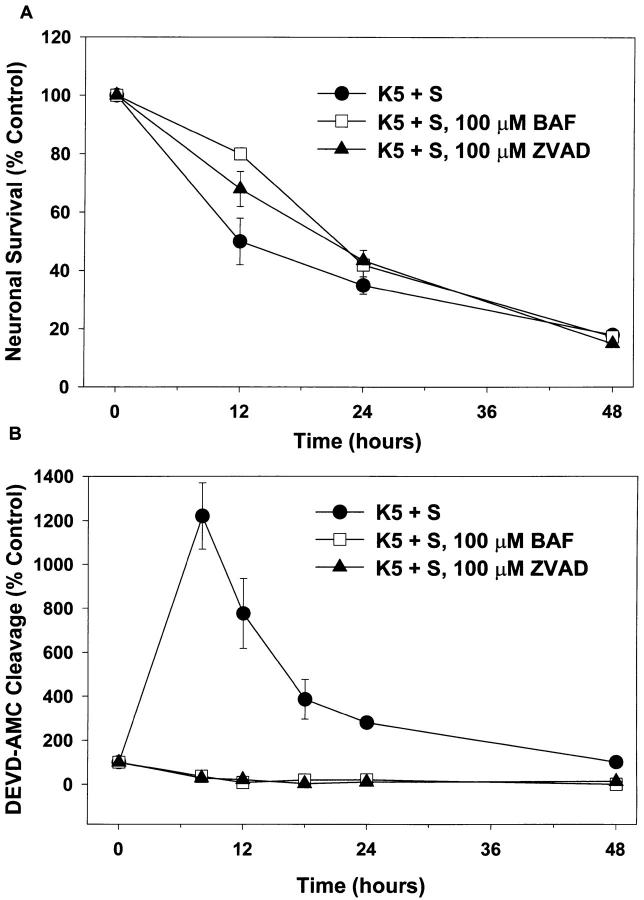
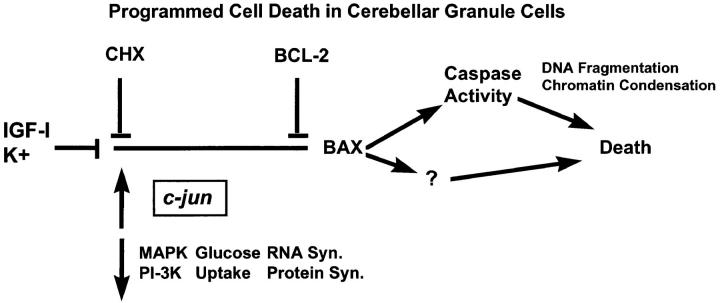
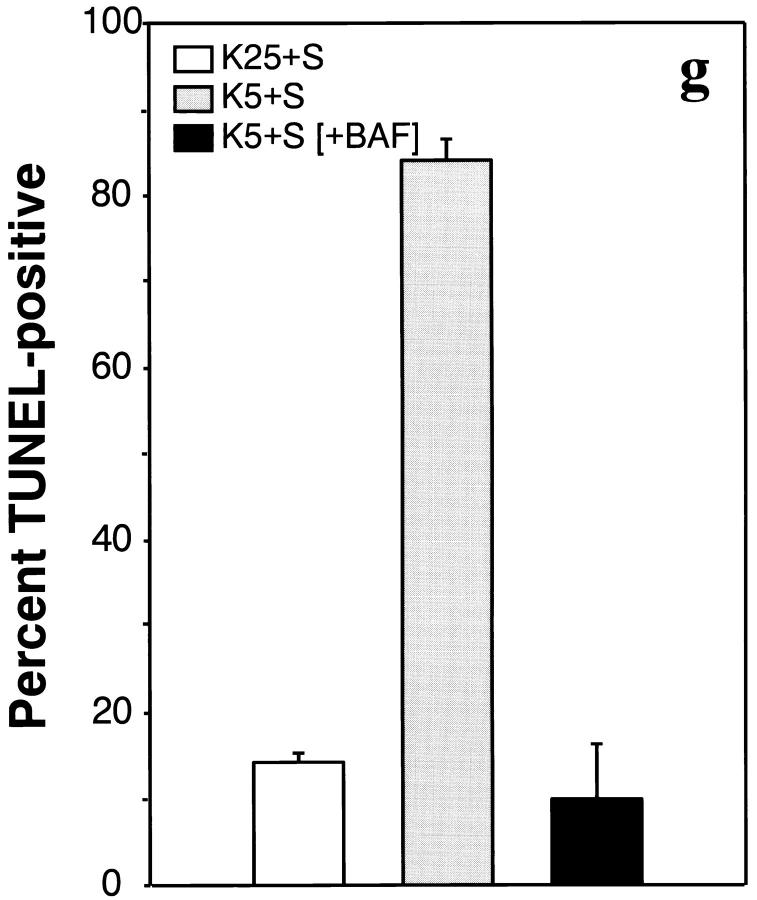
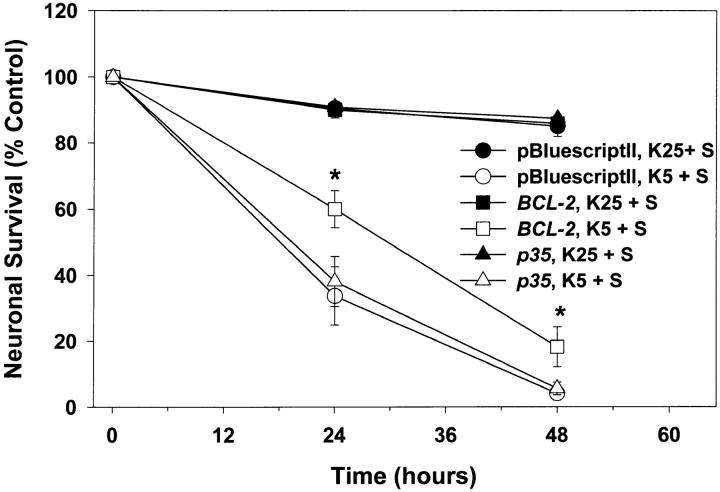
Dissociated cerebellar granule cells maintained in medium containing 25 mM potassium undergo an apoptotic death when switched to medium with 5 mM potassium. Granule cells from mice in which Bax, a proapoptotic Bcl-2 family member, had been deleted, did not undergo apoptosis in 5 mM potassium, yet did undergo an excitotoxic cell death in response to stimulation with 30 or 100 microM NMDA. Within 2 h after switching to 5 mM K+, both wild-type and Bax-deficient granule cells decreased glucose uptake to <20% of control. Protein synthesis also decreased rapidly in both wild-type and Bax-deficient granule cells to 50% of control within 12 h after switching to 5 mM potassium. Both wild-type and Bax -/- neurons increased mRNA levels of c-jun, and caspase 3 (CPP32) and increased phosphorylation of the transactivation domain of c-Jun after K+ deprivation. Wild-type granule cells in 5 mM K+ increased cleavage of DEVD-aminomethylcoumarin (DEVD-AMC), a fluorogenic substrate for caspases 2, 3, and 7; in contrast, Bax-deficient granule cells did not cleave DEVD-AMC. These results place BAX downstream of metabolic changes, changes in mRNA levels, and increased phosphorylation of c-Jun, yet upstream of the activation of caspases and indicate that BAX is required for apoptotic, but not excitotoxic, cell death. In wild-type cells, Boc-Asp-FMK and ZVAD-FMK, general inhibitors of caspases, blocked cleavage of DEVD-AMC and blocked the increase in TdT-mediated dUTP nick end labeling (TUNEL) positivity. However, these inhibitors had only a marginal effect on preventing cell death, suggesting a caspase-independent death pathway downstream of BAX in cerebellar granule cells.
维持在含25 mM钾培养基中的解离小脑颗粒细胞,当转换到含5 mM钾的培养基时会发生凋亡性死亡。来自Bax(一种促凋亡Bcl-2家族成员)基因缺失小鼠的颗粒细胞,在5 mM钾环境中不会发生凋亡,但在用30或100 μM NMDA刺激时会发生兴奋性毒性细胞死亡。转换到5 mM K⁺后2小时内,野生型和Bax缺陷型颗粒细胞的葡萄糖摄取均降至对照的<20%。转换到5 mM钾后12小时内,野生型和Bax缺陷型颗粒细胞的蛋白质合成也迅速降至对照的50%。野生型和Bax⁻/⁻神经元在钾离子剥夺后,c-jun、半胱天冬酶3(CPP32)的mRNA水平升高,且c-Jun反式激活结构域的磷酸化增加。5 mM K⁺环境中的野生型颗粒细胞增加了DEVD-氨基甲基香豆素(DEVD-AMC,半胱天冬酶2、3和7的荧光底物)的切割;相比之下,Bax缺陷型颗粒细胞未切割DEVD-AMC。这些结果表明BAX在代谢变化、mRNA水平变化和c-Jun磷酸化增加之后,但在半胱天冬酶激活之前,并且表明BAX是凋亡性而非兴奋性毒性细胞死亡所必需的。在野生型细胞中,半胱天冬酶的通用抑制剂Boc-Asp-FMK和ZVAD-FMK可阻断DEVD-AMC的切割,并阻断TdT介导的dUTP缺口末端标记(TUNEL)阳性率的增加。然而,这些抑制剂对预防细胞死亡的作用很小,提示小脑颗粒细胞中BAX下游存在一条不依赖半胱天冬酶的死亡途径。