Allemand J F, Bensimon D, Jullien L, Bensimon A, Croquette V
LPS, ENS, URA D 1306 CNRS, associé aux universitié Paris VI, France.
Biophys J. 1997 Oct;73(4):2064-70. doi: 10.1016/S0006-3495(97)78236-5.
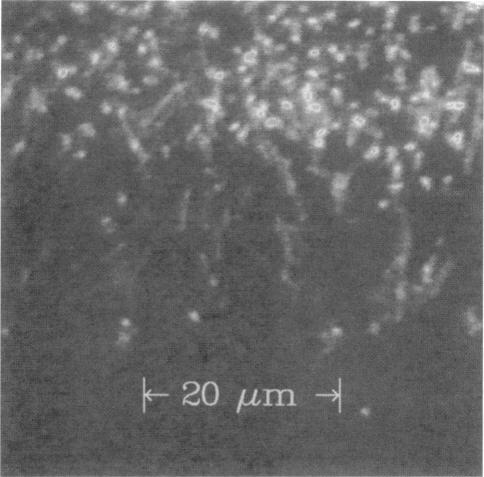
Recent developments in the rapid sequencing, mapping, and analysis of DNA rely on the specific binding of DNA to specially treated surfaces. We show here that specific binding of DNA via its unmodified extremities can be achieved on a great variety of surfaces by a judicious choice of the pH. On hydrophobic surfaces the best binding efficiency is reached at a pH of approximately 5.5. At that pH a approximately 40-kbp DNA is 10 times more likely to bind by an extremity than by a midsegment. A model is proposed to account for the differential adsorption of the molecule extremities and midsection as a function of pH. The pH-dependent specific binding can be used to align anchored DNA molecules by a receding meniscus, a process called molecular combing. The resulting properties of the combed molecules will be discussed.
DNA快速测序、图谱绘制及分析方面的最新进展依赖于DNA与经过特殊处理的表面的特异性结合。我们在此表明,通过明智地选择pH值,可在多种表面上实现DNA通过其未修饰末端的特异性结合。在疏水表面上,pH约为5.5时可达到最佳结合效率。在该pH值下,一条约40千碱基对的DNA通过末端结合的可能性比通过中间片段结合的可能性大10倍。本文提出了一个模型,用以解释分子末端和中间部分作为pH值函数的差异吸附现象。pH依赖的特异性结合可用于通过后退弯月面排列固定的DNA分子,这一过程称为分子梳拉。本文将讨论梳拉后分子的所得特性。