Wyrobek A J, Meistrich M L, Furrer R, Bruce W R
Biophys J. 1976 Jul;16(7):811-25. doi: 10.1016/S0006-3495(76)85730-X.
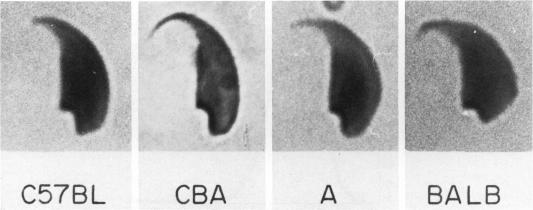
The nuclei of epididymal sperm, isolated from C57BL/6J and CBA/J inbred mice by their resistance to trypsin digestion, retain the shape differences of the intact sperm head. Various physical characteristics of these nuclei were measured and compared. The measurement of the projected dimensions of nuclei showed that the CBA nuclei are 13.5% longer than C57BL/6 nuclei (8.64 +/- 0.02 mum compared with 7.61 +/- 0.02 mum), 0.8% narrower (3.51 +/- 0.01 vs. 3.54 +/-0.01 mum) with 6.8% more area (22.34 +/- 0.10 vs. 20.91 +/- 0.09 mum2). However, the volumes of the nuclei as based on reconstructing calibrated electronmicrographs of serial sections of the nuclei indicated that CBA are about 7% smaller than C57BL/6 nuclei (3.72 +/- 0.08 vs. 4.01 +/- 0.03 mum3). The buoyant density of the CBA nuclei is 1.435 +/- 0.002 g/cm3 compared with 1.433 +/- 0.002 g/cm3 for the C57BL/6 nuclei as determined on linear CsCl and Renografin-76 density gradients and confirmed by a technique utilizing physiological tonicities. Therefore, the average mass of the CBA nuclei is less than that of the C57BL/6 nuclei (5.34 +/- 0.12 vs. 5.75 +/- 0.05 pg). The sedimentation velocities at unit gravity of nuclei from 11 inbred strains differ over a range of more than 6% with CBA nuclei sedimenting about 2.0% more slowly than C57BL/6 nuclei. We show that for these nuclei the sedimentation velocity can be related to their buoyant density, volume and a sedimentation shape factor. Within the errors of our measurements of these various characteristics, it was found that C57BL/6 and CBA nuclei have similar sedimentation shape factors. Therefore, the difference in sedimentation velocity between these nuclei appears to be primarily a result of differences in volume. The possible applications of these techniques to the physical separation of sperm are evaluated in the discussion.
通过对胰蛋白酶消化的抗性从C57BL/6J和CBA/J近交系小鼠中分离出的附睾精子细胞核,保留了完整精子头部的形状差异。对这些细胞核的各种物理特性进行了测量和比较。细胞核投影尺寸的测量表明,CBA细胞核比C57BL/6细胞核长13.5%(分别为8.64±0.02μm和7.61±0.02μm),窄0.8%(分别为3.51±0.01μm和3.54±0.01μm),面积大6.8%(分别为22.34±0.10μm²和20.91±0.09μm²)。然而,基于对细胞核连续切片的校准电子显微镜照片进行重建所得到的细胞核体积表明,CBA细胞核比C57BL/6细胞核小约7%(分别为3.72±0.08μm³和4.01±0.03μm³)。在CsCl线性梯度和泛影葡胺 - 76密度梯度上测定并通过利用生理张力的技术确认,CBA细胞核的浮力密度为1.435±0.002g/cm³,而C57BL/6细胞核为1.433±0.002g/cm³。因此,CBA细胞核的平均质量小于C57BL/6细胞核(分别为5.34±0.12pg和5.75±0.05pg)。来自11个近交系的细胞核在单位重力下的沉降速度差异超过6%,CBA细胞核的沉降速度比C57BL/6细胞核慢约2.0%。我们表明,对于这些细胞核,沉降速度与它们的浮力密度、体积和沉降形状因子有关。在我们对这些各种特性的测量误差范围内,发现C57BL/6和CBA细胞核具有相似的沉降形状因子。因此,这些细胞核之间沉降速度的差异似乎主要是体积差异的结果。在讨论中评估了这些技术在精子物理分离中的可能应用。