Kleinow K M, James M O, Tong Z, Venugopalan C S
Department of Physiology, Pharmacology and Toxicology, School of Veterinary Medicine, Louisiana State University, Baton Rouge, LA 70803, USA.
Environ Health Perspect. 1998 Mar;106(3):155-66. doi: 10.1289/ehp.98106155.
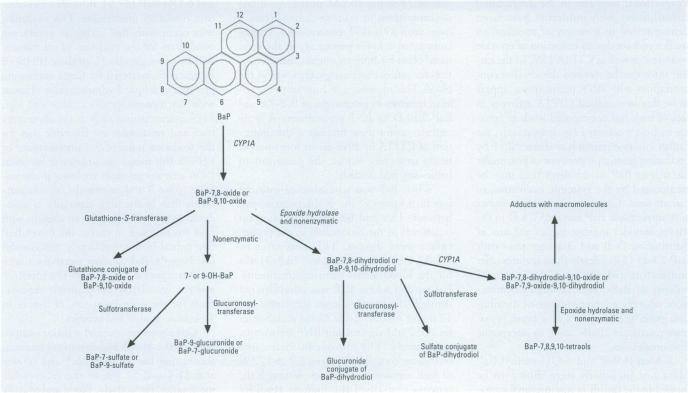
In the aquatic environment, diet is an important route of exposure for the common contaminant and procarcinogen benzo(a)pyrene (BaP). Dietary organisms vary in their BaP content and in contaminated areas often contain other xenobiotics including cytochrome P4501A inducers. This study examined the effect of dose and previous dietary exposure to the inducer ss-naphthoflavone (BNF) upon the intestinal metabolism of BaP and the systemic bioavailability of BaP-derived products in catfish. BaP was administered at 2 and 20 microM into in situ-isolated perfused intestines of control and BNF-pretreated catfish. The intestine formed an array of metabolites in all treatments including potentially hazardous metabolites such as BaP-7,8 and 9,10 dihydrodiols and 6-methyl-BaP. BNF treatment disproportionally increased the contribution of BaP-7,8 and 9,10 dihydrodiols relative to the contributions of other metabolites. A greater percentage of metabolites was evident as conjugates in 2 microM controls, whereas a greater percentage of unconjugated metabolites was evident for 20 microM controls and BNF treatments of both dosages. BNF pretreatment and the higher 20 microM BaP dosage resulted in greater bioavailability, with 2.6-5.5-fold and 3.0-6. 3-fold increases in systemically available BaP products, respectively. Metabolites represented 10.2-23.1% of the increased bioavailability with BNF treatment, suggesting that mechanisms, in addition to induced metabolism, may be operative. These results indicate that intestinal bioavailability, level of biotransformation, and the metabolic profile of BaP-derived products entering the blood from the intestine may be altered by dose and dietary BNF pretreatment.
在水生环境中,饮食是常见污染物及前致癌物苯并(a)芘(BaP)的重要暴露途径。作为食物的生物体内BaP含量各异,在受污染区域,这些生物通常还含有其他异生素,包括细胞色素P4501A诱导剂。本研究考察了剂量以及先前饮食暴露于诱导剂β-萘黄酮(BNF)对鲶鱼肠道中BaP代谢及BaP衍生产物全身生物利用度的影响。将BaP以2微摩尔/升和20微摩尔/升的剂量施用于对照鲶鱼和经BNF预处理鲶鱼的原位分离灌注肠道。在所有处理组中,肠道均形成了一系列代谢产物,包括潜在危险代谢产物,如BaP - 7,8和9,10二氢二醇以及6 - 甲基 - BaP。相对于其他代谢产物,BNF处理使BaP - 7,8和9,10二氢二醇的生成比例不成比例地增加。在2微摩尔/升的对照组中,更大比例的代谢产物以缀合物形式存在,而在20微摩尔/升的对照组以及两种剂量的BNF处理组中,未缀合代谢产物的比例更高。BNF预处理以及较高的20微摩尔/升BaP剂量导致更高的生物利用度,全身可利用的BaP产物分别增加了2.6 - 5.5倍和3.0 - 6.3倍。代谢产物占BNF处理后生物利用度增加量的10.2% - 23.1%,这表明除了诱导代谢外,可能还有其他机制在起作用。这些结果表明,剂量和饮食BNF预处理可能会改变肠道生物利用度、生物转化水平以及从肠道进入血液的BaP衍生产物的代谢谱。