Westmoreland S V, Rottman J B, Williams K C, Lackner A A, Sasseville V G
Division of Comparative Pathology, New England Regional Primate Research Center, Harvard Medical School, Southborough, Massachusetts 01772-9102, USA.
Am J Pathol. 1998 Mar;152(3):659-65.
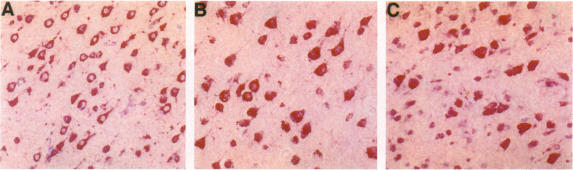
Although the mechanisms of human immunodeficiency virus (HIV) neuroinvasion, neuronal injury, and subsequent development of HIV-1-associated AIDS dementia complex are not fully understood, a correlation between monocyte/macrophage infiltrates in the brain and neurological disease exists. In light of the many potential roles that chemokines and chemokine receptors may play in HIV neuropathogenesis, we sought to describe their pattern of expression in the SIV-infected rhesus macaque model of HIV encephalitis. We previously demonstrated elevated expression of the chemokines macrophage inflammatory protein (MIP)-1alpha, MIP-1beta, RANTES, and interferon-inducible protein (IP)-10 in brain of macaque monkeys with SIV encephalitis. In this study, we demonstrate that the corresponding chemokine receptors CCR3, CCR5, CXCR3, and CXCR4 are expressed in perivascular infiltrates in these same tissues. In addition, we detected CCR3, CCR5, and CXCR4 on subpopulations of large hippocampal and neocortical pyramidal neurons and on glial cells in both normal and encephalitic brain. These findings suggest that multiple chemokines and their receptors contribute to monocyte and lymphocyte recruitment to the brain in SIV encephalitis. Furthermore, the expression of known HIV/SIV co-receptors on neurons suggests a possible mechanism whereby HIV or SIV can directly interact with these cells, disrupting their normal physiological function and contributing to the pathogenesis of AIDS dementia complex.
尽管人类免疫缺陷病毒(HIV)神经侵袭、神经元损伤以及随后HIV-1相关艾滋病痴呆综合征的发病机制尚未完全明确,但大脑中的单核细胞/巨噬细胞浸润与神经疾病之间存在关联。鉴于趋化因子和趋化因子受体在HIV神经病理发生过程中可能发挥的多种潜在作用,我们试图描述它们在HIV脑炎的猴免疫缺陷病毒(SIV)感染恒河猴模型中的表达模式。我们之前已证明,在患有SIV脑炎的猕猴大脑中,趋化因子巨噬细胞炎性蛋白(MIP)-1α、MIP-1β、调节激活正常T细胞表达和分泌因子(RANTES)以及干扰素诱导蛋白(IP)-10的表达升高。在本研究中,我们证明相应的趋化因子受体CCR3、CCR5、CXCR3和CXCR4在这些相同组织的血管周围浸润中表达。此外,我们在正常和脑炎大脑中的大型海马和新皮质锥体细胞亚群以及神经胶质细胞上检测到了CCR3、CCR5和CXCR4。这些发现表明,多种趋化因子及其受体有助于在SIV脑炎中单核细胞和淋巴细胞向大脑的募集。此外,神经元上已知的HIV/SIV共受体的表达提示了一种可能的机制,即HIV或SIV可直接与这些细胞相互作用,破坏其正常生理功能,并导致艾滋病痴呆综合征的发病。