Rowat S C
Grantham's Landing, British Columbia, Canada.
Environ Health Perspect. 1998 Feb;106 Suppl 1(Suppl 1):85-109. doi: 10.1289/ehp.98106s185.
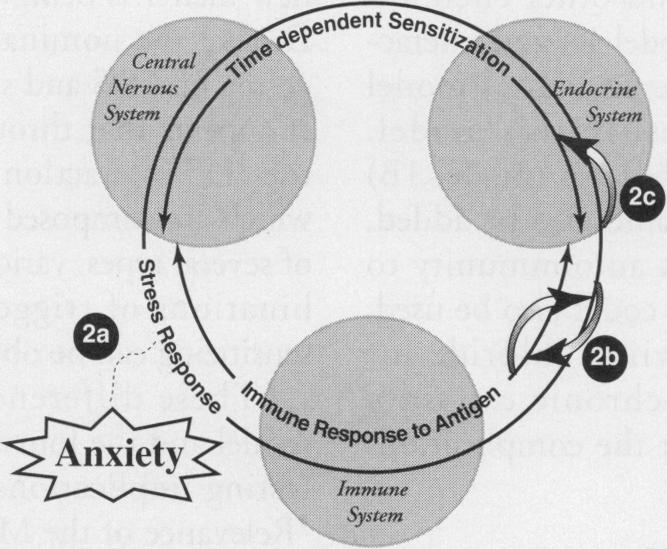
The central nervous, immune, and endocrine systems communicate through multiple common messengers. Over evolutionary time, what may be termed integrated defense system(s) (IDS) have developed to coordinate these communications for specific contexts; these include the stress response, acute-phase response, nonspecific immune response, immune response to antigen, kindling, tolerance, time-dependent sensitization, neurogenic switching, and traumatic dissociation (TD). These IDSs are described and their overlap is examined. Three models of disease production are generated: damage, in which IDSs function incorrectly; inadequate/inappropriate, in which IDS response is outstripped by a changing context; and evolving/learning, in which the IDS learned response to a context is deemed pathologic. Mechanisms of multiple chemical sensitivity (MCS) are developed from several IDS disease models. Model 1A is pesticide damage to the central nervous system, overlapping with body chemical burdens, TD, and chronic zinc deficiency; model 1B is benzene disruption of interleukin-1, overlapping with childhood developmental windows and hapten-antigenic spreading; and model 1C is autoimmunity to immunoglobulin-G (IgG), overlapping with spreading to other IgG-inducers, sudden spreading of inciters, and food-contaminating chemicals. Model 2A is chemical and stress overload, including comparison with the susceptibility/sensitization/triggering/spreading model; model 2B is genetic mercury allergy, overlapping with: heavy metals/zinc displacement and childhood/gestational mercury exposures; and model 3 is MCS as evolution and learning. Remarks are offered on current MCS research. Problems with clinical measurement are suggested on the basis of IDS models. Large-sample patient self-report epidemiology is described as an alternative or addition to clinical biomarker and animal testing.
中枢神经系统、免疫系统和内分泌系统通过多种共同的信使进行通讯。在进化过程中,已经形成了所谓的综合防御系统(IDS)来在特定情况下协调这些通讯;这些包括应激反应、急性期反应、非特异性免疫反应、对抗原的免疫反应、点燃、耐受性、时间依赖性致敏、神经源性转换和创伤性解离(TD)。本文描述了这些IDS并研究了它们的重叠情况。由此产生了三种疾病产生模型:损害模型,即IDS功能失常;不足/不适当模型,即IDS的反应被不断变化的情况超越;以及进化/学习模型,即IDS对某种情况的习得性反应被视为病理性的。多种化学物质敏感(MCS)的机制是从几种IDS疾病模型发展而来的。模型1A是农药对中枢神经系统的损害,与体内化学物质负担、TD和慢性锌缺乏重叠;模型1B是苯对白介素-1的破坏,与儿童发育窗口期和半抗原-抗原扩散重叠;模型1C是对免疫球蛋白G(IgG)的自身免疫,与扩散到其他IgG诱导物、激发物的突然扩散以及食物污染化学物质重叠。模型2A是化学和应激过载,包括与易感性/致敏/触发/扩散模型的比较;模型2B是遗传性汞过敏,与重金属/锌置换以及儿童期/孕期汞暴露重叠;模型3是作为进化和学习的MCS。文中对当前的MCS研究进行了评论。基于IDS模型提出了临床测量方面的问题。大样本患者自我报告流行病学被描述为临床生物标志物和动物试验的一种替代方法或补充方法。