Rodrigues C M, Fan G, Wong P Y, Kren B T, Steer C J
Department of Medicine, University of Minnesota Medical School, Minneapolis 55455, USA.
Mol Med. 1998 Mar;4(3):165-78.
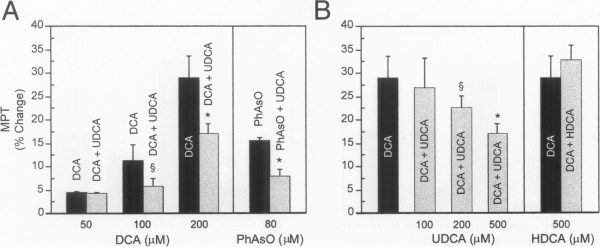
The hydrophilic bile salt ursodeoxycholate (UDCA) inhibits injury by hydrophobic bile acids and is used to treat cholestatic liver diseases. Interestingly, hepatocyte cell death from bile acid-induced toxicity occurs more frequently from apoptosis than from necrosis. However, both processes appear to involve the mitochondrial membrane permeability transition (MPT). In this study, we determined the inhibitory effect of UDCA on deoxycholic acid (DCA)-induced MPT in isolated mitochondria by measuring changes in transmembrane potential (delta psi m) and production of reactive oxygen species (ROS). In addition, we examined the expression of apoptosis-associated proteins in mitochondria isolated from livers of bile acid-fed animals.
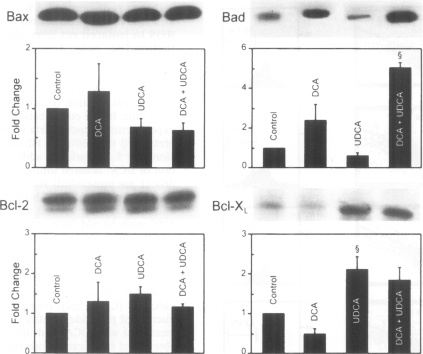
Adult male rats were maintained on standard diet supplemented with DCA and/or UDCA for 10 days. Mitochondria were isolated from livers by sucrose/percoll gradient centrifugation and MPT was measured using spectrophotometric and fluorimetric assays. delta psi m and ROS generation were determined by FACScan analysis. Cytoplasmic and mitochondrial protein abundance were determined by Western blot analysis.
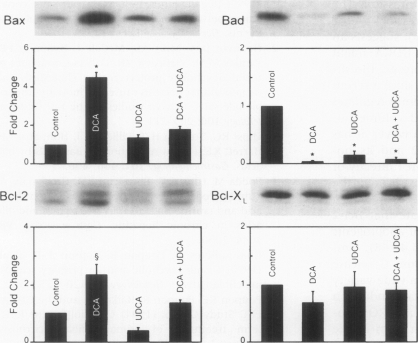
DCA increased mitochondrial swelling 25-fold over controls (p < 0.001); UDCA reduced the swelling by > 40% (p < 0.001). Similarly, UDCA inhibited DCA-mediated release of calcein-loaded mitochondria by 50% (p < 0.001). delta psi m was significantly decreased in mitochondria incubated with DCA but not with UDCA. delta psi m disruption was followed closely by increased superoxide anion and peroxides production (p < 0.01). Coincubation of mitochondria with UDCA significantly inhibited the changes associated with DCA (p < 0.05). In vivo, DCA feeding was associated with a 4.5-fold increase in mitochondria-associated Bax protein levels (p < 0.001); combination feeding with UDCA almost totally inhibited this increase (p < 0.001).
UDCA significantly reduces DCA-induced disruption of delta psi m, ROS production, and Bax protein abundance in mitochondria, suggesting both short- and long-term mechanisms in preventing MPT. The results suggest a possible role for UDCA as a therapeutic agent in the treatment of both hepatic and nonhepatic diseases associated with high levels of apoptosis.
亲水性胆盐熊去氧胆酸(UDCA)可抑制疏水性胆汁酸所致的损伤,用于治疗胆汁淤积性肝病。有趣的是,胆汁酸诱导的毒性导致的肝细胞死亡更多是通过凋亡而非坏死发生。然而,这两个过程似乎都涉及线粒体膜通透性转换(MPT)。在本研究中,我们通过测量跨膜电位(Δψm)的变化和活性氧(ROS)的产生,确定了UDCA对脱氧胆酸(DCA)诱导的离体线粒体MPT的抑制作用。此外,我们检测了从胆汁酸喂养动物肝脏分离的线粒体中凋亡相关蛋白的表达。
成年雄性大鼠维持在补充有DCA和/或UDCA的标准饮食中10天。通过蔗糖/ Percoll梯度离心从肝脏中分离线粒体,并使用分光光度法和荧光法测定MPT。通过FACScan分析确定Δψm和ROS生成。通过蛋白质印迹分析确定细胞质和线粒体蛋白丰度。
DCA使线粒体肿胀比对照组增加25倍(p <0.001);UDCA使肿胀减少> 40%(p <0.001)。同样,UDCA抑制DCA介导的钙黄绿素负载线粒体的释放达50%(p <0.001)。与DCA孵育的线粒体中Δψm显著降低,但与UDCA孵育的线粒体中未降低。Δψm破坏后紧接着超氧阴离子和过氧化物产生增加(p <0.01)。线粒体与UDCA共同孵育可显著抑制与DCA相关的变化(p <0.05)。在体内,喂养DCA使线粒体相关的Bax蛋白水平增加4.5倍(p <0.001);与UDCA联合喂养几乎完全抑制了这种增加(p <0.001)。
UDCA可显著降低DCA诱导的线粒体中Δψm破坏、ROS产生和Bax蛋白丰度,提示其在预防MPT方面的短期和长期机制。结果表明UDCA作为一种治疗剂在治疗与高水平凋亡相关的肝脏和非肝脏疾病中可能具有作用。